
Golden Retriever Puppy Sleep Chart
By JJ Allan (goldenretriever.hair)
Young Golden Retriever puppies sleep for most of the day. PDSA says some puppies sleep 18–20 hours, and VCA says a 2-month-old's bursts of energy usually take up only about 4 to 6 hours of the day. By a year old, owners in a large UK and Irish study reported about 11 hours of sleep in 24, and VCA says anywhere from 10 to 14 hours a day is normal variation in grown dogs.
Golden Retriever puppies need regular opportunities to sleep, alongside meals, toilet breaks, play and time with their people. Their routine changes as they grow, but the sources reviewed here do not establish exact sleep-hour requirements for Goldens at each age.
Use this chart to organize your day and notice changes in your puppy’s usual behavior. It provides general care information; your veterinarian can advise on your puppy’s individual needs.
Sleep and puppy-care sources checked November 9, 2026.
This guide is general information, not veterinary advice. Check with your veterinarian about your dog's sleep, especially if it changes suddenly or comes with low energy, appetite or toilet changes.
Quick Answer: How Much Do Golden Retriever Puppies Sleep?
Young puppies often spend a large part of the day asleep. PDSA’s veterinary guidance notes that some puppies can sleep 18–20 hours a day.
Treat that as broad context, rather than a daily minimum or a Golden Retriever-specific requirement. Include daytime naps when thinking about total sleep, and remember that lying quietly or spending time in a crate does not necessarily mean a puppy is asleep.
Protect rest opportunities and pay attention to appetite, energy when awake, toilet habits and changes from your puppy’s usual pattern.
The sleep numbers, and what each one measures
The two numbers you'll see quoted look like they disagree, but they measure different things. PDSA's 18–20 hours appears in its advice for a puppy's first day and night home, as a total for the whole day including naps, and it says "some" puppies, not all. The Generation Pup study asked owners of puppies of any breed or cross in the UK and Ireland to estimate how long their dogs slept at 16 weeks and again at 12 months. Owners' averages came out at about 11 hours in 24 at both ages.
AAHA's article on sleep and behavior points out the same gap. Popular guidance says 18 to 20 hours for puppies and 12 to 14 for adults, while measured data come in lower, closer to 11 hours for puppies. Neither figure is a target for your Golden.
| Age | Published figure | What it measures |
|---|---|---|
| About 2 months | Awake about 4 to 6 hours a day (VCA) | A general vet-clinic description, not a measurement |
| Young puppies | Some sleep 18–20 hours a day (PDSA) | A broad estimate of total daily sleep, naps included |
| 16 weeks | 11.2 hours in 24; 7.0 at night; daytime median 3.5 (Generation Pup) | Owner estimates across breeds, not sleep recordings |
| 12 months | 10.8 hours in 24; 7.3 at night; daytime median 3.0 (Generation Pup) | The same owners, eight months later |
| Adult dogs | At least half the day; 10 to 14 hours is normal variation (VCA) | A general range for dogs, not Golden-specific |
Golden Retriever Puppy Sleep Chart by Age
These are practical routine suggestions. The age bands do not represent proven hourly sleep targets or deadlines for sleeping through the night.
| Age | Sleep and rest planning | What to do |
|---|---|---|
| 8–12 weeks | Make frequent nap opportunities part of the first weeks home. Overnight toilet trips may be needed. | Keep activity sessions short, provide a comfortable resting place and help your puppy feel secure overnight. |
| 3–4 months | Continue daytime naps around meals, play and learning. Nighttime progress varies. | Offer quiet breaks after busy periods. Continue the toilet routine that keeps your puppy comfortable and dry. |
| 5–6 months | Adjust rest opportunities to the puppy you have, rather than reducing naps at a particular birthday. | Keep a predictable wind-down routine. Shorten toilet intervals again if accidents or urgent waking occur. |
| 7–12 months | Continue allowing daytime naps and an overnight sleep opportunity. Growing older does not mean naps are unnecessary. | Balance activity with undisturbed rest. Investigate a marked change in an established routine rather than assuming it is adolescence. |
For meal timing, use our Golden Retriever feeding chart. Keep the amount recipe-specific.
A Flexible Daily Sleep Routine
A Golden puppy's sleep schedule is less a clock than a loop. Use this sequence as a starting point, rather than a clock-based prescription:
- 🐾After waking: offer a toilet trip.
- 🐾During an awake period: provide the scheduled meal, gentle play, a short training session or another suitable activity.
- 🐾After eating, drinking or active play: offer another toilet opportunity.
- 🐾When activity ends: provide a quiet place where your puppy can settle and nap.
- 🐾Before bed: wind down, offer a final toilet trip and return to the usual sleeping area.
- 🐾Overnight: respond to toilet needs or distress calmly.
VCA’s housetraining guidance suggests frequent outings, including after naps and meals, every 1–2 hours while awake and more often during energetic play. These are starting points to adapt, not a guarantee of bladder capacity. Respond sooner when your puppy signals.
Keep your Golden’s daily routine handy
Join our newsletter and get the free Golden Retriever Owner Cheat Sheet: a printable overview of sleep, meals, and everyday care from puppyhood to senior years.
Night Waking and Potty Breaks
There is no single age when every Golden Retriever puppy should sleep through the night. Young puppies may need to toilet, and a new sleeping environment can also be unsettling. VCA's housetraining guidance notes that puppies may need overnight outings until they are 5 months of age.
If your puppy wakes and cries, check whether they need a toilet trip and whether they are comfortable. Keep necessary outings quiet, praise toileting and help them settle again without starting a play session.
Having their safe sleeping area near you initially can make reassurance and noticing signals easier. Avoid leaving a frightened puppy to cry until they give up. PDSA’s vets recommend checking toilet needs and offering calm reassurance.
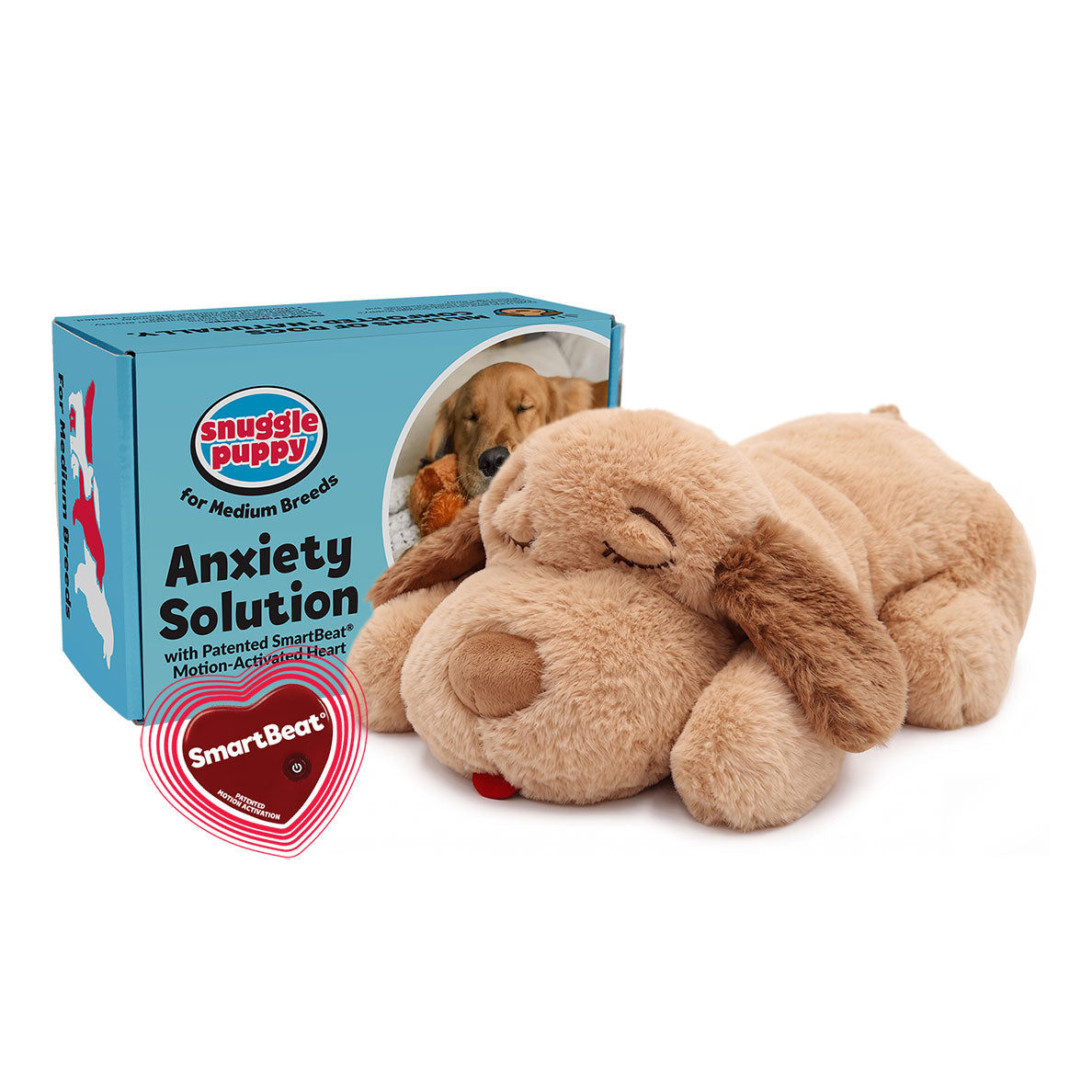
Snuggle Puppy Heartbeat Toy, Calming Comfort, Medium Breeds - Biscuit
For the first nights, some owners put a Snuggle Puppy in the crate or bed. It is a plush with a battery heartbeat and a disposable heat pack, and it doesn't replace checking toilet needs and reassuring your puppy.
The maker says it isn't a chew toy: watch your puppy with it at first, and take it away if they chew it or open the belly pouch. The Medium is listed for 25–70 lb; there's a Large for dogs over 70 lb.
Build your overnight plan around the puppy’s actual pattern. A birthday or an “age in months equals hours” rule should not override repeated accidents, urgent waking or signs of discomfort.
Crates, Pens and Comfortable Naps
A crate is one option for a safe resting place. A suitable puppy pen or puppy-proofed area can also work.
Introduce confinement gradually with positive experiences. Give your puppy enough room to stand comfortably, turn and stretch out. Do not use a crate to make them stay confined until a sleep-hour quota is reached.
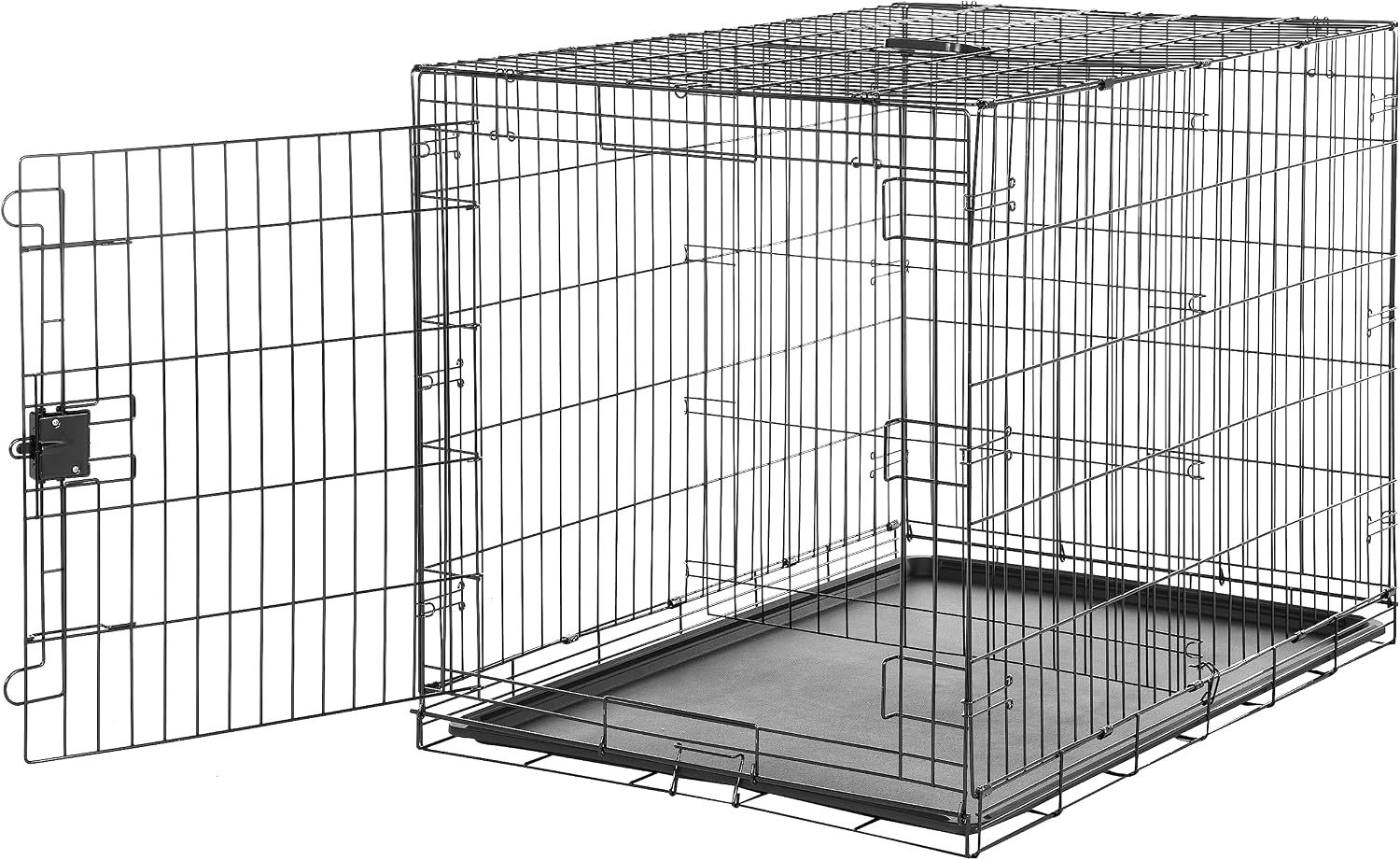
If you choose a crate, this 42-inch wire crate has a divider panel, so you can keep the space puppy-sized now and open it up as your Golden grows.
It has one door and a removable tray. Move the divider as your puppy grows so they can still stand, turn and stretch out, and introduce the crate gradually, as above.
Never use the crate as punishment.
If a puppy becomes very distressed, repeatedly tries to escape or cannot settle, end the session safely and seek veterinary or qualified behavior guidance. VCA’s confinement guidance emphasizes gradual training, appropriate alternatives and the need for daily interaction and activity.
Keep resting areas away from constant household disturbance. Children and other pets should leave the puppy alone while resting.
Activity, Naps and the “Overtired” Puppy
Mouthing, frantic play or difficulty settling can be a reason to check whether your puppy needs a quieter break. Those behaviors alone do not diagnose sleep deprivation.
Review the whole situation: toilet needs, comfort, stimulation and opportunities to rest. AAHA’s discussion of canine sleep and behavior supports considering sleep when addressing difficult evening behavior.
Avoid trying to exhaust a growing puppy into sleeping. Offer short, suitable play and training sessions, with rest between them. Build physical activity gradually and ask your vet about appropriate exercise. PDSA notes that the “five minutes per month of age” exercise rule lacks scientific evidence.
How much 1-year-old and adult Golden Retrievers sleep
A 1-year-old Golden Retriever typically sleeps around 11 hours in a 24-hour day, about 7 of them at night. That comes from the Generation Pup study's 12-month survey: owners reported 10.8 hours in total, 7.3 hours at night, and a daytime median of 3 hours. Those are averages across breeds, not a Golden figure, and they are owners' estimates. Compared with 16 weeks, the same dogs slept a little less in total but a little longer at night.
For adult Goldens, including 2-year-olds, VCA's answer is that most dogs still spend at least half of a 24-hour day asleep, and that a dog sleeping 10 hours or 14 hours a day is normal variation. No study we found measures 2-year-old or adult Goldens on their own. A 9-month-old sits between the 16-week and 12-month figures, and nothing we found gives a separate number for that age.
How well your dog sleeps may matter as much as how long. AAHA describes a 2022 survey of 1,330 dog owners: dogs sleeping less than eight hours during normal household sleeping hours had higher problem-behavior scores, and so did dogs sleeping more than 10. How easily a dog was disturbed mattered more than total hours. If your adult Golden's sleep changes, or comes with restlessness at night, appetite or potty changes, or lost interest in play, VCA says to talk to your vet to rule out a medical cause. Senior-dog sleep and sleeping positions are covered in How much sleep Goldens need at every age.
When to Contact Your Veterinarian
Frequent naps can be normal. A puppy who is unusually weak or uninterested in normal activities while awake needs a different response.
Contact your veterinarian promptly for a marked change in sleep or energy, particularly with reduced appetite, changed toilet habits, vomiting, diarrhea, pain or persistent difficulty settling. VCA explains the distinction between normal sleep variation and concerning changes.
Seek emergency veterinary care for trouble breathing, collapse, unresponsiveness, extreme weakness or pale/blue gums. These are recognized emergency signs.
Why This Chart Does Not Give Exact Hour Targets
A 2020 Generation Pup study reported average daily sleep estimates of 11.2 hours at 16 weeks and 10.8 hours at 12 months. These were owners’ observations across breeds, not recommended amounts or continuous sleep recordings. Owners could miss waking or confuse rest with sleep.
The study found differences between the two ages. It supports the conclusion that sleep patterns can differ with age, but it does not establish a continuous weekly or monthly decline or a Golden Retriever sleep quota. Its averages should not become replacement targets.
Quick answers
How many hours do Golden Retriever puppies sleep?
Some young puppies sleep 18–20 hours a day, according to PDSA. Individual patterns vary, and that estimate is not a minimum or a breed-specific requirement. Provide regular rest opportunities and monitor your puppy’s usual behavior.
How much sleep does a 1-year-old Golden Retriever need?
There is no proven requirement, but owners in the Generation Pup study reported about 10.8 hours in 24 at 12 months, roughly 7.3 of them at night. A healthy 1-year-old that sleeps a bit more or less is usually fine; a sudden change is worth a vet check.
How many hours a day do adult Golden Retrievers sleep?
Usually somewhere around 10 to 14 hours. VCA says most adult dogs spend at least half of the day asleep and that both 10 and 14 hours are normal.
When should my puppy sleep through the night?
There is no fixed deadline. Young puppies may need overnight toilet trips and help settling. Adapt the routine to your puppy, and consult your vet if waking changes suddenly or comes with other symptoms.
Should I wake my puppy from naps?
Usually, let a healthy puppy nap peacefully. Offer a toilet trip when they wake, while following necessary meal times, their overnight toilet plan and any veterinary instructions.
Does every nap need to happen in a crate?
No. A positively introduced crate, suitable pen or puppy-proofed resting area can work. Choose a safe arrangement where your puppy can relax, and do not equate crate time with sleep.
Does biting or having zoomies mean my puppy is overtired?
Not necessarily. Consider a quiet break, but also check toilet needs, comfort and stimulation. These behaviors alone cannot tell you how much sleep your puppy needs.
More Golden Retriever puppy guides:
- 🐾Golden Retriever Puppy Care Guide
- 🐾How much sleep Goldens need at every age
- 🐾Golden Retriever First Week Home Guide
- 🐾Golden Retriever Puppy Not Sleeping Through the Night
- 🐾Overtired Golden Retriever Puppy
- 🐾Golden Retriever Puppy Feeding Schedule Chart
- 🐾Golden Retriever Potty Training Schedule
Sources
Some puppies sleep 18–20 hours a day: PDSA, first day and night with your puppy. Calm reassurance at night: PDSA vet Q&A, why do puppies cry at night. The five-minute rule: PDSA, exercising your puppy.
Awake 4 to 6 hours at 2 months, at least half the day asleep as adults, 10 to 14 hours as normal variation, and signs to raise with your vet: VCA, how much sleep do puppies need. Outings every 1–2 hours while awake and overnight until about 5 months: VCA, training your puppy. Crate introduction: VCA, crate training your dog.
11.2 and 10.8 hours in 24, 7.0 and 7.3 hours at night, and daytime medians of 3.5 and 3.0 hours at 16 weeks and 12 months: Kinsman et al., Animals 2020, Generation Pup. Popular figures versus measured data, and the 2022 survey of 1,330 dogs: AAHA, how sleep shapes canine behavior. Emergency signs: Cornell University College of Veterinary Medicine, emergency and critical care.