
Golden Retriever Potty Training Schedule Chart (By Age)
By JJ Allan (goldenretriever.hair)
Quick answer: take a Golden Retriever puppy out every 1 to 2 hours while it is awake, every 30 minutes during busy play, and right after it wakes up, eats, drinks or plays. At 6 to 8 weeks that works out to about every 2 hours, and young puppies need trips during the night too. A rough guide to how long a puppy can hold it is about one hour per month of age, so a 3-month-old can wait about 3 hours. Most puppies are fully potty trained by about 6 months.
Below: a by-age potty chart, how long a puppy can really hold it, the times to take your puppy out, a sample day, night trips, accidents, regression, and the signs that mean a vet visit.
Sources checked November 14, 2026.
Quick answer: how often a Golden Retriever puppy needs to go out
- 🐾6–8 weeks: about every 2 hours, plus night trips (VCA).
- 🐾Any age while house training: every 1–2 hours awake, every half hour in high-energy play and every 4 hours even when resting (VCA).
- 🐾Always: right after waking, after meals and big drinks, after naps, after play, after time in the crate, and last thing at night.
- 🐾Holding it: a rough guide is one hour per month of age. A 3-month-old can wait about 3 hours. Treat that as a limit, not a target.
- 🐾Nights: puppies may need an overnight trip until about 5 months.
- 🐾Done: most puppies are fully potty trained by about 6 months.
These numbers come from the VCA house-training article by a board-certified veterinary behaviorist, VCA's puppy potty guide, the Ohio State Veterinary Medical Center and the AKC. Golden Retrievers follow the same puppy rules as other breeds; none of these sources gives a separate Golden schedule.
Golden Retriever potty training schedule chart by age
The middle column uses the one-hour-per-month rule of thumb that VCA and Ohio State both give. Sources don't all agree on it, so read it as a ceiling for a quiet, resting or crated puppy. While your puppy is awake, keep to the shorter daytime schedule.
| Age | Longest gap when resting (rough guide) | While awake | Overnight | What's normal now |
|---|---|---|---|---|
| 8 weeks | About 2 hours | Every 1–2 hours; every 30 minutes in play | Night trips needed | Bladder control is at its weakest, and accidents are expected |
| 10–12 weeks | About 2–3 hours | Every 1–2 hours; every 30 minutes in play | Often still needed | Accidents are still normal; keep the schedule tight |
| 3 months | About 3 hours | Every 1–2 hours; every 30 minutes in play | Often still needed | Still building bladder control (the AKC says control comes at about 16 weeks) |
| 4 months | About 4 hours | Every 1–2 hours; every 30 minutes in play | May still be needed | Should be learning to ask to go out |
| 5 months | About 5 hours | Keep the trigger trips; space them out as accidents stop | VCA says night trips may be needed until about now | Past the AKC's 16-week bladder-control mark |
| 6 months | About 6 hours | Keep the trigger trips; space them out as accidents stop | Past VCA's 5-month mark for night trips | Most puppies are fully potty trained |
| Adult | Up to about 8–10 hours at most | A chance to go about every 4 hours when possible | Can be expected to hold 8 hours or longer (Ohio State) | Sudden accidents call for a vet check |
Where the figures come from: the 2-hour starting point and "3 months, 3 hours" are from VCA's puppy potty guide. The every 1–2 hours, every 30 minutes and every 4 hours times, and night trips until 5 months, are from VCA's house-training article. The AKC says a 6-month-old may hold it for around six hours. "Asks to go out by about 4 months" and "fully trained by about 6 months" are from VCA. The adult row combines the Ohio State Indoor Pet Initiative, which says adults should get a chance about every four hours and can be expected to hold urine 8 hours or longer, with the Ohio State Veterinary Medical Center cap of about 10 hours.
How long can a Golden Retriever puppy hold its pee?
Every "hold it" rule is a rough guide, and the sources state it a little differently:
- 🐾One hour per month of age. VCA says to add an hour for every month, so a 3-month-old should be able to wait 3 hours. Ohio State's behavior service gives the same rule as a maximum, up to about 10 hours.
- 🐾Give or take an hour. The Ohio State Indoor Pet Initiative says one hour per month "give or take an hour," so a 3-month-old might hold it for three to four hours.
- 🐾Months plus one. The AKC's timeline uses age in months plus one as the most a puppy can comfortably hold it, which is 4 hours for a 3-month-old. Another AKC article adds that puppies can't control their bladder until about 16 weeks.
Use the lower number. A puppy that is pushed to its limit every day will have accidents, and an accident in the house teaches the wrong habit.
Day and night are different. A sleeping puppy can usually go longer than an awake one; the AKC notes puppies can usually hold their bladder longer when asleep and not active. Play, excitement, a meal or a big drink all cut the gap.
For time alone, VCA says puppies left alone for no more than 3 hours can usually be confined in a crate, and a puppy left longer than 3 hours will need a potty break. If you work long days, arrange a friend, neighbor or pet sitter. Another option is a pen with a bed at one end and a potty pad or artificial turf at the other.
When to take your puppy out: the potty triggers
Clocks help, but triggers matter more. The AKC says that for a young puppy these trips can add up to a dozen or more a day.
| Trigger | When to go out | Source |
|---|---|---|
| Morning wake-up | Straight out of the crate, before coffee or email | AKC |
| Waking from a nap | Immediately | VCA, AKC |
| After a meal | Within 5–30 minutes; the younger the puppy, the sooner | AKC |
| After a big drink | Soon afterward; treat it like a meal | VCA, AKC |
| Play or zoomies | Every 30 minutes during high-energy play, and when play ends | VCA, Ohio State |
| Chewing a toy or bone | When the chew session ends | AKC |
| Out of the crate or pen | Right away | AKC, VCA |
| Any change of activity | Assume the puppy may need to go | Ohio State |
| Quiet time | At least every 4 hours, even if resting | VCA |
| Bedtime | One last trip before you go to bed | AKC |
Feeding at the same times each day makes potty times easier to predict, and the AKC suggests not feeding within 2 hours of bedtime. For meal times by age, see the Golden Retriever puppy feeding schedule chart.
A sample day for an 8- to 12-week-old Golden
This example puts the VCA and AKC rules above into an ordinary day. Shift the times to fit your home.
- 🐾Wake-up: straight outside on a leash to the same spot.
- 🐾Breakfast: out again within 5–30 minutes.
- 🐾Play: out every 30 minutes while play is lively, and again when it ends.
- 🐾Nap in the crate: out the moment your puppy wakes.
- 🐾Late morning, afternoon and evening: repeat the meal, play and nap pattern, with a trip at least every 1–2 hours while awake.
- 🐾Dinner: at least 2 hours before bed, then a trip outside.
- 🐾Bedtime: last trip outside, then the crate.
- 🐾Night: one or more quiet trips if your puppy wakes and whines.
On each trip, go out the same door to the same spot. Stand quietly, and say your cue, such as "go potty," as your puppy starts. Praise and reward right there, outside. VCA suggests that if nothing happens in 5 minutes, you bring your puppy back in, watch closely and try again soon. Playtime comes after the potty, not before. For how naps fit in, see the Golden Retriever puppy sleep chart, and for a full first-week routine see the first week home schedule.
Signs Your Puppy Needs to Go Outside
Puppies give short warnings. Watch for:
- 🐾Sniffing the floor or carpet.
- 🐾Circling.
- 🐾Restlessness or pacing.
- 🐾Stopping play suddenly and squatting.
- 🐾Wandering away from the family.
- 🐾Zoomies or sudden overexcitement.
- 🐾Whimpering or whining.
- 🐾Running to the door.
- 🐾Walking with stiff back legs.
These signs come from VCA, the AKC and the ASPCA. VCA notes that it takes time for puppies to grow enough to hold it, and longer still to learn to tell you. When you see a sign, calmly but quickly take your puppy out.
Nighttime potty breaks
VCA says puppies may need overnight outings until they are about 5 months old, and that most puppies learn to go to sleep in a crate, where they are less likely to feel the urge to go. Young puppies at 6 to 8 weeks need night breaks (VCA).
- 🐾Last trip before bed. The AKC says the last thing to do before you go to bed is take your puppy out.
- 🐾Crate in or near your bedroom. The AKC suggests this so you hear the whimper when your puppy needs to go.
- 🐾Carry small puppies out. Carrying a young puppy to the door stops it from peeing on the way, the AKC notes.
- 🐾No play. Go out on a leash, wait, praise, and go back to the crate.
Ask your vet before limiting water in the evening. If your puppy wakes often for reasons other than a potty trip, see why a Golden Retriever puppy won't sleep.
Crate, supervision and when to give more freedom
VCA's veterinary behaviorist describes two modes for a puppy in training. In the first, it is directly supervised, within sight and less than about 10 feet (3 meters) away, or on a leash attached to you. In the second, it is safely confined to an area where it could eliminate if it needed to.
Crate size matters for a Golden. The crate should be just big enough to stand, turn around and lie down. If it is bigger, a puppy may use one end as a toilet (VCA, AKC). Goldens grow fast, so the AKC's tip of a crate with an adjustable divider lets one crate fit from puppy to adult.
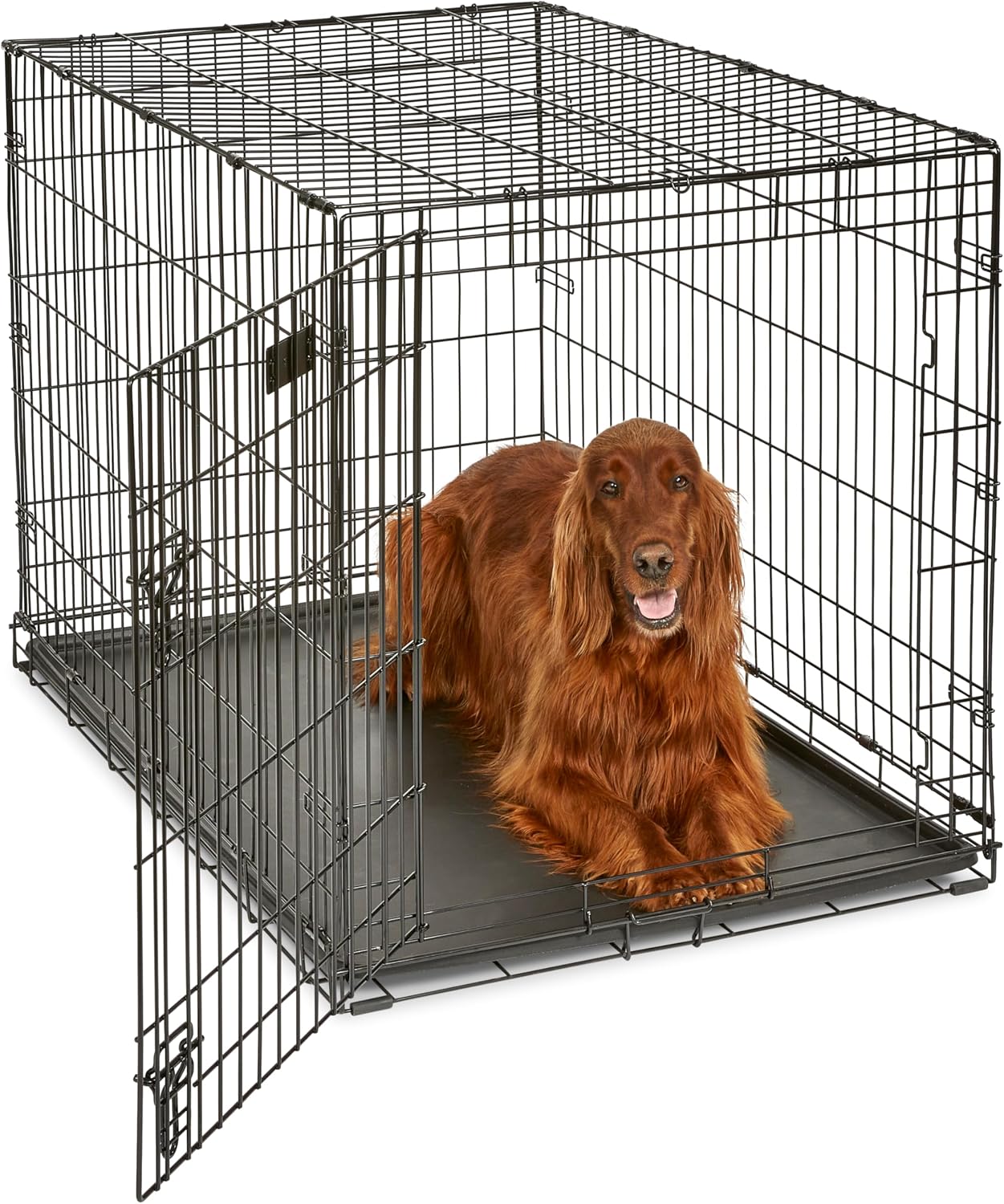
Best for: a den that helps a puppy build bladder control
MidWest Homes for Pets iCrate Folding Dog Crate, 42 in, Single Door
A crate about 42 x 28 x 30 inches, with a divider and a leak-proof tray. Use the divider so your puppy has only enough room to stand, turn and lie down, and can't pee at one end and sleep at the other.
That den helps build bladder control.
Freedom comes room by room. The AKC and the ASPCA both suggest starting with one or two rooms. VCA says a puppy that has gone 8–12 weeks without mistakes is probably ready for more freedom.
Always go along. VCA notes that most untrained puppies sent outside alone get distracted and then go once they're back indoors.
What to do when your puppy has an accident
- 🐾Caught in the act: make a noise that interrupts without scaring, such as an odd sound or a light tap on a table. Then take your puppy out and praise it if it finishes there (VCA, AKC).
- 🐾Found it later: clean up quietly, ideally with your puppy out of the room. Then supervise more closely. Don't scold. VCA says a dog's "guilty look" most likely means worry, not guilt.
- 🐾Never rub its nose in it or strike your puppy. VCA warns that punishing a natural act can teach a puppy never to toilet near a person. The ASPCA adds that it can teach a dog to hide its messes.
- 🐾Use an enzyme cleaner. VCA says the smell of old urine or feces cues a dog to use that spot again, and recommends a cleaner with enzymes that break the urine down.
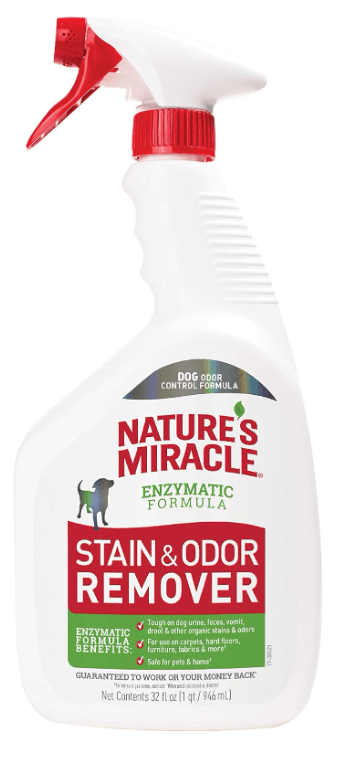
Best for: eliminating odor (not masking it) during early potty training
Nature's Miracle Dog Stain and Odor Remover
Enzymatic formula breaks down urine and organic residue instead of temporarily covering smells—so lingering scent is less likely to cue repeat visits to the same spot.
Keep a bottle on hand from day one of training; thorough cleanup after accidents helps prevent repeat mistakes while your puppy is still learning where to go.
If accidents keep happening in the same place, shorten the time between trips and tighten supervision before anything else. The AKC suggests that too little supervision and too much freedom are the usual reasons.
Potty pads, bells and teaching your puppy to ask
Pads can help if you can't get home in time. The AKC cautions that they may slow house training by giving your puppy two options instead of one, and suggests a pet sitter instead where you can. If you use pads in an apartment, VCA suggests not lining the crate with them.
By about 4 months a puppy should be learning to ask to go out (VCA). Using the same door every time helps, because the puppy starts heading to that door. Some puppies scratch or bark; you can also teach a bell on the door handle. VCA warns that some dogs learn to ring it just to play outside, so keep bell trips boring. Ohio State notes that not every dog learns to signal in a way owners notice, so keep the schedule even after your puppy starts asking.
How long potty training takes and why puppies regress
VCA says most puppies are fully potty trained by about 6 months, and recommends talking to your veterinary team if a puppy isn't making progress by 4 to 6 months. Dr. Jerry Klein, the AKC's Chief Veterinarian, puts it this way in the AKC timeline: if training begins early, a 6-month-old is usually dependable most of the time. Neither source gives a separate time for males and females.
Setbacks happen. The common training reasons for accidents in a puppy that seemed trained:
- 🐾Too much freedom too soon. It's one of the two common reasons the AKC gives. The other is a puppy that was never fully trained.
- 🐾Waiting too long between trips. A schedule that worked at 3 months may not fit a busy week.
- 🐾Leftover odor drawing your puppy back to an old spot.
- 🐾Excitement or worry. VCA says some young dogs urinate when greeting people, called submissive or excitement urination. It isn't deliberate and isn't a house-training lapse. Calm, low-key greetings help.
- 🐾Marking. VCA notes even house-trained dogs may mark, and intact dogs may be more likely to.
If your puppy is healthy, VCA's advice is to restart training as though it were a young puppy again: the schedule, the supervision and the rewards. A medical problem can also cause a sudden slip, so check with your vet first (see the next section).
When it's not ordinary: see your vet
Most accidents are a schedule or supervision problem. Some are not. VCA calls a break in house training "a red flag that something is wrong in the bladder." See your vet if:
- 🐾your puppy suddenly starts having accidents after being reliably clean;
- 🐾it tries to pee very often, or strains, cries or whines while peeing;
- 🐾you see blood in the urine, or it dribbles urine or licks its genitals a lot;
- 🐾the urine smells very strong;
- 🐾it seems to be drinking and peeing far more than usual;
- 🐾it has diarrhea or loose stools along with accidents;
- 🐾it's 4 to 6 months old and not making progress despite a steady routine.
The signs of a urinary tract infection on this list come from VCA's UTI article. It notes that young puppies and female dogs are more represented among dogs with UTIs. VCA's house-soiling article, by three board-certified veterinary behaviorists, adds that infections, diabetes, kidney disease, bladder stones and intestinal parasites can all cause house soiling. The AKC's Chief Veterinarian also says a puppy that isn't progressing should be checked for a urinary tract infection or another health issue. Fear or anxiety can also cause accidents, and your vet may refer you to a veterinary behaviorist.
Related Golden Retriever puppy guides
- 🐾Golden Retriever Potty Training Guide, the step-by-step method
- 🐾Golden Retriever Puppy Sleep Chart
- 🐾Golden Retriever Puppy Not Sleeping Through the Night
- 🐾Golden Retriever Puppy Feeding Schedule Chart
- 🐾Golden Retriever First Week Home Schedule
- 🐾Golden Retriever Puppy Care Guide
Quick answers
How often should a Golden Retriever puppy go potty?
Every 1 to 2 hours while awake, every 30 minutes during high-energy play, at least every 4 hours when resting, and right after waking, meals, drinks, naps and play. A young puppy can need a dozen or more trips a day.
How often does an 8-week-old puppy need to pee?
VCA says to take a puppy out about every 2 hours at 6 to 8 weeks, plus after meals, naps and play, and during the night. Go sooner during busy play.
How long can a Golden Retriever puppy hold its pee?
As a rough guide, about one hour per month of age, so about 3 hours at 3 months. The AKC's months-plus-one rule gives a little more. Use the lower number, and don't leave a puppy crated alone during the day for more than about 3 hours.
Do puppies need to go out at night?
Yes. VCA says puppies may need overnight potty trips until about 5 months. Take your puppy out last thing before bed and keep night trips quiet and short.
How long does it take to potty train a Golden Retriever?
Most puppies are fully potty trained by about 6 months, according to VCA. If your puppy isn't making progress by 4 to 6 months, talk to your vet.
Should I change the schedule during play?
Yes. Play speeds things up, so VCA advises a trip every 30 minutes during high-energy play, and Ohio State says to expect a potty need at any change of activity.
Why does my potty-trained puppy keep peeing in the house?
Usually too much freedom too soon, too long between trips, or leftover odor. A sudden change after being reliably clean can mean a urinary tract infection or another medical problem, so check with your vet.
Should I punish my puppy for accidents?
No. Interrupt gently if you catch it in the act, finish outside, and clean with an enzyme cleaner. VCA and the ASPCA warn that punishment teaches fear and hiding, not where to go.
Sources
- 🐾VCA Animal Hospitals: House training for puppies and dogs (Ellen Lindell, VMD, DACVB; Monique Feyrecilde, LVT, VTS Behavior)
- 🐾VCA Animal Hospitals: How to potty train your puppy
- 🐾VCA Animal Hospitals: Dog behavior problems, house soiling (Lindell, Horwitz and Landsberg, DACVB)
- 🐾VCA Animal Hospitals: Urinary tract infections in dogs
- 🐾Ohio State Veterinary Medical Center: Behavior guide for your new puppy
- 🐾Ohio State Indoor Pet Initiative: Housetraining
- 🐾AKC: Puppy potty training timeline and tips (quotes Dr. Jerry Klein, AKC Chief Veterinarian)
- 🐾AKC: How to potty train a puppy
- 🐾AKC: Why does my puppy keep peeing in the house?
- 🐾ASPCA: House training your dog or puppy
P.S. Get the free Golden Retriever Owner Cheat Sheet — daily feeding, sleep, and care in one printable guide.
Get the Cheat Sheet when you join the newsletter — instant access in your welcome email.