
Golden Retriever Growth Chart by Month
By JJ Allan (goldenretriever.hair)
Male Golden Retrievers usually finish at 65–75 lbs and 23–24 inches at the shoulder. Females finish at 55–65 lbs and 21.5–22.5 inches. Most Goldens reach full height by 12–14 months and full weight by 18–24 months. Those adult numbers are the breed standard published by the Golden Retriever Club of America, and the month-by-month chart below shows how a puppy usually gets there.
Goldens keep growing after they look grown, which generic puppy charts skip. The Golden Retriever Club of America says many Goldens do not reach standard height until well after six months, and calls that a normal rate of maturation for many bloodlines. Read the chart as a range and watch the trend over weeks. Size is only half of bringing a puppy home; the gear to have waiting is the puppy checklist.
This guide is general information, not veterinary advice. Every puppy grows at its own pace, so check with your veterinarian about your Golden's weight, food, exercise, and spay or neuter timing, and see a vet promptly for a limp, sudden weight loss, or a puppy who stops gaining.
Month-by-month weight and height
Find your puppy's age, check that the weight sits in the band, and look for a steady climb from one weigh-in to the next.
| Age | Male Weight | Female Weight | Height (approx) |
|---|---|---|---|
| 8 weeks | 10–12 lbs | 8–10 lbs | 8–10 in |
| 3 months | 22–26 lbs | 20–24 lbs | 12–14 in |
| 4 months | 30–35 lbs | 28–32 lbs | 14–16 in |
| 5 months | 38–45 lbs | 35–42 lbs | 16–18 in |
| 6 months | 45–55 lbs | 40–50 lbs | 18–20 in |
| 7 months | 52–60 lbs | 47–55 lbs | 19–21 in |
| 8 months | 55–65 lbs | 50–58 lbs | 20–22 in |
| 9 months | 58–68 lbs | 52–60 lbs | 21–22.5 in |
| 10 months | 60–70 lbs | 53–62 lbs | 22–23 in |
| 12 months | 62–72 lbs | 55–65 lbs | 22.5–23.5 in |
| 18 months (adult) | 65–75 lbs | 55–65 lbs | 23–24 in |
These ranges are averages. Individual growth varies by genetics, nutrition, and health. Use our Golden Retriever feeding chart to support proper development.
The adult height row, 23–24 inches, is the male standard; females finish at 21.5–22.5 inches.
How big Golden Retrievers get
Adult male Golden Retrievers typically reach 65–75 lbs and stand 23–24 inches at the shoulder. Females reach 55–65 lbs and 21.5–22.5 inches. Those are the numbers in the AKC breed standard, which the Golden Retriever Club of America publishes as its own. Height is measured at the withers, the top of the shoulder blades.
The standard is stricter about height than weight: a dog more than one inch outside the height range is disqualified in the show ring, while weight is listed as a guide. The standard also says a Golden should be slightly longer than tall, in a ratio of 12 to 11, and describes the breed as primarily a hunting dog that "should be shown in hard working condition."
Males are typically 5–10 lbs heavier and 1–2 inches taller than females. Both follow the same growth pattern; males just land on the higher end of the range.
When Golden Retrievers stop growing
Most Goldens reach full height by 12–14 months and full weight by 18–24 months. Males often finish later than females. Growth slows after 6 months but continues until maturity.
Height stops when the growth plates close. Dr. Jerry Klein, the AKC's chief veterinary officer, explains in the AKC's puppy growth article that the long bones of the legs grow from soft growth plates. Once those plates stop producing new tissue and fully calcify, they have closed and the bone has reached its final size. In the AKC's large-breed care article he says large-breed growth plates fuse "as late as 16 to 18 months." VCA Animal Hospitals gives the wider window for large breeds: most reach adult size between 12 and 18 months.
Klein also gives owners a hands-on check. Run your hands down the rib cage. If you can still feel little "knobs" along the ribs, those are growth plates still developing, and the dog will probably keep growing in height.
When Golden Retrievers are full grown
Full grown means adult height and adult weight, and for most Goldens that lands between 18 and 24 months. VCA's guide to feeding growing puppies says large breeds mature to adulthood at up to 18–24 months. The AKC notes that dogs keep building muscle and body fat after skeletal growth ends.
Here is how the stages usually run:
- 🐾8 weeks–4 months: Rapid growth; most visible change
- 🐾4–8 months: Continued growth; limbs lengthen
- 🐾8–12 months: Slower growth; filling out
- 🐾12–18 months: Final height; filling out to adult weight
- 🐾18+ months: Adult size; maintenance phase
A full-grown body is not a grown-up dog; the calm-down guide covers when the puppy energy eases.
Golden Retriever weight chart by age
If you only need the weight checkpoints, these are the ones that matter most:
| Life Stage | Key Milestone |
|---|---|
| 8 weeks | 8–12 lbs; ready for new home |
| 6 months | ~60–70% of adult weight; rapid growth phase |
| 12 months | Near full height; still filling out |
| 18 months | Adult size; full maturity |
At 6 months a Golden is roughly 60–70% of its adult weight. The AKC's puppy growth chart by percentage puts large breeds (51–100 lbs) at about 60% at 6 months, and the 6-month ranges in the chart above sit at the upper end of that span or a little above it.
The fastest gains come early. In the month-by-month chart, the male range climbs from 10–12 lbs at 8 weeks to 30–35 lbs at 4 months. From 6 months to 12 months it rises much more slowly, from 45–55 lbs to 62–72 lbs. If your puppy's gains slow down around six months, that matches the chart.
Checking that your Golden is growing normally
VCA's body condition guide explains the vets' hands-on check. Thumbs on the backbone, fingers across the ribs: at a healthy weight the ribs feel like the knuckles of your hand lying flat. Knuckles of a closed fist mean underweight; the palm side means overweight. From above, look for a waist; from the side, a tummy tuck.
A Golden's coat can hide the waist and ribs, so trust your hands.
Signs of healthy growth:
- 🐾Steady weight gain (not sudden jumps)
- 🐾Good energy and appetite
- 🐾Shiny coat, clear eyes
- 🐾Normal stool and no vomiting
What affects how big your Golden gets
Genetics. Genetics are the main driver of size. Puppies from larger parents tend to be larger; those from smaller lines stay smaller. Breed standards put males at 23–24 inches and females at 21.5–22.5 inches at the shoulder.
Nutrition. Steady, balanced nutrition supports healthy growth. Large breed puppy formulas with controlled calcium and phosphorus help avoid growth issues. Overfeeding or underfeeding can skew growth. See our feeding chart for portion guidance. VCA's large-breed puppy guide explains why: puppies cannot regulate how much calcium they absorb, and excess calcium can cause skeletal malformations. VCA's guide to feeding growing puppies adds: give no extra vitamin or mineral supplements without checking with your veterinarian first.
Health. Parasites, illness, or stress can slow growth. Regular vet visits, parasite control, and vaccinations support healthy development.
Spay/neuter timing. Early spay/neuter (before skeletal maturity) can affect final size and joint health. The AAHA's 2019 Canine Life Stage Guidelines say dogs expected to weigh 45 lbs or more as adults, which includes Goldens, should be neutered after growth stops, at about 9–15 months for males. For large-breed females AAHA gives a 5–15 month window, set with your vet. In UC Davis research by Hart and colleagues' 2020 study, neutering Goldens before a year of age was linked to more joint disorders, and female Goldens neutered at any age had more of the cancers studied. Discuss timing with your vet. Show, field, and regional lines can also differ in build—see our English vs American Golden Retriever guide for how type affects appearance more than health guarantees.
Supporting healthy growth
Food. Use a large breed puppy formula until 12–18 months. Avoid overfeeding. See our best dog food guide for recommended brands. The AKC's puppy nutrition article says puppies expected to reach 70 lbs or more should eat a large-breed growth formula for the whole growth period, which covers many male Goldens. VCA notes large-breed puppies may need puppy food for up to two years, so ask your vet when to switch.
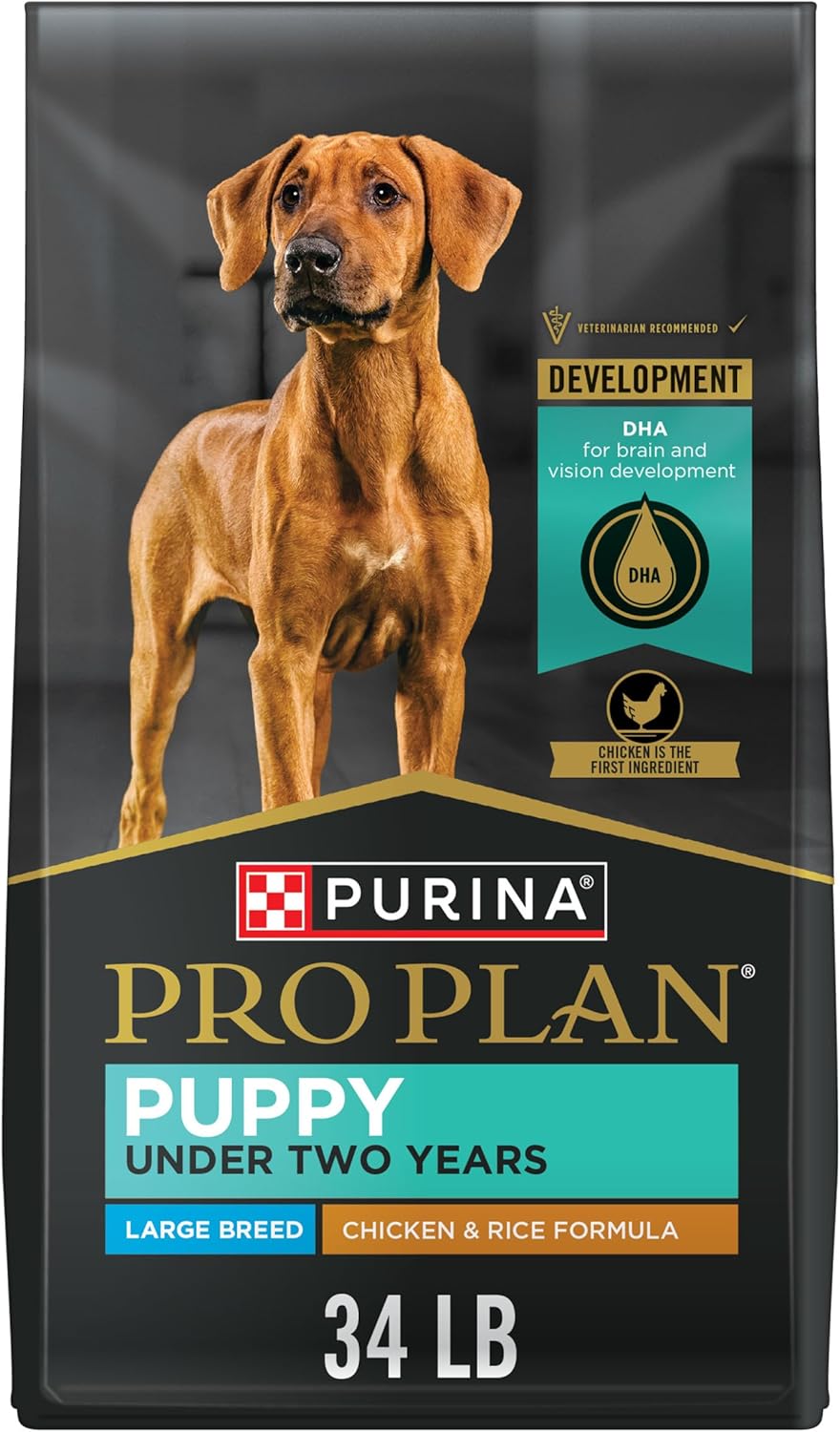
Purina Pro Plan Large Breed Dry Puppy Food, Chicken & Rice, 34 lb Bag
This is the large-breed puppy food on our puppy care page, and it fits the AKC rule above: a large-breed growth formula for puppies headed past 70 lbs.
The bag alone doesn't make it right for your puppy. VCA says to look for an AAFCO statement for growth of puppies including large dogs (more than 70 lbs adult weight). Set portions with your vet and feed to body condition, not the bag chart.

Etekcity Food Kitchen Scale, Digital Grams and Ounces, 11lb
VCA says weighing a puppy's food on a gram scale is far more accurate than a measuring cup. This is the scale on our puppy care page.
It tops out at 11 lb, so it weighs meals, not the puppy. Weigh your Golden at the vet or on a scale made for dogs.
Exercise. Moderate, age-appropriate exercise supports muscles and joints. Avoid long runs or jumping until growth plates close (around 14–18 months). That timing is the AKC's. VCA's growth-plate page says walks are fine and a puppy should run and play as it wants, setting its own pace. The exercise needs guide has age-by-age amounts.
Monitoring. Weigh your puppy every 1–2 weeks and track on a growth chart. Compare to the ranges above. If your adult Golden gains excess weight, see our weight and obesity guide.
For feeding amounts by age and weight, see our Golden Retriever feeding chart. For managing weight in adults, see our weight and obesity guide. For food and supplies, visit our products page.
When growth is not ordinary
When to be concerned:
- 🐾No weight gain for 2+ weeks
- 🐾Sudden weight loss
- 🐾Limping or reluctance to move
- 🐾Very thin or very heavy for age
If growth seems off, see your vet. Rule out parasites, joint issues, or metabolic problems. VCA also flags any change in how a puppy walks, sits, or moves as a reason to ask. The hip dysplasia guide explains what vets check.
Quick answers
When do Golden Retrievers stop growing?
Most Goldens stop growing taller by about 12–14 months, once the growth plates in the legs close, and keep filling out to adult weight until 18–24 months. Males often finish later than females.
At what age is a Golden Retriever fully grown?
Most Golden Retrievers reach full height by 12–14 months and full weight by 18–24 months. Males often finish growing later than females. Growth plates typically close by 18 months.
How much should a 6-month-old Golden Retriever weigh?
A 6-month-old male Golden typically weighs 45–55 lbs; females 40–50 lbs. That is roughly 60–70% of adult weight; the AKC's percentage chart gives about 60% at 6 months for large breeds. Individual variation is normal. Focus on steady growth and body condition rather than hitting an exact number.
Why is my Golden Retriever smaller than the growth chart?
Genetics, nutrition, health, and line (show vs. field) all affect size. Some Goldens are naturally smaller. If your puppy is healthy, energetic, and growing steadily, being below the chart range can be normal. Discuss any concerns with your vet.
Can I predict my Golden Retriever's adult size?
Rough estimates: double the weight at 4 months, or use the 6-month weight as a rough indicator. Genetics matter most. Your breeder or vet can give a better estimate based on parents and current growth.
When should I switch from puppy to adult food?
Most Golden Retrievers can switch to adult food between 12–18 months, when growth slows. Use a large breed puppy formula until then. See our feeding chart for transition timing. Because large breeds can keep growing toward two years, confirm the switch with your vet.
Sources
Adult height and weight, the height rule, the 12:11 proportion, and "hard working condition": the AKC breed standard for the Golden Retriever, also published by the Golden Retriever Club of America. Standard height arriving well after six months: GRCA, size disqualification.
Growth plates, the rib check, no jogging before 14 to 18 months, and about 60% of adult weight at 6 months for large breeds: AKC, When Do Dogs Stop Growing? Fusion as late as 16 to 18 months: AKC, large-breed care. Overfeeding and the 70 lb growth-formula rule: AKC, puppy nutrition.
Adult size at 12 to 18 months: VCA, puppy growth and maturity. Adulthood at up to 18 to 24 months, food restriction and hips, and no extra supplements without your vet: VCA, Feeding Growing Puppies. Calcium, growth curves, and up to two years on puppy food: VCA, large and giant breed puppies. Self-paced play and gait changes: VCA, growth plates and exercise. Rib and waist checks: VCA, Body Condition Scores.
Spay and neuter timing: AAHA 2019 Canine Life Stage Guidelines and Hart et al., Frontiers in Veterinary Science, 2020.
P.S. Get the free Golden Retriever Owner Cheat Sheet — daily feeding, sleep, and care in one printable guide.
Get the Cheat Sheet when you join the newsletter — instant access in your welcome email.