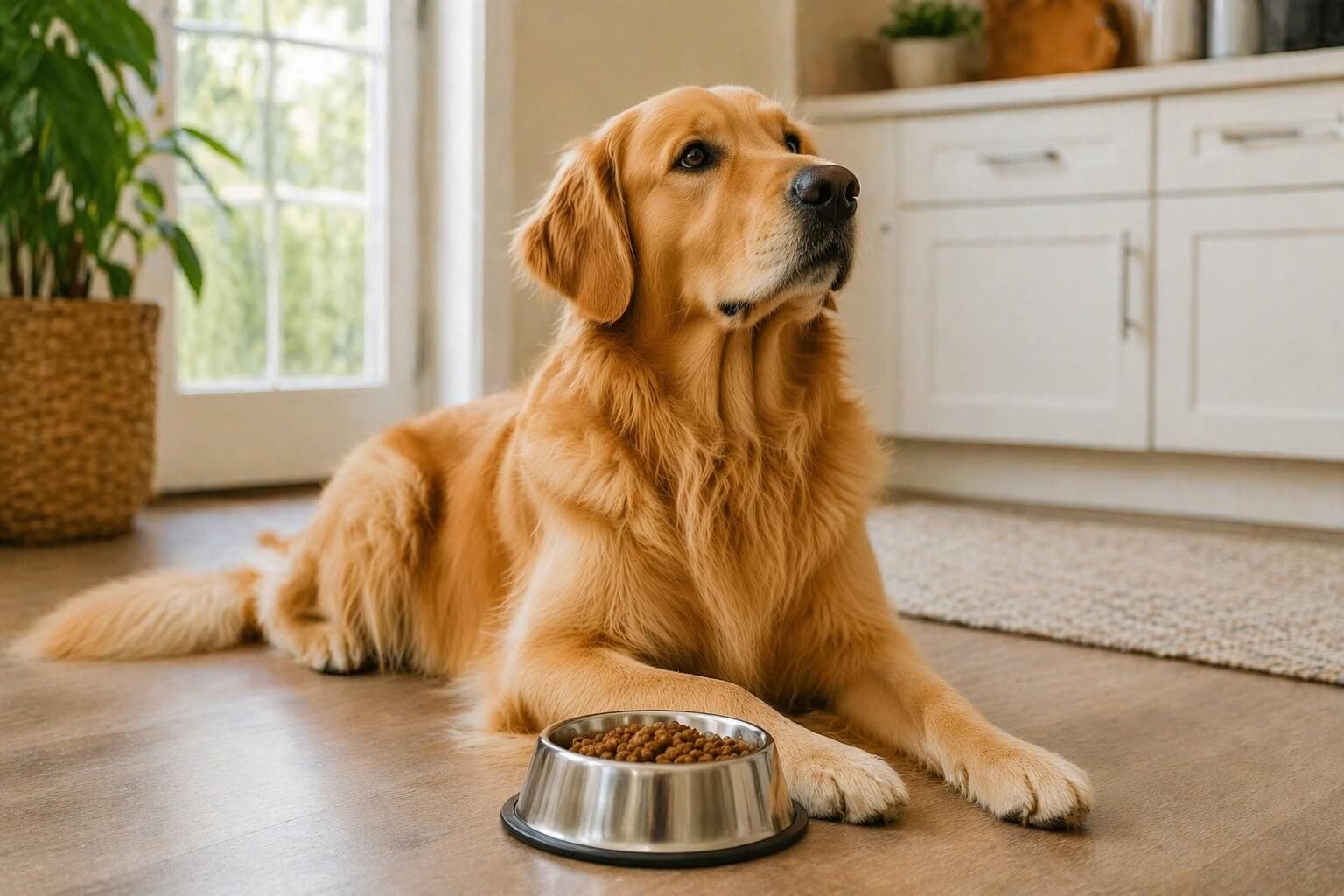
Golden Retriever Feeding Chart: How Much to Feed by Age & Weight
By JJ Allan (goldenretriever.hair)
A Golden Retriever feeding chart is useful only when it accounts for the food as well as the dog. Age helps determine meal frequency; healthy body weight, activity, neuter status, and the exact recipe affect portions. Use the guidance below to read your food label and work out a daily amount, then adjust as your dog's needs change.
Nutrition sources checked October 25, 2026.
This guide provides general feeding information. Your veterinarian can help set portions for your dog's growth, body condition, and health.
How Much Should You Feed a Golden Retriever? (Quick Answer)
There is no universal cups-per-day amount for every Golden Retriever. A cup of one recipe can contain substantially more calories than a cup of another, so start with the exact food's label and calories per cup.
- 🐾Young puppies: commonly eat 3–4 measured meals a day from 8–12 weeks, then 3 meals until about 6 months.
- 🐾Older puppies: usually move to 2 measured meals a day from about 6 months. Keep dividing the recipe-specific daily total; fewer meals do not automatically mean fewer daily calories.
- 🐾Adults: usually eat 2 measured meals a day. Check calories per cup before converting a calorie allowance into cups.
- 🐾Seniors: need an individualized amount based on body and muscle condition, activity, and health—not an automatic age-based reduction.
For example, if the whole-day allowance is 1,300 kcal and 100 kcal is reserved for treats, 1,200 kcal remains for the main food. At 400 kcal per cup, that is 3 cups per day, or 1.5 cups at each of two meals. This illustrates the calculation; 1,200 kcal is not a target for every Golden Retriever.
Sources: Merck Veterinary Manual feeding guidance, MSD Veterinary Manual puppy feeding schedule, and AAHA life-stage nutrition guidance.
How to Use This Feeding Chart
- 🐾Choose the appropriate life stage and confirm that the food's nutritional adequacy statement fits it.
- 🐾Use a healthy target weight and, for puppies, the label's stated current- or expected-adult-weight basis.
- 🐾Set a starting daily calorie allowance or use the exact food's labeled daily amount.
- 🐾Subtract treats and extras, then convert the remainder using the recipe's calories per cup or kilogram.
- 🐾Divide the daily total among meals, measure consistently, and reassess weight and body condition.
What to Do Next
- 🐾If you have a puppy: use the puppy meal schedule below and the exact food bag's daily feeding instructions.
- 🐾If you have an adult: review the calorie examples, then convert the allowance using your food's calories per cup or per kilogram.
- 🐾If you are choosing or switching food: compare options in our best dog food for Golden Retrievers guide.
- 🐾If you are planning a puppy routine: pair meals with our Golden Retriever puppy sleep chart.
- 🐾If appetite, weight, growth, or stool changes without a clear reason: ask your veterinarian rather than changing portions repeatedly.
Golden Retriever Puppy Feeding Chart
The meal schedule below is a practical starting point. Use the exact puppy food's daily amount, then divide that daily total across the listed number of meals.
| Age | Meals per day | How to set the daily amount |
|---|---|---|
| 8–12 weeks | 3–4 | Use the exact food's puppy age-and-weight instructions and divide the daily total among the meals. |
| 3 to under 6 months | 3 | Recheck the label row as weight changes, then divide the daily total among three meals. |
| 6–12 months | Usually 2 | Continue a food suitable for large-breed growth and reassess the labeled daily amount as the puppy grows. |
| 12–18 months if still growing | Usually 2 | Ask your veterinarian when to transition to adult food; maturity timing varies. |
Some puppies do better staying on three smaller meals for longer; VCA advises measured meals 2–3 times a day for growing puppies, based on body condition and age, so ask your veterinarian when to drop the third meal.
Meal timing can flex around your household's routine. When a puppy moves from three meals to two, divide the same current daily total between the two meals unless growth, body condition, the food label, or your veterinarian indicates that the total should change.
Read each product's feeding table carefully. Some labels calculate puppy portions from current weight, while others use expected adult weight; Hill's puppy feeding directions and Purina puppy feeding directions illustrate why the table heading matters.
Choose a complete and balanced food whose nutritional adequacy statement says it is suitable for growth of large-size dogs. Some foods labeled for all life stages meet that requirement, so a blanket ban on all-life-stages food is not accurate. Do not add calcium or other mineral supplements unless your veterinarian directs you to.
Track a growing puppy's weight and body condition at least weekly, and recheck the food label as weight changes. Golden Retrievers may continue maturing through roughly 12–18 months, so use growth and veterinary guidance—not a birthday alone—to decide when to move to adult food. See Tufts Petfoodology's large-breed puppy guidance for more context.
Adult Golden Retriever Feeding Chart: Calorie Examples
These examples are starting estimates for healthy, neutered adults at ideal body weight. They are not breed-specific requirements, minimums, or maximums.
| Healthy weight | Starting calorie example |
|---|---|
| 55 lb | About 1,090–1,250 kcal/day |
| 65 lb | About 1,240–1,420 kcal/day |
| 75 lb | About 1,380–1,580 kcal/day |
| 85 lb | About 1,520–1,730 kcal/day |
The method uses the AAHA resting energy requirement formula: RER = 70 × body weight in kilograms0.75, multiplied by 1.4–1.6 for a healthy, neutered adult, then rounded to the nearest 10 kcal. Real dogs can fall outside a calculated range; Ohio State's veterinary nutrition service recommends using calculations as a starting point and monitoring the individual.
Compare adult food options
Check the exact recipe’s life-stage label and feeding instructions before choosing. Ask your vet about your dog’s individual dietary needs.
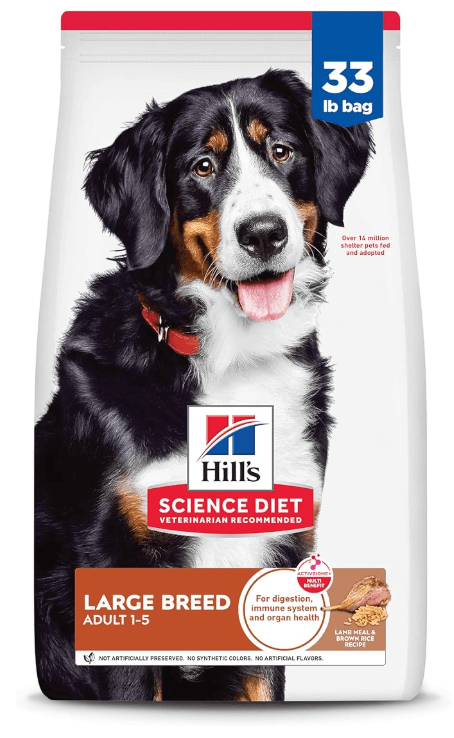
Hill’s Science Diet Large Breed Adult
Large-breed adult dry dog food with lamb meal and brown rice.
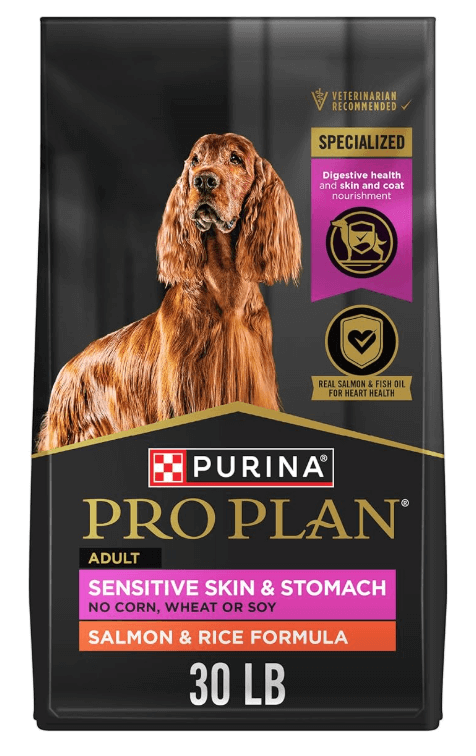
Purina Pro Plan Sensitive Skin & Stomach Adult
Adult dry dog food with a salmon-and-rice formula.
As an Amazon Associate, GoldenRetriever.hair earns from qualifying purchases.
How to Convert Calories to Cups or Grams
Cups per day = calories allotted to the main food ÷ calories per cup.
| Calories for main food | 350 kcal/cup | 400 kcal/cup | 450 kcal/cup |
|---|---|---|---|
| 800 kcal | 2.3 cups | 2.0 cups | 1.8 cups |
| 1,000 kcal | 2.9 cups | 2.5 cups | 2.2 cups |
| 1,200 kcal | 3.4 cups | 3.0 cups | 2.7 cups |
| 1,400 kcal | 4.0 cups | 3.5 cups | 3.1 cups |
| 1,600 kcal | 4.6 cups | 4.0 cups | 3.6 cups |
Example: if the whole-day allowance is 1,300 kcal and 100 kcal is reserved for treats, 1,200 kcal remains for the main food. At 400 kcal per cup, that is 3 cups for the whole day.
Official product information shows why the exact recipe matters: one Hill's large-breed adult recipe lists 369 kcal per cup, while one Purina Pro Plan adult recipe lists 449 kcal per cup. Formulas can change, so the current package or manufacturer page is decisive.
For a gram-based label: grams per day = allotted kcal ÷ (kcal per kilogram ÷ 1,000). A food containing 4,000 kcal/kg supplies 4 kcal/g, so 1,200 ÷ (4,000 ÷ 1,000) = 300 g/day.
Keep treats and extras at or below about 10% of daily calories so at least 90% comes from complete and balanced food, and count those extras within the allowance.
Meal Timing and a Daily Feeding Routine
Once you know the daily amount, a steady routine makes it easier to use. Two measured meals a day suit most adult Goldens. One in the morning and one in the evening works for most households.
- 🐾Pick times you can keep. The exact clock time matters less than doing it the same way each day. A morning meal after the first trip outside and an evening meal a few hours before bed is a common pattern.
- 🐾Plan a bathroom trip after meals. Regular mealtimes make bathroom times more predictable, which helps with puppy potty training and apartment living. See our potty training schedule chart.
- 🐾Measure meals rather than free-feeding. A bowl left full all day makes it hard to know how much your dog actually ate and makes weight gain easier to miss.
- 🐾Watch for skipped meals. Scheduled meals show you quickly when your dog leaves food or loses interest. A change in appetite is worth a call to your veterinarian.
- 🐾Keep mealtimes calm. For dogs at higher risk of bloat, the Merck Veterinary Manual advises several smaller meals instead of one large one, a low-stress mealtime, and limited exercise right before and after eating. See our bloat and GDV guide.
Once or twice a day? Some adult dogs manage on one meal, but splitting the daily total into two meals is the usual recommendation for Goldens. A smaller meal is easier to handle than one large one, and you get two chances a day to notice appetite changes. Seniors usually stay on two meals. Your veterinarian may suggest smaller, more frequent meals for some health conditions.
Sources: Merck Veterinary Manual feeding guidance and MSD Veterinary Manual on feeding dogs.
Senior Golden Retriever Feeding
There is no fixed senior cup amount and no automatic need to lower protein simply because a dog reaches a certain age. Use weight, muscle condition, activity, appetite, health, and the recipe's calorie density.
| What you observe | What to do |
|---|---|
| Stable healthy weight and muscle | Keep monitoring; do not automatically cut food or switch recipes. |
| Less activity or unwanted weight gain | Review total calories, treats, and the target weight with your veterinarian. |
| Unexplained weight loss, muscle loss, or appetite change | Arrange a veterinary assessment rather than making repeated portion changes. |
Older dogs do not universally need a low-protein diet; Tufts Petfoodology explains why senior nutrition should be individualized.
Use Body Condition as Well as Weight
For most dogs, a healthy target is a body condition score of 4–5 on a 9-point scale. You should be able to feel the ribs with a light fat covering, see a waist from above, and see an abdominal tuck from the side. A Golden Retriever's coat can hide these landmarks, so use your hands as well as your eyes.
- 🐾Healthy condition: keep the current measured plan and monitor weight and muscle condition.
- 🐾Unwanted gain: count every calorie source and review the target and adjustment with your veterinarian.
- 🐾Underweight or losing weight: seek veterinary guidance, especially when the change is unexplained or accompanied by appetite, stool, or energy changes.
References: WSAVA Body Condition Score for Dogs and AAHA nutritional risk-factor guidance.
Signs You're Feeding the Wrong Amount
Goldens are food-motivated, and begging after dinner is not a reliable sign that a dog needs more food. Your hands and the scale give a better answer.
| Check | Possibly too much | Possibly too little |
|---|---|---|
| Ribs (feel just behind the front legs) | Ribs feel like the fleshy palm of your hand, or are hard to find | Ribs feel like the knuckles of a closed fist, or stick out |
| Waist from above | Little or no waist behind the ribs | A very deep waist, with hip bones or spine easy to see |
| Belly from the side | No tuck, or a sagging belly | A sharp tuck with little cover |
| Weight trend | Weight creeping up on the scale or at vet visits | Weight dropping, or hard to keep on |
At a healthy weight, the ribs feel like the back of your hand: a thin layer of fat with the ribs right underneath. Feel through the coat; a Golden's fur can hide a lot.
If the amount seems off:
- 🐾Count everything for a week. Write down meals, treats, chews, and table food. Treats should stay under about 10% of the day's calories.
- 🐾Measure, don't eyeball. A kitchen scale that weighs in grams is more accurate than a measuring cup. If you use a cup, level it and use the same one every time.
- 🐾Cut extras before meals if your dog is gaining.
- 🐾Give a portion change a few weeks before judging it, and recheck body condition and weight along the way, rather than changing portions daily.
- 🐾Call your veterinarian if your Golden is losing weight without a clear reason, especially with vomiting, diarrhea, or appetite changes. Weight loss can come from too little food or from illness, and a vet looks at those signs to tell which.
Factors That Affect How Much to Feed
- 🐾Growth and maturity: puppies need food and portions appropriate to growth, with frequent reassessment as weight changes.
- 🐾Activity and neuter status: energy needs can change with exercise, work, recovery, and neutering.
- 🐾Recipe and format: dry, canned, fresh, and mixed diets can differ greatly in calories per cup, can, tray, or gram.
- 🐾Health and body condition: pregnancy, nursing, illness, medication, weight goals, and muscle loss can all change the appropriate plan.
See the Merck Veterinary Manual's feeding-practice overview for additional factors.
Common Feeding Mistakes
- 🐾Treating cups from different recipes as interchangeable.
- 🐾Reading a daily total as the amount for each meal.
- 🐾Missing whether a puppy label uses current weight or expected adult weight.
- 🐾Forgetting calories from treats, chews, toppers, and table food.
- 🐾Increasing food to match a calculated estimate without checking body condition and weight trend.
- 🐾Automatically reducing food at age 7 even when weight, muscle condition, and health are stable.
When Feeding Problems Need More Than a Portion Change
A slow feeder can help pace a dog that gulps food, but it does not diagnose the cause of vomiting, regurgitation, discomfort, or appetite change. Persistent digestive signs, appetite changes, unexplained weight change, or a puppy that is not growing as expected need veterinary assessment. American Kennel Club guidance on appetite loss explains why a change in eating can warrant prompt attention.
Recommended Products
For food and feeding tools, see our products page and best dog food for Golden Retrievers guide.
Related Golden Retriever Guides
- 🐾Golden Retriever puppy feeding schedule chart
- 🐾Best dog food for Golden Retrievers
- 🐾Golden Retriever weight and obesity guide
- 🐾Golden Retriever exercise needs
- 🐾Golden Retriever growth chart
Sources
- 🐾Merck Veterinary Manual feeding guidance
- 🐾MSD Veterinary Manual puppy feeding schedule
- 🐾AAHA life-stage nutrition guidance
- 🐾Hill's puppy feeding directions
- 🐾Purina puppy feeding directions
- 🐾Tufts Petfoodology's large-breed puppy guidance
- 🐾Ohio State's veterinary nutrition service
- 🐾Hill's large-breed adult recipe
- 🐾Purina Pro Plan adult recipe
- 🐾Tufts Petfoodology explains why senior nutrition should be individualized
- 🐾WSAVA Body Condition Score for Dogs
- 🐾AAHA nutritional risk-factor guidance
- 🐾VCA advises measured meals 2–3 times a day for growing puppies
- 🐾VCA Animal Hospitals on body condition scoring
- 🐾VCA Animal Hospitals on obesity in dogs
- 🐾AAHA guidance on preventing obesity
- 🐾VCA Animal Hospitals on weight loss in dogs
- 🐾American Kennel Club guidance on appetite loss
Frequently Asked Questions
How many times a day should I feed my Golden Retriever?
Young puppies commonly eat three to four measured meals a day from 8 to 12 weeks, then three meals until about 6 months. Older puppies and adults usually eat two measured meals a day. When meal frequency changes, divide the same recipe-specific daily total across the new schedule unless your veterinarian recommends a different total.
How many cups should an adult Golden Retriever eat?
There is no universal cup amount because recipes contain different calories per cup. First estimate a daily calorie allowance, subtract calories from treats and extras, then divide the remaining calories by the food's calories per cup. For example, 1,200 kcal divided by 400 kcal per cup is 3 cups for the whole day, or 1.5 cups at each of two meals. That example is not a target for every dog.
How do I know if I am overfeeding my Golden Retriever?
Difficulty feeling the ribs, loss of a visible waist, or steady unwanted weight gain can point to overfeeding. Count meals, treats, chews, toppers, and table food, then review the total and your dog's body condition with your veterinarian. Do not apply one generic percentage cut to every dog, and do not restrict a growing puppy without veterinary guidance.
Should I feed my Golden Retriever puppy large-breed food?
Choose a complete and balanced food whose nutritional adequacy statement says it is suitable for growth of large-size dogs. Some foods labeled for all life stages meet that requirement, so the life-stage statement matters more than a blanket rule about the words on the front of the bag. Do not add calcium unless your veterinarian directs you to.
How much should a 6-month-old Golden Retriever eat per day?
Use the exact food's puppy feeding instructions and the correct weight basis; some labels use current weight while others use expected adult weight. At about 6 months, many puppies can eat the labeled daily total in two meals, but they still need food suitable for large-breed growth. Recheck growth and body condition rather than copying a universal cup amount.
Should I automatically feed less when my Golden Retriever becomes a senior?
No. Age alone does not determine a lower portion. Keep monitoring weight, muscle condition, activity, appetite, and health. An older dog with unwanted weight gain may need a different calorie allowance, while unexplained weight or muscle loss needs veterinary assessment rather than an automatic food reduction.
Can I give my Golden Retriever human food?
Small amounts of dog-safe human food can fit as counted treats, but treats and extras should generally stay at or below 10% of daily calories so at least 90% comes from complete and balanced food. Avoid toxic foods and ask your veterinarian about unfamiliar ingredients or a dog with medical needs. Review the FDA's list of potentially dangerous items for pets.
Keep Your Golden's Daily Care on Track
Get the free Golden Retriever Owner Cheat Sheet for a printable daily-care reference.
Get the Cheat Sheet when you join the newsletter — instant access in your welcome email.