
Golden Retriever Alone Time by Age (How Long Is Too Long?)
By JJ Allan (goldenretriever.hair)
Quick answer: a Golden Retriever puppy can be left alone for about one hour per month of age, up to about 6 hours at 6 months. An adult Golden should be alone for no more than 6 to 8 hours without a chance to relieve itself, according to a board-certified veterinary behaviorist interviewed by the AKC. So an 8-hour day alone is at the limit, not a routine. Plan a midday walk, a dog walker or daycare, and teach alone time gradually so your Golden can relax while you're gone.
Below: the 8-hour question, an alone-time chart by age, puppies, how to train alone time, safe setups, long workdays, signs of separation anxiety, and when to see your vet.
Sources checked November 14, 2026.
General training information, not veterinary advice. If your dog seems distressed when left alone, check with your veterinarian.
Quick answer: how long can a Golden Retriever be left alone?
- 🐾Under 10 weeks: about 1 hour (AKC).
- 🐾10–12 weeks: about 2 hours.
- 🐾3 to 6 months: about one hour per month of age, so 3 hours at 3 months and 6 hours at 6 months (AKC, VCA).
- 🐾Over 6 months and adults: a maximum of 6–8 hours without a chance to relieve themselves (AKC, quoting veterinary behaviorist Dr. Vint Virga).
- 🐾Seniors: often less, because older dogs may need to go out more often.
- 🐾Every dog: at least two hours of dedicated social time a day with people or other dogs, per Dr. Virga.
These are upper limits for a dog that is already comfortable alone. A Golden that panics when you leave needs training first, not more hours. None of these sources gives a separate limit for Golden Retrievers. Dr. Virga says a dog's need for company varies by individual and can't be generalized by breed, age or overall health.
Can Golden Retrievers Be Left Alone?
Yes, if they learn it gradually and the time fits their age. Start with seconds and minutes while you're home, add time only while your dog stays relaxed, and keep within the age limits: about one hour per month of age for a puppy, up to about 6 hours at 6 months, and no more than 6 to 8 hours for an adult. The training steps are below.
Can Golden Retrievers be left alone for 8 hours?
An adult Golden that has learned to be alone can sometimes manage an 8-hour stretch, but it is the limit, not a target. Six or seven hours falls inside the same 6-to-8-hour adult maximum, so the advice below applies to all three. Here is what the sources say:
- 🐾6–8 hours at most. Dr. Vint Virga, a board-certified veterinary behaviorist quoted by the AKC, recommends that dogs spend no more than six to eight hours alone without a chance to relieve themselves. "For a dog to spend all of their day alone is too much," he says.
- 🐾Not for puppies. The AKC's puppy guide caps a 6-month-old at about 6 hours and says puppies work up to an eight-hour workday gradually. Even adults shouldn't be home alone for much longer than six to eight hours without a bathroom break.
- 🐾Bladder limits. The Ohio State Indoor Pet Initiative says adult dogs should get a chance to go out about every four hours when possible, though they can be expected to hold urine for 8 hours or longer.
- 🐾Build up to it. The ASPCA says that once a dog in training can stay alone for 90 minutes without getting upset, it can probably handle four to eight hours. Try four hours first, then work up to eight over a few days.
For an 8-hour workday, Dr. Virga suggests breaking up the time: doggy daycare, a dog walker, or a neighbor, friend or relative who drops by. The 8-hour, 7-hour and 6-hour questions all have the same answer. The shorter the stretch, the easier it is, and a midday visit makes any of them better.
Golden Retriever alone time chart by age
The chart uses the AKC's puppy guidelines, which follow roughly one hour per month of age, and the veterinary behaviorist's 6–8 hour adult maximum. VCA gives the same hour-per-month rule up to 6 months.
| Age | Longest time alone | Why | What helps |
|---|---|---|---|
| Under 10 weeks | About 1 hour | Can't usually hold the bladder longer than about an hour | Time off work at first; short crate or pen practice while you're home |
| 10–12 weeks | About 2 hours | Can usually hold it about two hours | Someone to let the puppy out once or twice a day once you're back at work |
| 3 months | About 3 hours | About an hour of bladder control per month of age | A potty trip as soon as you're back |
| 4 months | About 4 hours | Same hour-per-month rule | A midday visit on long days |
| 5 months | About 5 hours | Same hour-per-month rule | Special toys that only come out when you leave |
| 6 months | About 6 hours | Can usually hold it up to about six hours | Keep building alone time gradually |
| Over 6 months and adults | 6–8 hours at most | The veterinary behaviorist's maximum without a chance to relieve themselves | A midday walker or daycare for full workdays; two hours of social time a day |
| Seniors | Often less than adults | May need to go out more often | A lunchtime visit or a sitter, per the AKC |
Ages and hours from the AKC's puppy guide and VCA's new puppy guide. The adult maximum and social-time figure are from Dr. Virga in the AKC's alone-time article. For a puppy shut in a crate, VCA's house-training article is stricter: no more than about 3 hours before a potty break. If you work long days, match your plan to your Golden's energy levels by age.
Can a Golden Retriever puppy be left alone?
Yes, as long as the time is short and the puppy is safe. VCA recommends a crate to keep a puppy safe when unattended. Its house-training article, by a board-certified veterinary behaviorist, says puppies left alone for no more than about 3 hours can usually be crated. Longer than that, they need a potty break. Other options are a pet sitter, or a pen with a bed at one end and a potty pad or artificial turf at the other.
The AKC's puppy guide, quoting trainer Mary Janek, suggests:
- 🐾Take time off at first. Plan some vacation time when the puppy comes home, so it can get used to the house and the crate.
- 🐾Start with an hour or more in the crate once your puppy is comfortable there.
- 🐾Arrange visits. Have someone let the puppy out at least once or twice a day once you're back at work.
- 🐾Think ahead. Consider how long the puppy will be alone before you bring one home.
For a puppy's first days and nights, see the Golden Retriever first week home guide. For the potty side of alone time, see the potty training schedule chart. If nights are the hard part, such as crying in the crate after bedtime or a puppy not sleeping through the night, settle nights before stretching daytime absences.
How to train a Golden Retriever to be alone
The AKC notes that puppies need to learn to be alone, and that it is a gradual process. VCA says separation anxiety might be prevented by giving puppies scheduled times to spend alone in their own crates or beds. The steps below come from VCA's separation anxiety article, by board-certified veterinary behaviorists, and from the ASPCA.
- 🐾Practice at home first. Put your puppy in a crate or pen and leave the room (AKC). Feed meals there and give special toys it only gets in that space.
- 🐾Teach a relaxed stay on a mat or bed. Walk a few feet away for a few seconds and come back. Over time, work up to leaving the room for 30 minutes or longer (VCA).
- 🐾Make departures real but short. Leave the house for just long enough to come back before your dog gets anxious. That may be a few seconds or a couple of minutes. Add time gradually and randomly, and only if your dog stays relaxed (VCA).
- 🐾Don't jump. VCA warns that going from a 5-minute departure to a 30-minute one can make a dog anxious.
- 🐾Watch for stress. The ASPCA lists dilated pupils, panting, yawning, salivating, trembling, pacing and exuberant greetings as signs to shorten the time again.
- 🐾Expect weeks, not days. The ASPCA says most anxious responses happen in the first 40 minutes alone, so building up to 40 minutes takes the longest.
Short training sessions from the basic obedience training guide give you the stay and settle skills these steps rely on. For a daily rhythm by age, see the puppy training schedule.
Setting up a safe space: crate, pen or room
The AKC lists the basics as a safe area, such as an exercise pen or crate, positive associations such as treat-dispensing toys, and a gradual increase in time. Free run of the house comes once your dog is potty trained and sure of being home alone.
VCA says a puppy that is crated while napping or playing with its own toys may be less likely to become overattached. Puppies that learn to spend time away from their owners may be less likely to develop separation anxiety.
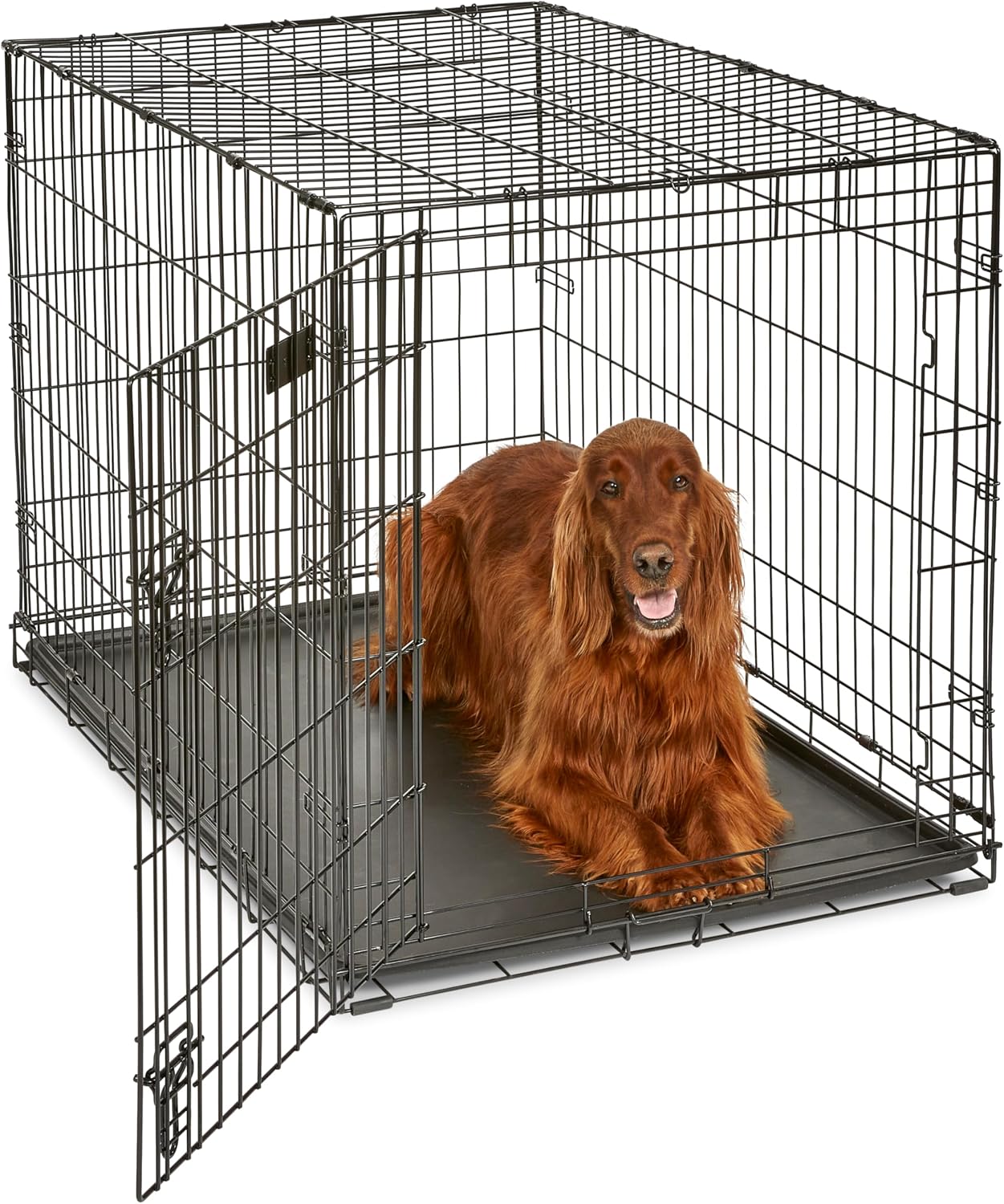
Best for: a crate-based safe space that grows with your Golden
MidWest Homes for Pets iCrate Folding Dog Crate, 42 in, Single Door
A folding wire crate about 42 x 28 x 30 inches, with a divider and a leak-proof tray. Use the divider to keep the space small for a puppy and open it up as your Golden grows.
Use it only if your dog relaxes in a crate; if not, a gated room is the better setup, as the next paragraph explains.
A crate isn't right for every dog. The ASPCA says crates help some dogs but add stress for others. If your dog shows heavy panting, excessive salivation, frantic escape attempts or persistent howling or barking in the crate while you're home, try one room behind a baby gate instead. VCA notes that some dogs become very anxious when confined, which it calls confinement or barrier anxiety.
Before you leave and when you come home
- 🐾Exercise and play first. VCA's puppy article suggests playing before you leave, then taking a break from play for at least half an hour before you go.
- 🐾Give a puzzle. Dr. Virga recommends activity puzzles as you head out, which can keep a dog busy for up to a few hours. VCA suggests a durable toy with a treat such as peanut butter, as long as it doesn't contain xylitol.
- 🐾Break the departure cues. If keys or shoes set your dog off, VCA suggests putting your shoes on and staying home, or picking up your keys and setting them down elsewhere.
- 🐾Leave quietly. The ASPCA says to be calm and quiet when going out and coming in.
- 🐾Low-key returns. VCA says a big reunion can make separation anxiety worse. Let your puppy out to relieve itself right away and keep things calm.
- 🐾Never punish a mess. VCA and the ASPCA both say punishment makes an anxious dog worse; anxious behaviors are distress, not spite.
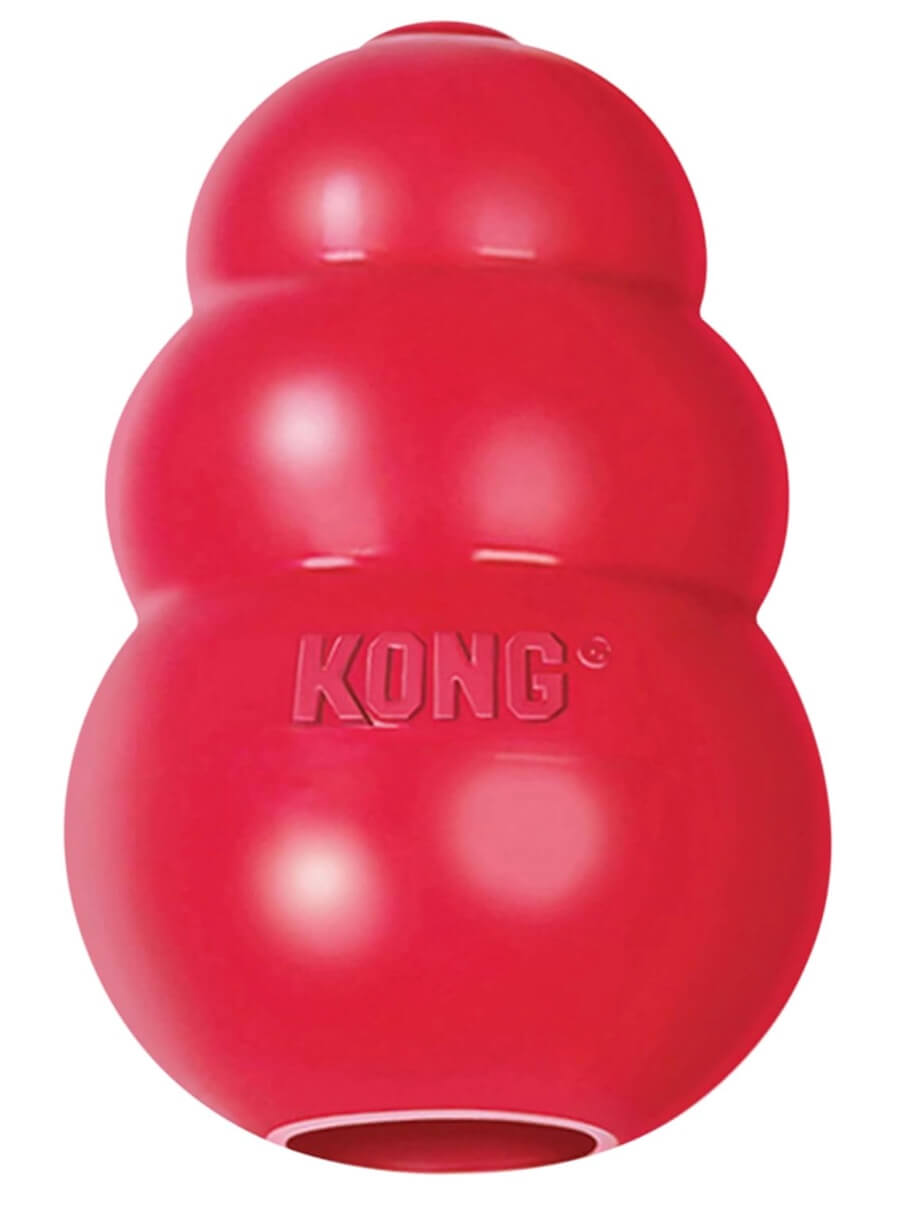
Best for: a special food toy that only comes out when you leave
KONG Classic Stuffable Dog Toy, Large
A stuffable rubber toy you can fill with part of a meal or a treat, the kind of activity puzzle described above. If you use peanut butter, check that it has no xylitol.
Pick a size that suits your dog and watch the first few uses before leaving them alone with it.
Some dogs relax with background sound. VCA suggests a radio or TV if specific noises set off a puppy's anxiety.
Long workdays: breaks, walkers and daycare
Dr. Virga's suggestions for dogs alone longer than six to eight hours are doggy daycare, a dog walker, or someone who drops by for a walk, a meal or just a quick visit. He says he didn't see the difference in his own dog until it went to daycare one day a week, and it became "a much more contented dog."
The AKC's puppy guide suggests coming home for lunch or hiring someone to do it, and a camera if you want to see how your dog copes. VCA also suggests a dog walker or daycare for longer periods such as the workday.
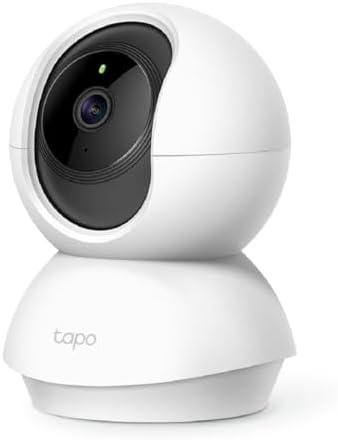
Best for: checking in on your dog during a long day
Tapo C200 1080p Pan/Tilt Pet Camera, 2-Way Audio, Night Vision
A Wi-Fi camera that pans and tilts, so you can see how your dog copes while you are out and save a clip to show your vet if something worries you.
It can record to a microSD card; Tapo also offers an optional paid cloud plan.
A second dog is not a fix for every dog. VCA says a second pet only occasionally helps keep a dog occupied, and is unlikely to help a dog that is too anxious.
Can Golden Retrievers be left alone outside?
The AKC's sources are direct about this. Dr. Virga describes a life spent "tied up outside all day" as one that isn't fulfilling for dogs. The AKC's puppy guide says dogs shouldn't be cooped up in a kennel or tied up outside all day. A secure fence helps for supervised yard time, but it doesn't replace alone-time training; see the yard and fence guide.
VCA adds a training reason. Until they are trained, puppies sent outside alone often get distracted and wait to go until they're back indoors, so go out with a young puppy.
Common Golden Retriever behaviors when left alone (signs of separation anxiety)
VCA, the AKC and the ASPCA list these signs when a dog is left alone:
- 🐾Barking, howling or whining that doesn't seem triggered by anything else.
- 🐾Destruction, often at doors, door frames, window sills or the crate.
- 🐾Peeing or pooping indoors only when alone.
- 🐾Drooling, panting or salivating more than usual.
- 🐾Pacing, restlessness, shaking or shivering.
- 🐾Escape attempts from a crate or room.
- 🐾Refusing to eat or going quiet and withdrawn while you're gone.
- 🐾Following you from room to room and getting anxious as you prepare to leave.
VCA's puppy article says some puppies are so distressed that they injure themselves, for example breaking teeth or cutting their gums chewing through crates, windows or doors. Separation anxiety is a real behavioral condition, says Dr. Virga, so it needs a vet or veterinary behaviorist, not just more hours of practice. Golden owners often ask whether the breed is especially prone to it. None of the veterinary sources checked names Goldens as a higher-risk breed. For prevention and training in depth, see the Golden Retriever separation anxiety guide.
Separation anxiety or something else?
Similar signs can have other causes, and the fix depends on which one it is. A phone video of your dog while you're out helps your vet tell them apart; VCA suggests one.
| What you see | Could also be | Source |
|---|---|---|
| Accidents when you're home too | Incomplete house training | ASPCA, VCA |
| Leaking urine, even while asleep | Incontinence from a medical problem | ASPCA |
| Accidents, chewing or barking that get worse the longer you're out | Being left alone too long | VCA |
| Chewing or mischief, but the dog doesn't seem anxious | Boredom and a need for mental stimulation | ASPCA, AKC |
| Barking at sights and sounds, at home or away | Barking at triggers, such as people or animals outside | ASPCA, VCA |
| Panic only when shut in a crate or small room | Confinement or barrier anxiety | VCA |
| Fear after storms or fireworks while alone | Noise or storm fear (may need treatment too) | VCA |
| Peeing during greetings or when scolded | Submissive or excitement urination | ASPCA |
| Small amounts of urine on upright surfaces | Urine marking | ASPCA |
Dr. Virga makes the same point: separation anxiety needs to be told apart from a dog that is bored, unfulfilled or frustrated, and the best way to do that is a visit to a vet or veterinary behaviorist. The behavior problems guide covers boredom, exercise and structure.
When it's not ordinary: see your vet
Some alone-time problems are medical or need medication. See your vet if:
- 🐾your dog has accidents when alone, especially if it was reliably house trained. The ASPCA says to rule out medical causes such as a urinary tract infection, bladder stones, diabetes, kidney disease or Cushing's disease first. Some medications can also cause frequent urination;
- 🐾your dog hurts itself trying to escape, such as broken teeth or cut gums, which VCA describes in severe cases;
- 🐾distress happens nearly every time you leave, or gets worse despite gradual training;
- 🐾your dog won't eat, drools heavily or shakes when left;
- 🐾a senior dog newly struggles alone, or seems to forget house training. VCA lists age-related cognitive decline as one cause of house soiling.
VCA says the first step with separation anxiety is to involve your veterinarian, who may prescribe anti-anxiety medication. For severe cases, or when treatment isn't working, it recommends a veterinary behaviorist. Treatment can include desensitization, counterconditioning and medication. VCA's separation anxiety article notes that medications have been approved for separation anxiety in dogs, and pheromone therapy can also help. Medication supports the retraining plan; it does not replace it. Only your vet can decide whether medication is right for your dog.
See your vet if your Golden shows distress, injuries or accidents when left alone. Never start, stop or share an anti-anxiety medication without your veterinarian.
Related Golden Retriever guides
- 🐾Golden Retriever Separation Anxiety Guide: symptoms and step-by-step prevention and training
- 🐾Golden Retriever Behavior Problems Guide: exercise, structure and other behavior fixes
- 🐾Golden Retriever Puppy Training Schedule: daily training rhythm by age
- 🐾Golden Retriever Energy Levels by Age: match activity to what your dog can handle
- 🐾Golden Retriever Potty Training Schedule Chart
Quick answers
How long can a Golden Retriever be left alone?
Puppies can be left about one hour per month of age, up to about 6 hours at 6 months. Adults should be alone no more than 6 to 8 hours without a chance to relieve themselves, according to a veterinary behaviorist quoted by the AKC, and shorter is better.
Can Golden Retrievers be left alone for 8 hours?
An adult that is used to being alone can sometimes manage it, but 8 hours is the top of the 6-to-8-hour maximum, not a routine. Puppies can't. For a full workday, arrange a midday walk, a dog walker or daycare.
Can golden retrievers be left alone?
Yes, if they learn it gradually and the time fits their age. Start with seconds and minutes while you're home, add time only while your dog stays relaxed, and keep within the age limits.
How long can a Golden Retriever puppy be left alone?
About 1 hour under 10 weeks, 2 hours at 10 to 12 weeks, then about one hour per month of age up to 6 hours at 6 months, according to the AKC. A puppy crated during the day needs a potty break within about 3 hours, VCA says.
Can Golden Retrievers be left alone all day?
Not every day without a break. A veterinary behaviorist quoted by the AKC says spending all day alone is too much for a dog, and that dogs need at least two hours of social time a day.
Can Golden Retrievers be left alone outside?
Not for long stretches. The AKC says dogs shouldn't be cooped up in a kennel or tied up outside all day. Use the yard for supervised time and a safe indoor space when you're out.
Do Golden Retrievers get separation anxiety?
Any dog can. Signs include barking, destruction, accidents, drooling and pacing when left alone. The veterinary sources checked don't name Goldens as a higher-risk breed. If you see these signs, talk to your vet.
How do I train my Golden Retriever to be alone?
Practice at home with a crate, pen or mat, leave for a few seconds, and add time gradually and randomly while your dog stays relaxed. Give a special toy as you leave and keep departures and returns calm.
Sources
- 🐾AKC: Alone time for dogs, how much is too much? (Dr. Vint Virga, board-certified in veterinary behavior)
- 🐾AKC: How long can a puppy be left alone?
- 🐾VCA Animal Hospitals: Separation anxiety in dogs (Horwitz and Landsberg, DACVB)
- 🐾VCA Animal Hospitals: Separation anxiety in puppies
- 🐾VCA Animal Hospitals: New puppy guide (how long a puppy can be left alone)
- 🐾VCA Animal Hospitals: House training for puppies and dogs (Lindell, DACVB)
- 🐾VCA Animal Hospitals: Reasons to crate train your dog
- 🐾VCA Animal Hospitals: House soiling (Lindell, Horwitz and Landsberg, DACVB)
- 🐾ASPCA: Separation anxiety
- 🐾Ohio State Indoor Pet Initiative: Housetraining
P.S. Get the free Golden Retriever Owner Cheat Sheet — daily feeding, sleep, and care in one printable guide.
Get the Cheat Sheet when you join the newsletter — instant access in your welcome email.