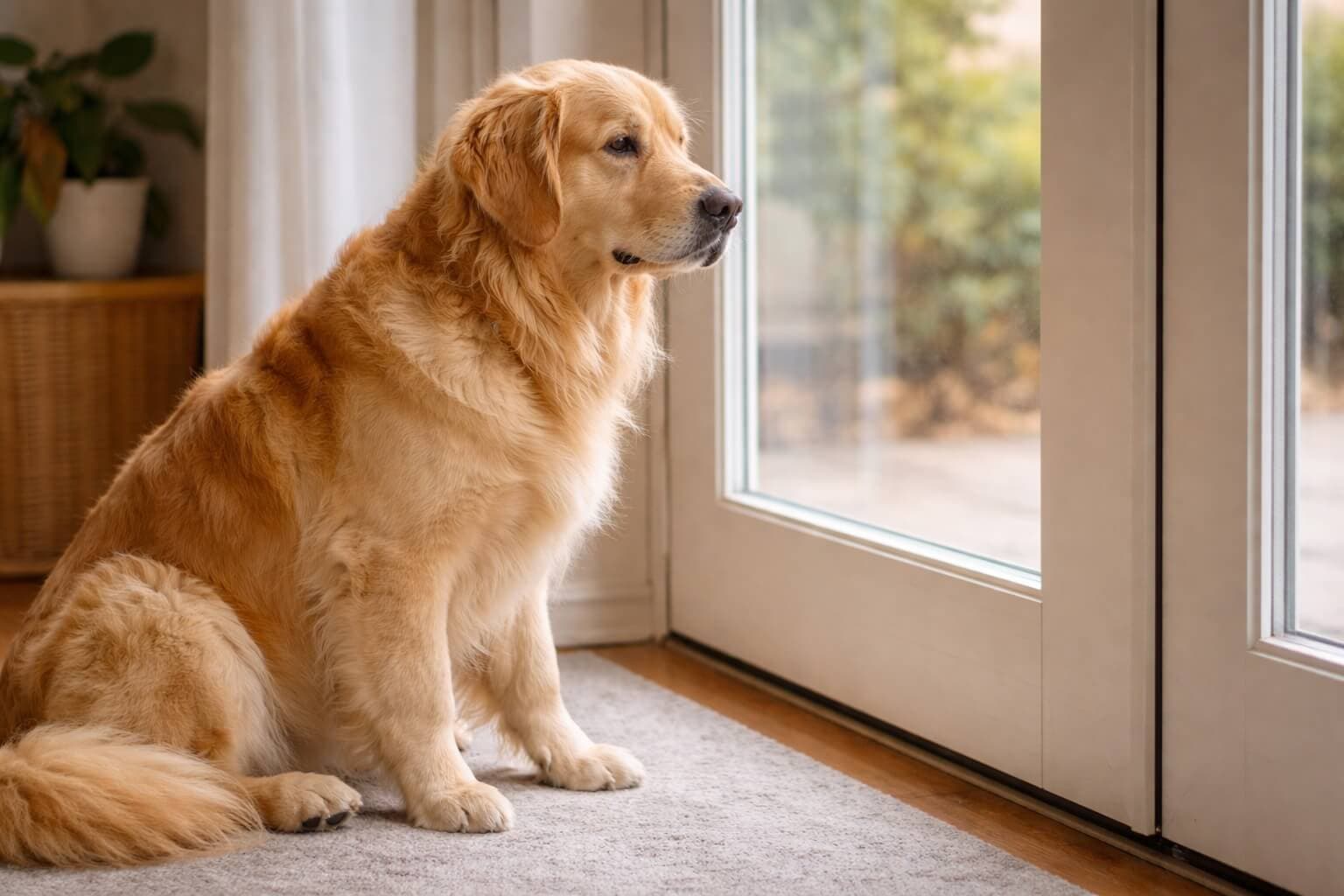
Golden Retriever Separation Anxiety Guide (Causes, Symptoms & How to Help)
GoldenRetriever.hair
By GoldenRetriever.hair
Golden Retrievers are famous for being affectionate, loyal, and people-focused—including everyday closeness like why Golden Retrievers lean on people. That strong bond is one of the best parts of living with the breed—but it can also create challenges when your dog has to spend time alone. Many owners notice that their Golden seems distressed when left, leading to questions about Golden Retriever separation anxiety and how to help.
This guide explains what separation anxiety is, why Golden Retrievers are prone to anxiety when left alone, how to recognize real anxiety versus simple boredom, and what you can realistically do to prevent or reduce separation anxiety in your dog.
What Is Separation Anxiety in Dogs?
Separation anxiety is a behavioral condition in which a dog experiences significant emotional distress when separated from their owner or primary attachment figures.
Key points:
- 🐾It is driven by fear, panic, or insecurity, not stubbornness or spite.
- 🐾Dogs with separation anxiety often:
- 🐾Become highly distressed as soon as they realize they’re alone—or even when they see departure cues.
- 🐾Struggle to settle until their person returns.
Common features:
- 🐾Emotional stress – Elevated heart rate, panting, pacing, and vocalizing.
- 🐾Fear of being alone – The dog’s coping skills collapse when they are isolated.
- 🐾Attachment behaviors – Dogs may shadow their owners constantly at home, showing distress when doors close or when separated even briefly.
Separation anxiety is more frequent in highly social, people-oriented breeds, which includes Golden Retrievers. That doesn’t mean every Golden will develop it, but the risk is higher than in many more independent breeds.
Why Golden Retrievers Are Prone to Separation Anxiety
Understanding why Golden Retrievers follow you everywhere gives insight into why separation can be hard for some of them.
Breed Traits That Increase Risk
From their history and breed standard, Goldens are:
- 🐾
Deeply people-oriented
- 🐾Bred to work closely with hunters and stay attuned to human cues.
- 🐾Selected for a strong desire to be with their human partners.
- 🐾
Highly social and emotionally intelligent
- 🐾Good at reading facial expressions, tone of voice, and body language.
- 🐾Naturally attuned to human emotions—great for therapy work, but it can make them sensitive to human stress around departures.
- 🐾
Eager to participate in family life
- 🐾Many Goldens want to be wherever the action is.
- 🐾Being shut away from their family can feel confusing or upsetting if they haven’t been taught how to handle it.
Our Golden Retriever temperament guide goes into this in more depth. These same traits that make Goldens wonderful companions also mean they need:
- 🐾Thoughtful alone-time training.
- 🐾Adequate exercise and mental stimulation.
Without those, it’s easier for normal attachment to slide toward problematic anxiety.
Signs of Separation Anxiety in Golden Retrievers
Not every Golden who whines when you leave has full separation anxiety. Still, it’s important to know the common symptoms.
Behavioral Signs When Left Alone
Typical Golden Retriever anxiety symptoms related to separation include:
- 🐾
Excessive barking, whining, or howling
- 🐾Vocalizing continuously or in long bursts while alone.
- 🐾
Destructive behavior
- 🐾Chewing or scratching at:
- 🐾Doors and door frames.
- 🐾Crates or baby gates.
- 🐾Window sills or walls.
- 🐾Destruction is often focused near exit points, not random items.
- 🐾Chewing or scratching at:
- 🐾
Attempts to escape
- 🐾Trying to push through doors or windows.
- 🐾Bending crate bars or breaking latches.
- 🐾Risk of injury: broken teeth, torn nails, cuts.
- 🐾
Pacing or restlessness
- 🐾Repeatedly walking the same route.
- 🐾Inability to lie down and relax until the owner returns.
- 🐾
House soiling when left alone
- 🐾Urinating or defecating in the house only when alone, despite being house trained.
Before You Leave and When You Return
You may also notice:
- 🐾
Clingy behavior
- 🐾Dog shadows you from room to room.
- 🐾Distress if you close the bathroom door or go out of sight.
- 🐾
Pre-departure anxiety
- 🐾Panting, pacing, whining when:
- 🐾You pick up keys.
- 🐾Put on shoes or grab a bag.
- 🐾Panting, pacing, whining when:
- 🐾
Over-the-top greetings
- 🐾Hyper arousal, vocalizing, and difficulty calming down after you return.
Distinguishing Anxiety From Boredom or Under-Exercise
Not all Golden Retriever behavior problems are separation anxiety. Consider:
- 🐾Boredom / under-exercise can cause:
- 🐾Chewing on furniture or shoes.
- 🐾Getting into trash or countersurfing.
- 🐾General mischief when alone.
But:
- 🐾These behaviors are often more generalized, not focused on exits.
- 🐾The dog may also be wild or restless even when you are home.
True separation anxiety is more about:
- 🐾Panic triggered by your absence, not simple lack of toys or walks.
You may need:
- 🐾Video recording of your dog when you leave.
- 🐾Help from a trainer or veterinary behaviorist to be sure which issue you’re facing.
Common Causes of Separation Anxiety
Separation anxiety rarely has one single cause. It usually arises from a combination of factors.
Sudden Changes in Routine
Dogs rely heavily on predictability. Separation anxiety can be triggered when:
- 🐾
A normally at-home owner suddenly:
- 🐾Returns to work outside the home.
- 🐾Changes work schedules drastically.
- 🐾
Household patterns change abruptly:
- 🐾New baby.
- 🐾Divorce or family member moving out.
- 🐾Moving homes.
Golden Retrievers, with their strong attachment, can be especially sensitive to these disruptions.
Lack of Exercise
An under-exercised Golden is:
- 🐾More prone to restlessness and frustration.
- 🐾More likely to escalate mild worry into full-blown panic.
Our Golden Retriever exercise needs guide explains appropriate activity levels. Without enough physical and mental outlets, even a mildly anxious dog may struggle much more when alone.
Insufficient Mental Stimulation
Goldens are intelligent dogs with high working and adaptive intelligence (see our Golden Retriever intelligence guide).
If they’re left alone with:
- 🐾No enrichment.
- 🐾No puzzle toys.
- 🐾No training foundation.
…their minds have nothing productive to do. That emptiness can amplify anxiety, especially for dogs already prone to it.
Early Separation or Inconsistent Early Routines
Puppies who:
- 🐾Are separated from littermates extremely early.
- 🐾Never learn how to handle short, gentle periods of alone time.
- 🐾Experience chaotic or unpredictable routines in their first weeks home.
…may have more difficulty with separation later.
Establishing calm routines and gradual alone-time training during the first days and weeks—like those described in our Golden Retriever First Week Home guide—can reduce risk.
Individual Sensitivity and Genetics
Finally, some Goldens are simply:
- 🐾More sensitive and prone to anxiety, due to:
- 🐾Genetic predisposition.
- 🐾Their early-life experiences.
In these cases, you may need:
- 🐾A more structured plan.
- 🐾Professional support.
…to fully address separation anxiety.
How to Prevent Separation Anxiety
Prevention is always easier than fixing a full-blown problem. Even if your Golden currently seems fine, it’s smart to build healthy alone-time habits.
Establish a Consistent Routine
Dogs feel safer when life is reasonably predictable. A daily Golden Retriever routine should include:
- 🐾
Regular:
- 🐾Feeding times.
- 🐾Walks and play.
- 🐾Rest periods.
- 🐾
Predictable alone-time windows:
- 🐾Short, consistent absences at first.
- 🐾Gradually lengthening as your dog proves comfortable.
Age-based starting points are in our Golden Retriever alone time by age guide.
Consistency helps your dog:
- 🐾Understand what to expect.
- 🐾Learn that you always come back.
Provide Adequate Exercise
Meeting your Golden’s exercise needs is foundational:
- 🐾
For most healthy adults:
- 🐾Aim for 1–2 hours of combined daily activity, adjusted for age and health.
- 🐾
Include:
- 🐾Walks.
- 🐾Off-leash play in safe areas.
- 🐾Fetch or other retrieving games.
Effect on anxiety:
- 🐾A dog who has regular outlets for energy and drive is:
- 🐾More likely to rest calmly when home alone.
- 🐾Less likely to redirect frustration into destructive behavior.
Again, see our exercise needs guide for age-specific details.
Provide Mental Stimulation
Intelligent dogs like Goldens also need brain work to feel satisfied:
- 🐾Puzzle toys and food-dispensing toys.
- 🐾Training sessions that teach skills or tricks.
- 🐾Scent games like “find it” with treats or toys.
These activities:
- 🐾Tire your dog mentally.
- 🐾Make alone time less boring and stressful.
Consider:
- 🐾Leaving a safe puzzle feeder or stuffed toy (e.g., frozen food in a durable chew toy) when you go out to create positive associations with your departures.
Practice Gradual Alone Time
One of the best ways to prevent separation anxiety in Golden Retrievers is to:
- 🐾Teach from puppyhood that being alone is safe and temporary.
Steps:
- 🐾
Start small, while you’re still home
- 🐾Put your puppy in a crate or pen with a chew or toy.
- 🐾Step out of the room briefly, then return before they panic.
- 🐾Gradually extend the time as they remain settled.
- 🐾
Short real departures
- 🐾Begin leaving the house for just a few minutes (take out the trash, short walk around the block).
- 🐾Keep your return low-key.
- 🐾Increase length only when your dog is consistently calm.
- 🐾
Vary your departure cues
- 🐾Pick up keys or put on shoes at times when you aren’t leaving.
- 🐾This prevents these cues from always predicting a long, stressful absence.
By the time your Golden is an adult, they should have a long history that says:
- 🐾“Being alone is normal, nothing bad happens, and my person always comes back.”
How to Reduce Existing Separation Anxiety
If your dog is already showing signs of separation anxiety, you’ll need a structured plan. Improvements are very possible, but they require:
- 🐾Patience
- 🐾Consistency
- 🐾Often, gradual behavior modification
Desensitization and Counterconditioning
These two techniques are at the core of how to stop separation anxiety in dogs:
- 🐾Desensitization – Gradually exposing your dog to being alone at levels they can handle, without triggering full panic.
- 🐾Counterconditioning – Changing your dog’s emotional response to being alone by pairing it with something positive.
Basic outline:
- 🐾
Start at a level your dog can handle
- 🐾This might be:
- 🐾You standing up and walking toward the door.
- 🐾You stepping outside for a few seconds and coming back.
- 🐾This might be:
- 🐾
Pair with something positive
- 🐾Give access to:
- 🐾A special chew.
- 🐾A food-stuffed toy used only during alone-time exercises.
- 🐾Give access to:
- 🐾
Gradually increase difficulty
- 🐾Add small increments in:
- 🐾Time alone.
- 🐾Distance.
- 🐾Complexity of departure cues.
- 🐾Add small increments in:
- 🐾
Avoid big setbacks
- 🐾If your dog panics, you’ve progressed too quickly.
- 🐾Step back to easier versions and rebuild.
Severe cases often benefit from:
- 🐾Guidance from a qualified trainer or behavior professional.
Calm Departure and Return Routines
Your own behavior around leaving and returning can influence your dog’s feelings.
Helpful habits:
- 🐾
Keep departures low-key
- 🐾Avoid long, emotional goodbyes.
- 🐾A simple “See you later” and quiet exit is best.
- 🐾
Stay calm on return
- 🐾Greet your dog, but don’t turn it into a big event.
- 🐾Wait for them to settle a bit, then offer calmer affection.
This teaches your dog that:
- 🐾Coming and going is normal life, not a crisis.
Use Enrichment and Distractions
Smart use of enrichment toys can help:
- 🐾Provide something constructive to focus on while you’re gone.
- 🐾Associate alone-time with good experiences.
Options:
- 🐾Stuffed and frozen chew toys (with part of your dog’s regular meal).
- 🐾Long-lasting chews appropriate for their age and chewing style (always consider safety).
Make sure:
- 🐾Any item left unsupervised is safe for your dog’s chewing habits.
Address the Underlying Lifestyle
Sometimes what looks like “just” separation anxiety is worsened by:
- 🐾Not enough daily exercise.
- 🐾Very little training or engagement.
- 🐾Highly inconsistent schedules.
Review your dog’s routine:
- 🐾Are they getting:
- 🐾Adequate walks or play for their age?
- 🐾Mental work (training, enrichment)?
- 🐾A predictable daily structure?
Improving overall lifestyle and management can reduce anxiety intensity even before you start formal behavior modification.
When to Seek Professional Help
Some cases of Golden Retriever separation anxiety are mild and respond well to home strategies. Others are more serious and need extra support.
Signs You Should Get Help
Consider consulting a professional trainer or veterinary behaviorist if:
- 🐾
Your dog:
- 🐾Causes significant destruction when left alone.
- 🐾Hurts themselves trying to escape or panic.
- 🐾Has long, intense episodes of howling, barking, or pacing.
- 🐾
Your efforts to:
- 🐾Provide exercise and enrichment, and
- 🐾Gradually increase alone-time
…have not improved the situation.
Types of Professional Support
You might work with:
- 🐾A qualified, positive-reinforcement trainer experienced in separation anxiety cases.
- 🐾A veterinary behaviorist, especially if:
- 🐾Medication might be appropriate alongside behavior modification.
- 🐾Your dog’s anxiety is severe and interferes with daily life.
Professionals can:
- 🐾Design a step-by-step plan tailored to your dog.
- 🐾Help you interpret signs of progress.
- 🐾Work with your vet on medical support if needed.
Frequently Asked Questions
Do Golden Retrievers commonly have separation anxiety?
Golden Retrievers are extremely social and people-oriented, which means they can be more prone to separation anxiety than some independent breeds. That doesn’t mean every Golden will have separation anxiety, but it does mean:
- 🐾Owners should be proactive:
- 🐾Teaching alone-time skills early.
- 🐾Providing adequate exercise and mental stimulation.
Can separation anxiety be cured?
Many dogs with separation anxiety improve dramatically with:
- 🐾Consistent behavior modification (desensitization and counterconditioning).
- 🐾Lifestyle changes (better exercise, enrichment, routine).
- 🐾In some cases, professional help and medical support.
“Cured” can be a tricky word—some dogs may always be sensitive to change. But most can reach a point where:
- 🐾They handle reasonable alone-time calmly and safely.
How long can Golden Retrievers be left alone?
General guidelines:
- 🐾
Puppies:
- 🐾Often can’t handle more than 1–3 hours alone, depending on age and potty needs.
- 🐾
Adult dogs (with training and gradual conditioning):
- 🐾Many can be left 4–6 hours at a time, sometimes a bit longer if:
- 🐾They’ve had exercise beforehand.
- 🐾They have mental enrichment and water.
- 🐾They’ve been slowly built up to that duration.
- 🐾Many can be left 4–6 hours at a time, sometimes a bit longer if:
Leaving any dog alone all day, every day without breaks, exercise, or engagement is not ideal—especially for a breed as social as the Golden Retriever.
Do puppies grow out of separation anxiety?
Some mild anxiety behaviors in puppies improve as they:
- 🐾Gain confidence.
- 🐾Learn routines.
- 🐾Practice alone-time gradually.
However:
- 🐾True, intense separation anxiety rarely disappears on its own.
- 🐾Waiting for a puppy to “grow out of it” without:
- 🐾Structure,
- 🐾Training, or
- 🐾Routine
…can allow patterns to become more entrenched.
Early steps—such as those in our First Week Home guide and puppy checklist guide—help puppies grow into dogs that tolerate alone-time well.
Conclusion
Golden Retrievers are exceptionally social dogs. Their tendency to:
- 🐾Follow you from room to room.
- 🐾Want to be involved in every aspect of family life.
…is part of what makes them so beloved. That same trait, though, can put them at higher risk for separation anxiety if alone-time skills are not built carefully.
The good news is that owners have a lot of influence:
- 🐾
Preventively, by:
- 🐾Establishing consistent routines.
- 🐾Meeting exercise and mental stimulation needs.
- 🐾Practicing gradual alone-time from puppyhood.
- 🐾
Therapeutically, by:
- 🐾Using desensitization and counterconditioning.
- 🐾Adjusting lifestyle factors that amplify anxiety.
- 🐾Seeking professional help for serious cases.
With patience, structure, and empathy, most Golden Retrievers can learn to stay calm and comfortable when left alone, preserving the strong bond you share while also protecting your home and your dog’s emotional well-being.
For more support on building a stable, confident Golden, see our guides on temperament, exercise needs, intelligence and mental stimulation, first week home, and training.
P.S. Get the free Golden Retriever Owner Cheat Sheet — daily feeding, sleep, and care in one printable guide.
Get the Cheat Sheet when you join the newsletter — instant access in your welcome email.