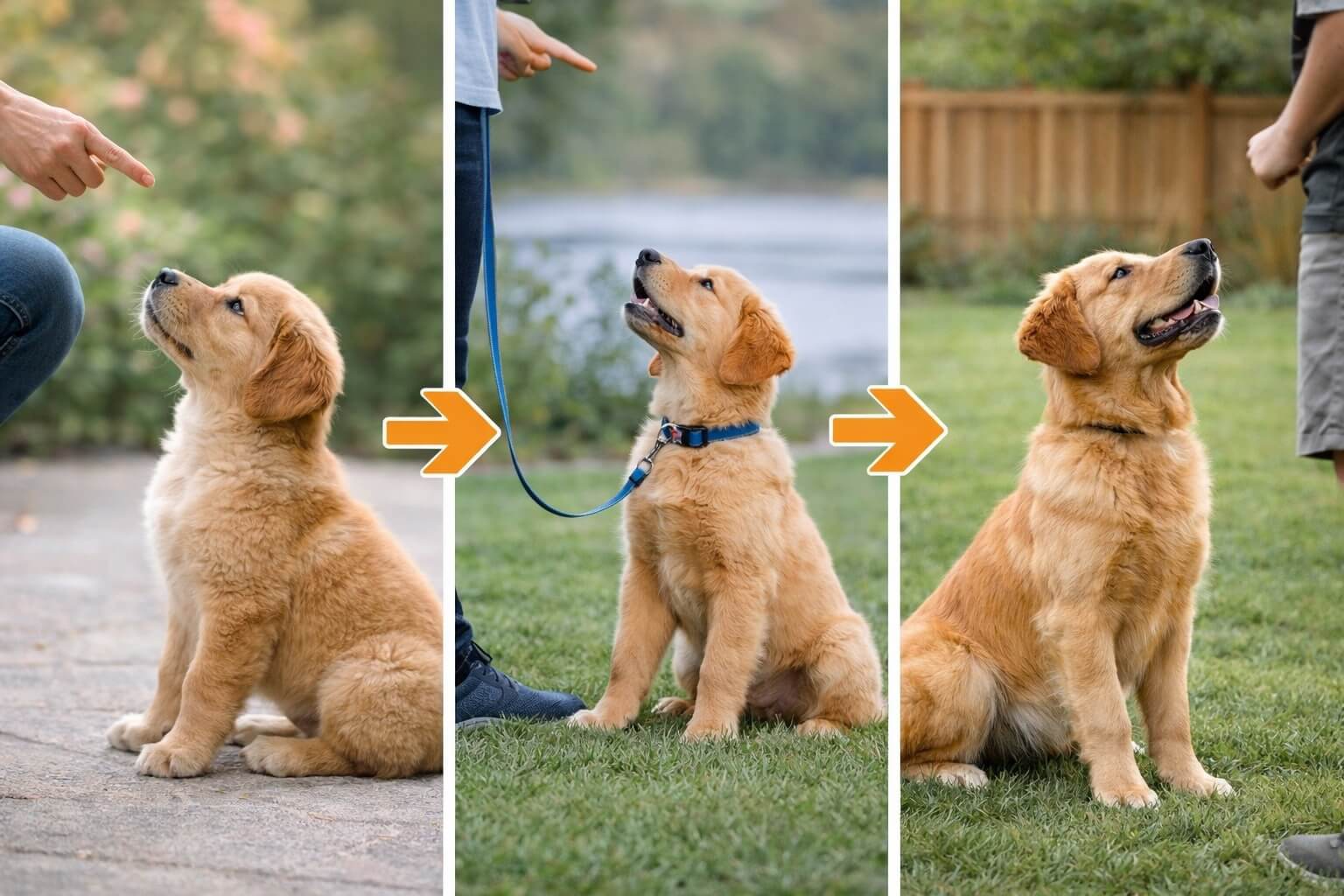
Golden Retriever Puppy Training Timeline Chart (By Age)
By JJ Allan, goldenretriever.hair
Last updated November 21, 2026
Quick answer: Start training a Golden Retriever puppy as soon as they come home, often around 8 weeks, with short 5- to 10-minute sessions and a consistent daily routine. This chart shows what to focus on from 8 weeks to 12 months, including the daily rhythm that used to live on a separate puppy training schedule page.
Sources checked November 21, 2026.
General information, not veterinary advice. This page is a training timeline and a daily-routine outline, not a medical schedule. Check house-training, vaccines, class enrollment, and longer outings with your veterinarian. If your puppy's behavior, energy, appetite, or house-training suddenly changes, check with your veterinarian. A health problem can look like a training problem.
Quick answer: Golden Retriever puppy training timeline by age
- 🐾8–10 weeks: name recognition, crate comfort, and a first sit, as soon as your puppy comes home.
- 🐾10–12 weeks: a potty routine, more sit practice, and calm handling. For break timing, use the Golden Retriever potty training schedule chart instead of copying it here.
- 🐾3–4 months: leash walking, stay, and calm socialization at your puppy's pace. See the leash training guide and the socialization guide.
- 🐾4–6 months: recall on a leash or long line, impulse control, and household manners.
- 🐾6–12 months: proof those cues in real life—walks, guests, and mild distractions—without a rigid "fully trained by" deadline.
This is a training timeline, not a growth chart. For weight and height by age, see the Golden Retriever growth chart.
Main puppy training timeline chart
Use this as an age-by-age focus chart plus a daily rhythm. Adjust for your puppy's sleep, stress, and your veterinarian's guidance. Step-by-step cue work lives in the puppy training guide and the basic commands checklist.
| Age | Training focus | Daily rhythm | Notes |
|---|---|---|---|
| 8–10 weeks | Name, crate comfort, first sit | Scheduled potty; several 5–10 minute sessions; meals on time; play, then rest | Start as soon as your puppy comes home, with positive reinforcement |
| 10–12 weeks | Potty routine, sit, calm handling | The same short-session rhythm; praise successful potty trips | The socialization window continues through about 16 weeks; keep exposures positive |
| 3–4 months | Leash walking, stay, calm socialization | Several short sessions; easy walks; new people, sounds, and surfaces at the puppy's pace | Start leash work in low-distraction places; do not flood a scared puppy |
| 4–6 months | Recall, impulse control, household manners | Train before the puppy is overtired; practice doors, meals, and greetings; age-appropriate exercise | Practice "come" on a leash or long line; sit before meals and play |
| 6–12 months | Proofing obedience in real life | Daily short sessions; cues on walks and with guests | Keep building sit, down, stay, come, loose-leash walking, drop it, and leave it. Progress is not a straight line. |
The age bands are a guide, not a week-by-week script. Puppies vary, and the AKC notes that key milestones depend on the individual dog and the home.
A daily training routine of short sessions
A useful daily rhythm looks like this: wake, go out to potty, eat on a regular meal schedule, train for a few minutes while the puppy is still fresh, play, then rest. Repeat short sessions later in the day when your puppy is awake and calm enough to think. Keep meals, potty trips, training, and sleep at roughly the same times when you can.
The AKC says to keep puppy training sessions brief—about 5 to 10 minutes—and always end on a positive note. If your puppy gets bored or frustrated, stop. That kind of session works against learning. Use small, high-value treats, praise, or a quick game as the reward, and use the same word and the same hand signal every time.
Plan exercise alongside training, not instead of it. The AKC says Golden Retrievers need daily exercise for both health and behavior, and that without enough activity they can become bored and may develop unwanted behaviors. For how energy changes with age, see Golden Retriever energy levels by age. For how much activity is appropriate, see Golden Retriever exercise needs. Do not copy those charts here, and check with your veterinarian before longer outings.
House-training timing belongs on the potty training schedule chart. Put a puppy checklist in place so the routine is easy to repeat.

Best for: short, reward-based training sessions
Zuke's Mini Naturals Training Dog Treats
Small, soft training treats that are easy to keep in a pocket for 5- to 10-minute sessions. The AKC says the foundation of puppy training should be positive reinforcement, using something your puppy values, such as small pieces of a high-value treat.
Use them to mark the moment your puppy gets the cue right, then end the session on a success.
8–12 weeks: start training when your puppy comes home
The AKC, citing certified trainer Kate Naito, says puppy training starts with two things: relationship building and structure. Training can begin as soon as your puppy comes home, often around 8 weeks, provided you use positive reinforcement. A first lesson is often a simple sit, including sitting before meals.
Name recognition belongs in these weeks too. When you practice "come," the AKC starts in a quiet indoor space and pairs the puppy's name or the cue with a treat, then builds distance slowly. Avoid repeating the name when the puppy is not responding.
Crate comfort is part of the early routine on this chart. The AKC's six-month goals include being able to stay alone for short periods in a crate or another safe, enclosed place. This page does not give a crate-training timetable; keep early crate time positive and short, and ask your veterinarian if your puppy panics or cannot settle.
This is also the main socialization window. The AKC describes the period from 8 to 16 weeks as a critical time for positive exposure to surroundings, sounds, people, car rides, vet visits, and body handling. The American Veterinary Society of Animal Behavior (AVSAB) says the primary socialization period is the first three months of life, and that puppies should get safe, well-paced exposure before they are fully vaccinated, without being pushed into fear, withdrawal, or avoidance. AVSAB also says well-run puppy classes can start as early as 7 to 8 weeks with appropriate vaccination and deworming, and that owners should avoid unsanitized, high-traffic dog areas. Check with your veterinarian before you enroll in a class or choose where to socialize. For the how-to, use the socialization guide.
The AKC adds that the first three to four months are especially important for an emotional foundation. Yelling, punishing, or forcing a puppy into scary situations can make later training harder.

Best for: the first weeks at home
Before and After Getting Your Puppy by Dr. Ian Dunbar
A book on our products page for new puppy owners, with the subtitle "The Positive Approach to Raising a Happy, Healthy, and Well-Behaved Dog." It fits this 8- to 12-week stage, when you are building a routine, a first sit, and reward-based habits.
Use it as a home reference alongside short daily sessions, not as a substitute for your veterinarian's advice.
3–4 months: leash walking, stay, and calm socialization
By this stage, keep the same short sessions and add leash manners and a longer stay. The AKC's loose-leash advice is to make the puppy comfortable in the leash first, reward walking beside you, and use the same cue every time. Start in a quiet place. The leash training guide covers the method in more detail.
Stay is a duration skill. The AKC teaches a release word, then adds time and distance in small steps, and says to make it easier again if the puppy gets up early. Work on one criterion at a time.
Socialization should stay positive and continue past the first weeks. Do not flood a scared puppy. If fear shows up, AVSAB says owners should seek veterinary guidance.
Bite redirection also comes up here. Teach what is a toy and what is not, and see the puppy biting guide if mouthing is the main problem.
4–6 months: recall, impulse control, and manners
The AKC's six-month goals, again from Naito, are practical rather than perfect:
- 🐾Polite play, including "drop it" and knowing that hands and clothing are not toys, taught with force-free methods.
- 🐾Housetraining that is still a work in progress for several months, with steady progress toward going in the right place.
- 🐾Being comfortable alone for short periods.
- 🐾A recall the puppy is happy to offer, even if it is not yet a "rocket recall."
- 🐾Impulse control that includes sitting before meals and play. If barking, jumping, or nipping is how your puppy gets attention, that habit gets harder as the puppy grows.
Practice recall on a leash or long line before you expect an off-leash "come." Train before your puppy is overtired, and keep using short sessions. Energy often ramps up in this stretch; that is not a reason to drop the routine. If habits such as jumping or chewing escalate, see the behavior problems guide.
6–12 months: proofing obedience in real life
By one year, the AKC says dogs should be making progress on the polite behaviors they will need for the rest of their lives. Those basics typically include sit, down, and stay even with distractions; coming when called, including off-leash when it is safe; loose-leash walking; and drop it and leave it. The exact list depends on your dog and your home.
Use daily short sessions, then practice the same cues on walks, when guests arrive, and around mild distractions. Progress is often uneven. The AKC is clear that it is not too late to teach a dog after puppyhood, and that positive-reinforcement training can help at any age. There is no sourced "fully trained by 6 months" deadline, and this page does not use one.
How to stay consistent with training
- 🐾Keep sessions short and frequent. Several 5- to 10-minute blocks beat one long session. End on a success.
- 🐾Use positive reinforcement. The AKC defines this as giving a reward to encourage the behavior you want—treats, praise, or play. Avoid punishment such as leash corrections or yelling, which can confuse a puppy about what you asked.
- 🐾Keep a daily schedule. Wake, potty, meals, training, and rest at roughly the same times when you can.
- 🐾Repeat the same cues. The same word, the same hand signal, and the same consequence from every person in the house. Inconsistent rules confuse puppies quickly.
- 🐾Supervise before you give more freedom. Freedom before habits exist leads to accidents and rehearsed unwanted behavior.
If your Golden seems sore, shuts down, or suddenly ignores cues they already know, pause and check with your veterinarian. Training trouble is sometimes a health issue, not a motivation issue.
Common puppy training mistakes
- 🐾Waiting too long to start. The AKC says you can begin simple training around 8 weeks, and that the first three to four months are a critical window for trust.
- 🐾One long session instead of short, frequent practice. Brief sessions that end well stick better than a marathon that leaves the puppy frustrated.
- 🐾Inconsistent rules. Different cues or different household rules undo progress.
- 🐾Training when the puppy is already overtired or overexcited. Wait for a calm, awake window.
- 🐾Unrealistic expectations. Do not expect adult-level focus in week one, or a perfectly trained dog by a fixed date.
- 🐾Punishing instead of redirecting. Especially after the fact. The AKC says punishment can make a puppy confused and unsure, and that force-free, reward-based training is the foundation.
- 🐾Skipping socialization, or flooding a scared puppy. Safe, positive exposure in the early months matters; over-facing a puppy can backfire. Check with your veterinarian about where and when to socialize.
Related Golden Retriever guides
- 🐾Golden Retriever Puppy Training Guide
- 🐾Golden Retriever Basic Obedience Training Guide
- 🐾Golden Retriever Basic Commands Checklist
- 🐾Golden Retriever Leash Training Guide
- 🐾Golden Retriever Socialization Guide
- 🐾Golden Retriever Potty Training Schedule Chart
- 🐾Golden Retriever Puppy Biting Guide
- 🐾Golden Retriever Energy Levels by Age
- 🐾Golden Retriever Exercise Needs
- 🐾Golden Retriever Growth Chart
- 🐾Golden Retriever Puppy Care Guide
- 🐾Golden Retriever Puppy Checklist
- 🐾Golden Retriever Behavior Problems Guide
- 🐾Golden Retriever Puppy Sleep Chart
- 🐾Golden Retriever Puppy Feeding Schedule Chart
Quick answers
When should I start training a Golden Retriever puppy?
You can start as soon as your puppy comes home, often around 8 weeks. The AKC says simple training can begin at that age, starting with cues such as sit, as long as you use positive reinforcement.
How often should you train a Golden Retriever puppy?
Use several short sessions during the day, when your puppy is awake and calm enough to think, instead of one long drill. The AKC recommends keeping each session to about 5 to 10 minutes and ending on a positive note.
How long should puppy training sessions be?
About 5 to 10 minutes. The AKC says to keep sessions brief, end on a success, and stop if your puppy gets bored or frustrated, because that works against learning.
What commands should a Golden Retriever puppy learn first?
Start with name recognition, sit, and a potty routine. The AKC's basic cues also include come, loose-leash walking, down, and stay, added in short steps as your puppy is ready. For house-training detail, use the potty training schedule chart.
How long does it take to train a Golden Retriever puppy?
There is no fixed deadline. The AKC says the first three to four months are especially important for building trust, housetraining can take several months, and basic skills should keep developing through the first year. Basics often improve over weeks, but reliable manners usually take many months. Dogs of any age can keep learning with positive reinforcement.
Are Golden Retrievers easy to train as puppies?
The AKC says Golden Retrievers are relatively easy to train because of their intelligence and desire to please, as long as training is consistent and sessions stay short and reward-based. Individual puppies still vary, and early socialization matters.
What should a Golden Retriever puppy's daily training routine include?
A consistent daily rhythm: wake, potty, meals, several short training sessions, play, and rest at roughly the same times when you can. Pair that with daily exercise and safe socialization, and adjust the details with your veterinarian. See the energy and exercise guides for activity, and the potty chart for bathroom timing.
Sources
- 🐾AKC: Puppy Training Timeline: Teaching Good Behavior Before It's Too Late
- 🐾AKC: Teach Your Puppy These 5 Basic Cues
- 🐾AKC: Is the Golden Retriever the Right Dog Breed for You?
- 🐾AVSAB Position Statement on Puppy Socialization
JJ Allan has many years of hands-on experience caring for and training Golden Retrievers
P.S. Get the free Golden Retriever Owner Cheat Sheet — daily feeding, sleep, and care in one printable guide.
Get the Cheat Sheet when you join the newsletter — instant access in your welcome email.