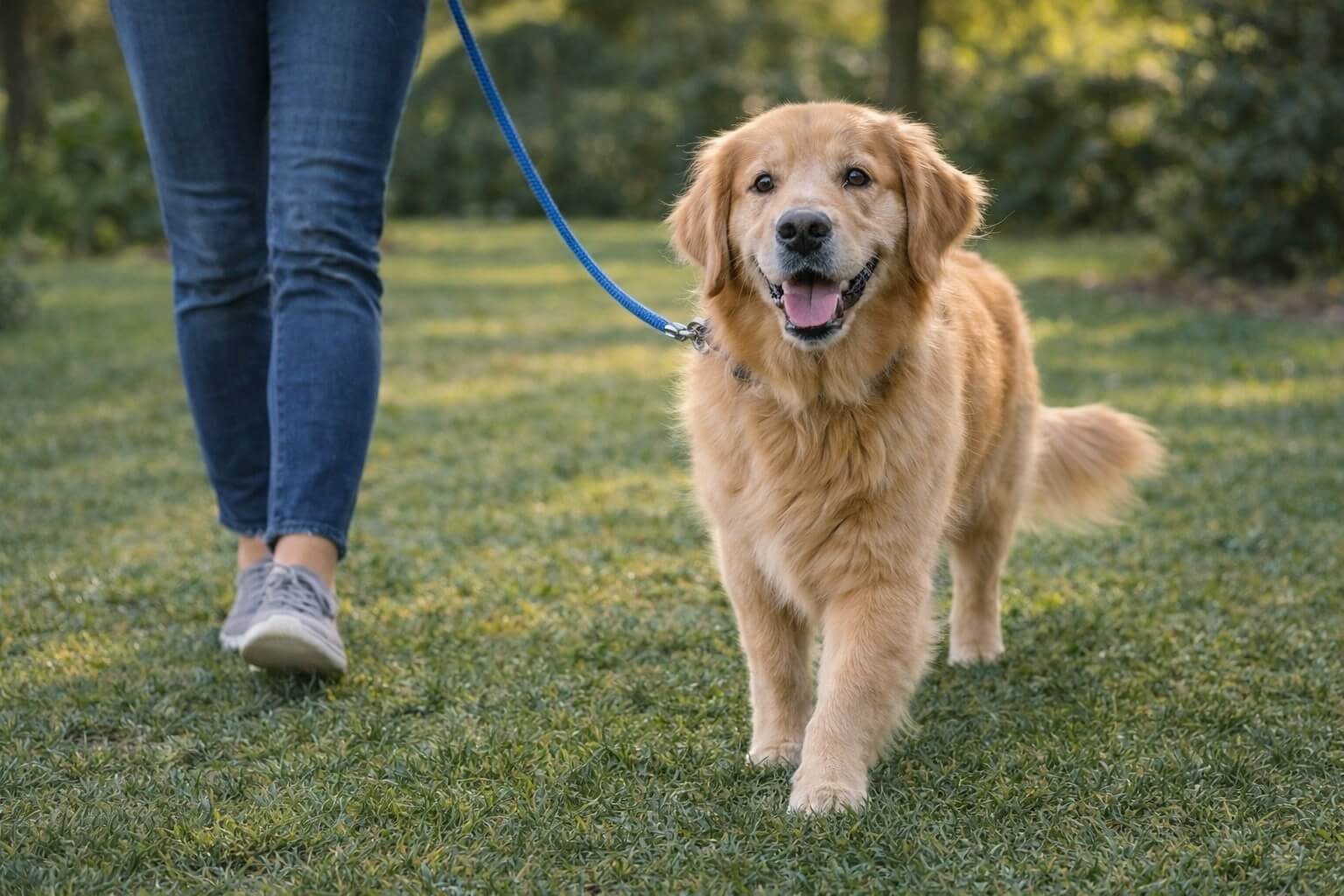
Stop Golden Retriever Pulling by Age
By JJ Allan (goldenretriever.hair)
A Golden Retriever pulls because pulling has worked. The smell, the person, or the park arrived at the other end of a tight leash, so the dog repeats it. The breed adds two complications that generic leash articles skip. Adolescent Goldens need to run, and a neighborhood walk does not spend that energy. Many of them also settle when their mouth is full, which is why leash-grabbing and greeting everyone show up in the same dogs.
The method changes with age. Karen Pryor Clicker Training says being a tree works nicely with puppies, and that it fails once an adolescent or older dog has learned that pulling pays. Owners on r/goldenretrievers and GoldenRetrieverForum.com describe the same split: stop and reset with a youngster, and turn away from a teenager who already drags you. Equipment can change where the pull points. It does not install the habit.
Choose the method by age and habit
Match the tool to what the dog has already learned. The ages below are practical bands for this guide. They line up with Pryor’s puppy-versus-adolescent split. They follow the teenage pattern owners describe from about six months through a year and a half. They also follow owner reports of pulling easing somewhere around two or three years. They are decision points, and they are open to the individual dog.
Expect this to take weeks of short daily sessions. A puppy who has not learned to pull yet can show the idea in that span, and an adult with a long pulling habit usually needs longer. Treat that as a general expectation, not a measured timetable.
| If this is the dog | Do this | Why |
|---|---|---|
| Puppy, about 8 weeks to 6 months, still learning the leash | Be a tree. Mark the slack and feed beside your leg. | Karen Pryor: being a tree works nicely with puppies. |
| Adolescent, about 6 to 18 months, and pulling already works | Turn and go, or use Penalty Yards. Run or long-line first, then teach. | Forum: teen Goldens want what they can see or smell right now, and a walk is not their exercise. |
| Any age, too fired up to eat | Back up when the leash tightens. Let a sniff be the reward. Shorten the outing. | Kikopup’s approach when food stops working. |
| A regression, or a crowded place, for a few weeks | A head halter used briefly, then retired. | Owners report a few weeks or a month or two. Some dogs hate the halter. |
| Adult, about 2 years and older, pulling is the habit | Walk away, mark the catch-up, and treat at your leg. Use a front clip while you retrain. | Pryor: being a tree does not work once pulling has been learned. |
Puppies, about 8 weeks to 6 months
Start around eight weeks, in a quiet room or yard, when a puppy is settling in at home. The first week home is the right window to let the collar or harness feel ordinary. Gear for that week is listed in the puppy checklist. Ask your veterinarian before a young puppy joins busy public dog routes.
Being a tree is the whole lesson at this age. The puppy moves ahead, the leash begins to tighten, and you stop. When the puppy turns, steps back, or otherwise puts slack in the line, mark that moment with a word or a click and feed beside your leg, where you want the puppy to be. Karen Pryor’s loose-leash page is explicit that this works nicely with puppies. Sessions stay short. A few successful steps are enough.
The Golden Retriever Rescue of Mid Florida adds a cue you can layer on once the puppy is walking with you. Say “slow down” just before the puppy reaches the end of the leash, and anchor the leash to your body so your arm does not act like a bungee. If that arm swings, the dog learns that a little more pressure buys a little more line.
Raise the difficulty the way the socialization guide raises new places: one change at a time. A new block, a single person, or a longer stretch of sidewalk. When the leash stays tight, go back to the room or the yard.
Adolescent Goldens, about 6 to 18 months
This is the age when a previously polite puppy starts hauling. On GoldenRetrieverForum.com, the description of a teen Golden is that they want what they can see or smell right now. In one r/goldenretrievers thread, an 11-month-old weighing 33 kg ignores treats at the park. Standing still and waiting that dog out is the puppy method, used on a dog Pryor says it was not built for.
Spend the energy before you teach. The same forum thread treats a neighborhood walk as too little work for a Golden, because the dog needs to run. The practical version owners are given is about 15 minutes of fetch with a ball or bumper, or a long-line session, and then a walk that is treated as training. How much running fits your dog’s age and joints is covered in the exercise needs guide. A short game, a scent search, or a sprint keeps that outing from being only a straight line at the end of a leash. Susan Garrett’s exercise article lists exercise options in that family, including nose work and a retrieve.
Once the lesson starts, turn and go. The forum version is specific. Turn and walk the other way with no words and no coaxing, and expect to stay near the house. Moving in the direction of the pull is what keeps the pull going. On the 11-month-old thread, one owner kept turning until the walk ended back at the car, and still counted the session as a success. That is the exercise working, even when the route looks ridiculous.
When a person, dog, or other distraction shows up, the Mid Florida rescue and the Dogs That podcast, episode 53, both describe walking a circle rather than marching straight at the interesting thing. The circle spends the forward rush without handing over the destination.
On a busy route, food often stops working at this age. Kikopup’s video on strong pullers still has you back up when the dog pulls, and still offer food for the slack, even if the dog is too excited to eat every piece. In that video, the reward she describes for a loose leash is access to the bushes: the dog sniffs, you say “let’s go,” and you click when the dog chooses to come along. If the park is the place treats fail, the park is too hard for the lesson that day. Practice the turn on a quieter street.
A head halter is the short-term tool owners reach for in this window, not a permanent costume. On one thread, people describe using a Gentle Leader or Halti for a few weeks, or a month or two, during a regression or in busy places, then taking it off. On another, dogs hated the halter or pushed their face along the ground. If yours face-plows or shuts down, take it off. A halter is management while the turn-and-go lesson catches up. The RSPCA says a dog has to be trained to accept a head collar, so condition it before a walk: let your dog wear it at home and eat while it is on, and only then clip the leash. Jerking a dog by the head is outside this guide.
The same “few weeks” thread includes a reset one trainer gave an owner: a nose touch, then a sit, then “let’s go,” with treats often enough that the dog stays in the game. That owner’s report was about a month of work, with some days needing many resets. Treat that as one household’s timeline, not a promise.
Adult Goldens, about 2 years and older
An adult who has pulled for years has a habit that paid off hundreds of times. Being a tree reads to that dog as a pause before the usual haul. Pryor’s replacement is to walk away, mark the moment the dog catches up, and drop the treat by your leg or slightly behind you. The food marks the place you want the shoulders, which is next to you, after the dog has closed the gap.
Keep a front-clip harness on for these walks while the habit changes. Owners who liked the Easy Walk sometimes outgrew it. Across the pulling thread and the 11-month-old thread, one person moved to a regular collar after about two years, and another said the dog stopped pulling at about three years old. The harness managed the body. The stopping, turning, and paying the slack are what changed the habit. Pryor also says to keep rewarding on a variable schedule. Fading the treats the week the leash first looks good is how the old pull comes back.
A training walk and a run are different outings
Use two setups. The training walk is a front-clip harness and a leash of about 6 feet, which is the 2 meters the RSPCA recommends. A shorter leash holds the dog at the end of the line by default, so the dog is pulling before the lesson starts. The exercise outing is the 15-minute fetch or a long line. Rescue groups, including the Golden Retriever Rescue of Mid Florida, recommend the long line for running and freedom before or between the training walks. Mixing them teaches the dog that the training leash sometimes means a tow to the park.
Harnesses, head halters, and leash length
Front-clip harnesses are the equipment change owners repeat most often. People who moved the leash from the back clip to the chest clip describe a large difference on the 11-month-old thread, this pulling thread, and this one. The same conversations warn that a back clip gives a Golden something to lean into. A harness protects the neck better than a collar when the dog pulls. The RSPCA calls a harness ideal for leash walking and training because it stops the dog pulling on, and potentially hurting, the neck. The same page says check chains, choker chains, slip collars, and prong or pinch collars must not be used, because they cause pain and can damage the neck. The Mid Florida rescue recommends avoiding prong and choke chains and using a front-clip harness instead. This guide does not use a shock collar for leash walking either. The harness comparison below is the honest version of that advice: what each piece does well, and the complaint or measurement that should keep you from buying on a slogan.
| Gear | Where it helps | The limit |
|---|---|---|
| Front-clip harness | Training walks with a dog who pulls. The chest clip is the change owners report most often. | It redirects the body. It does not teach loose-leash walking by itself. |
| Back-clip harness | A dog who already walks on a slack line, or a free run where you are not teaching leash manners. | Owners say it turned their Golden into a sled dog that pulled harder. |
| PetSafe Easy Walk | A front-clip option several owners credit while a puller is learning. | Whole Dog Journal: the strap crosses the shoulders, the martingale chest loop sags and slips, the buckle sits in the armpit and can chafe, and the company also makes shock collars. |
| 2 Hounds Freedom | An across-the-shoulder harness when the fit is actually right. | The Whole Dog Journal reviewer uses it at her training center and calls it her favorite of that style for fit and quality. An r/dogs reviewer found it solid, with a velvet-lined strap, and hard to fit on their dog. |
| Ruffwear Front Range | Handlers who want both a front clip and a back clip. Whole Dog Journal praises the build. | The r/dogs reviewer said a hard puller twists it sideways and the front fabric loop frays. A dissertation by Lauren Dowdeswell found it changed shoulder and elbow movement the most of six harnesses tested, with shoulder extension reduced by 12.7°. That cuts against “non-restrictive” marketing. The PDF is hosted by Julius-K9, so read the number with that possible bias in mind. |
| Head halter (Gentle Leader, Halti) | A few weeks, or a month or two, during a regression or in a busy place. | Then stop. Some dogs hated it or face-plowed. It is a bridge, then it comes off. |
| Leash about 6 ft / 2 m | The training walk. Room for real slack. | The RSPCA’s length is about 2 m. A short leash sets a dog up to pull. |
| Retractable leash | This guide does not use one for training walks. | The line pays out as the dog forges, so pulling still gains ground. That is the bargain the forum and Pryor tell you to stop paying. |
| Long line | Running and freedom before or between training walks. | Rescue groups, including the Golden Retriever Rescue of Mid Florida, recommend it for that job. The loose-leash lesson stays on the shorter leash. |
A short gear list for the two-outing setup:
- 🐾Front-clip harness for the training walk
- 🐾Leash of about 6 feet (2 meters)
- 🐾Long line for the run
- 🐾Ball, bumper, or other toy for the mouth
- 🐾Small treats the dog will still eat outside
Treats and the Easy Walk we actually use are on the training products page. Fit any harness on a standing dog, watch the dog move, and stop if a strap rubs or the gait changes.
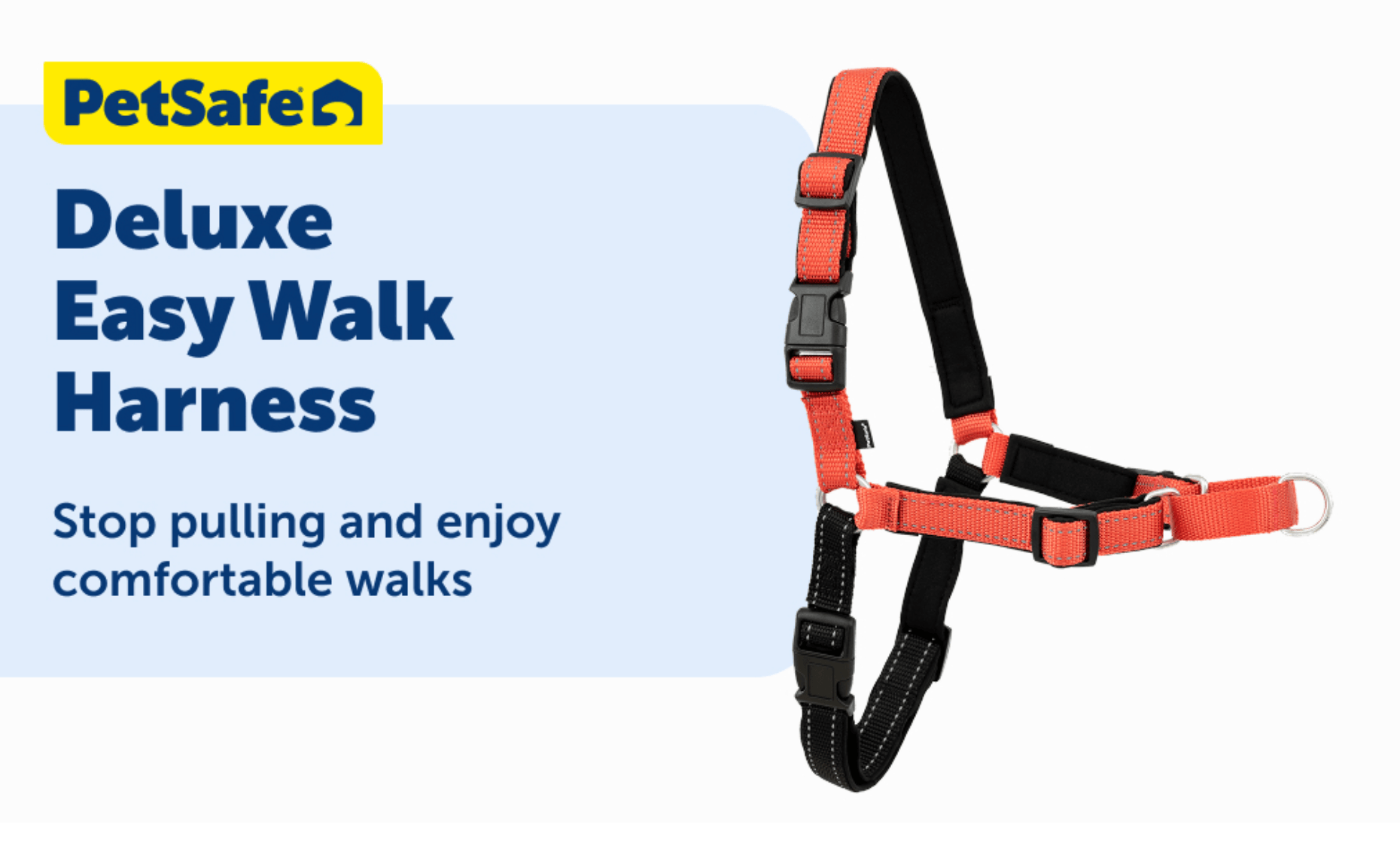
PetSafe Deluxe Easy Walk Harness
This is the front-clip harness on our training list, and it is the Easy Walk style several Golden owners credit while a dog is learning. Whole Dog Journal’s review is the counterweight: the strap crosses the shoulders, the martingale loop can sag, the buckle can chafe in the armpit, and PetSafe also sells shock collars.
Choose the size from the current manufacturer chart and fit it while the dog is standing. It can make a pull easier to steer. The turn, the stop, and the reward for slack are still the training.
Give the mouth a job
Goldens grab leashes, carry shoes, and show up to greetings with something already in the mouth. On the toy-carrying thread, owners describe that as a common Golden habit: something in the mouth calms the dog, and people encourage it during greetings so the dog stays easier to handle. The American Kennel Club’s article on dogs who tug leashes gives mouthy breeds a ball or toy to carry on the walk, and uses a short tug game on that toy as the reward for leaving the leash alone.
The leash itself is the wrong tug toy. When a Golden grabs the leash, especially at the end of a walk or outside a park, the GoldenRetrieverForum.com thread on adolescent fits says to step on the leash, turn your back, and not tug. When the line goes slack, ask for a sit and praise. Dogs Out Loud says the same thing in equipment terms: never tug back, hold the leash low, or clip a second leash so you can switch off the one in the mouth and keep a connection. Playing tug on the leash is one of the ways the grabbing continues.
Use the retrieve as the reward
A Golden’s retrieve is useful on a leash because it is a reward the dog already wants. The forum’s 15 minutes of fetch with a ball or bumper, done before the training walk, is the same drive used so the lesson does not have to compete with an unspent sprint. Kikopup’s sniff is the quieter version of that bargain: slack line, then the bushes, then “let’s go.”
Rotate the reward with the dog in front of you. Food beside your leg when the dog is able to eat. A sniff when the environment is the paycheck. A 10-second tug or a thrown bumper when the dog has just walked a slack stretch and you want the retrieve to confirm it. The game happens after the slack, on a toy, so the leash is never the thing being pulled.
Greeting everyone
The person on the sidewalk is the distraction a Golden is most willing to tow you toward. Letting the tight leash arrive at that person is the reinforcement the forum warns about: the direction of the pull delivered the greeting. Turn away while the line is tight. Walk a circle, as the Mid Florida rescue and Dogs That describe, until the dog can approach on a slack line. If the person is willing to wait, the greeting is the reward for the slack, in the same way the treat bowl is the reward in Penalty Yards.
Something in the mouth makes that moment easier for a lot of Goldens. The toy-carrying thread is where owners say they encourage it during greetings because the dog stays calmer. Four paws on the floor is a separate skill, covered in the jumping guide. A carried toy does not replace that practice. It gives the mouth a job while you do it.
Mistakes that keep the leash tight
Following the dog is the expensive one. Every time a tight leash still arrives at the corner, the person, or the park, the pull gets another repetition. Pryor and the forum describe the same fix from two angles: be a tree only with a puppy who has not learned the game yet, and otherwise leave in the other direction.
Holding the leash short, or letting your arm swing, recreates a tight line even when your feet are doing the right thing. The RSPCA’s case for about 2 meters of leash, and the Mid Florida rescue’s instruction to anchor the leash to your body, are the equipment half of that mistake.
A back-clip harness on a dog who already pulls gives the dog a towing point. Owners who switched to the chest clip did it because the back clip had made the hauling worse.
Treating the walk as the exercise, especially from six to eighteen months, asks a lesson to do a sprinter’s job. Run first.
Tugging back when the dog grabs the leash, or starting a tug game with the leash as the toy, is the mouth version of following the pull. Step on the line or switch to the second leash. Save tug for the toy, and only after the leash is out of the mouth.
Stopping the treats the first week the walk looks easy undoes the variable reward Pryor tells you to keep. An intermittent treat, a sniff, or a short retrieve is what holds the slack after the behavior is familiar.
Some popular owner advice, including on one of the pulling threads, uses leash pops or jerks. This guide does not teach that. The methods here are the ones from Pryor, the Mid Florida rescue, Kikopup, and the forum threads linked above.
When it is not ordinary pulling
A dog who is too excited to eat is still a leash-training dog. Kikopup’s version is to back up, keep offering food for the slack, and let sniffing carry the reward. A dog who freezes, bolts, or lunges and cannot recover is a different problem. Create distance, end the lesson, and get help from a reward-based trainer or behavior professional. The behavior guide is the on-site starting point for that pattern.
A limp, a yelp, a sudden refusal to walk, or a gait that changes during the session is a veterinary question. Stop the walk.
Sources
Puppy versus adolescent method, marking the catch-up, and where to drop the treat: Karen Pryor Clicker Training, loose-leash walking. The “slow down” cue, anchoring the leash, walking a circle when a distraction appears, and a long line for running and freedom: Golden Retriever Rescue of Mid Florida. The circle also shows up in Dogs That, episode 53.
Adolescent Goldens, running before the walk, and turning away with no coaxing: GoldenRetrieverForum.com, loose-leash training. Leash-grabbing at the end of a walk: the forum thread on adolescent fits. Mouthing the leash, holding it low, and using a second leash: Dogs Out Loud. Carrying a toy, and a short tug on that toy as the reward for leaving the leash: American Kennel Club.
Owner reports on front clips, back clips, the Easy Walk, and head halters are paraphrased from r/goldenretrievers threads on pulling, another pulling discussion, a smaller thread, and a regression thread. Toy-carrying and calmer greetings: the toy thread. Freedom harness and Front Range owner notes: r/dogs.
Harness pros and cons for the Easy Walk, the 2 Hounds Freedom, and the Ruffwear Front Range: Whole Dog Journal’s harness review. Shoulder and elbow measurements, including the 12.7° figure for the Front Range: Lauren Dowdeswell’s dissertation, hosted by Julius-K9. Strong pullers, sniffing as the reward, and backing up when food fails: Kikopup. Penalty Yards: Blue-9, written up here. Nose work and retrieve as exercise options: Susan Garrett. Leash length of about 2 meters, a harness so a pulling dog is not loading the neck, and no check, choke, slip, or prong collar: RSPCA.
P.S. Get the free Golden Retriever Owner Cheat Sheet — daily feeding, sleep, and care in one printable guide.
Get the Cheat Sheet when you join the newsletter — instant access in your welcome email.