Golden Retriever Socialization
By JJ Allan (goldenretriever.hair)
The puppy care guide is the health page. It already covers AVMA's critical period of 3 to 14 weeks, the vaccine series, deworming, growth, coat handling, and how long a walk can be. This page covers the practice: who and what the puppy meets, in what order, how a class decides to let a puppy in, and what to do when the puppy is afraid. Cues, session length, housetraining, the clicker, and the stuffed toy are the puppy training hub. The veterinarian sets which of these outings are allowed. A friendly breed reputation does not replace them.
This guide is general information, not veterinary advice. Your veterinarian sets the vaccine plan and which outings are safe for this puppy where you live. Follow those recommendations for shot dates, deworming, and same-day illness calls. This page gives no medication doses. Call the clinic the same day for a puppy who is fearful or aggressive.
Where the other guides start
Health stays on the puppy care guide, including the vaccine card and the length of a walk. The temperament guide is the breed's reputation for friendliness. VCA's socialization and fear-prevention page says personality also depends on genetics, the mother's behavior and health, nutrition, and the early environment. A Golden who came from a steady litter still needs the outings. An aptitude test is a guideline. VCA says it is not a guarantee, and a puppy who is already fearful or easily frustrated is likely to keep those traits. Socialization is still the best chance that puppy gets.
The first days in the house are the first-week guide. Sit, down, come, the crate, and bite inhibition are the training hub. Sidewalk position is the leash guide. Outdoor come is the recall guide. The car as its own place is the car travel guide. Elevators, hallways, and a shared building are the apartment guide. Panic when you leave is the separation anxiety guide. Fear that has already become lunging, hiding, or aggression is the behavior guide, and it is a veterinary question before it is a longer walk.
The early window is real, and the end dates differ
The AVSAB position statement on puppy socialization calls the first three months of life the primary and most important time. In those months, sociability outweighs fear. The statement asks owners to expose the puppy to as many new people, animals, stimuli, and environments as can be done safely, without overstimulation. AVSAB defines overstimulation as excessive fear, withdrawal, or avoidance. Incomplete socialization, it says, can increase fear, avoidance, and aggression later. Keep going after three months. The statement says owners of older puppies should continue, and it says exposures should continue into adulthood.
AVMA's selecting-a-pet page puts the critical period at 3 to 14 weeks. Proper socialization in those weeks has a big impact on behavior for the rest of the dog's life. Frequent positive contact with people and other dogs, early, makes later interactions easier. Puppy classes, where the community offers them, are one way to get that contact and to learn basic cues. AVMA also says eight to ten weeks is an ideal age to bring a puppy to a new home, and that isolating a dog from interaction is one of the worst things an owner can do.
VCA draws the sensitive period for socialization as 3 to 16 weeks. It says the first socialization happens with the mother and the littermates, and that puppies should stay with them until 7 to 10 weeks, depending on breed and maturity. That is VCA's range for leaving the litter. It is a different sentence from AVMA's "eight to ten weeks is an ideal age to move." Use the one your veterinarian and the breeder or shelter are actually following. VCA also says that even after 16 weeks, social contact should continue, and that adolescence, from 6 to 18 months, still needs calm, positive experiences.
A 1961 paper in Science is the study people often mean when they talk about a closing window. Freedman, King, and Elliot kept litters with the mother in a fenced field and brought puppies indoors, at different ages, for a week of handling, then returned them to the field. The abstract reports a growing tendency to withdraw from people after five weeks of age. It also reports that when socialization had not occurred before 14 weeks, withdrawal became so intense that normal relationships could not be established afterward. That was an isolation experiment. It is not a plan for a pet home, and it is not a reason to keep a puppy away from people. Set its window beside AVSAB's, AVMA's, and VCA's. The four do not share one end date.
Touch is an exposure of its own. Brushing, nails, and the short coat passes are the puppy care guide. AVSAB wants every body part handled from birth, plus new surfaces, steps, simple obstacles, and car trips. VCA says puppies who are stimulated and handled from birth to five weeks are more confident and more likely to be social. For a puppy who comes home at about eight weeks, the breeder or the shelter did that first stretch. You continue with paws, ears, mouth, and a collar, paid with food. If the puppy stiffens or tries to leave, that body part is done for the day.
Vaccines, classes, and the places to skip
Follow your veterinarian's recommendations for this puppy's vaccines, deworming, and which public places are safe before the series is complete. Local disease risk is a clinic decision.
AVSAB states the tradeoff in plain language. Behavior problems, it says, are the greatest threat to the owner-dog bond. They are the number one cause of relinquishment to shelters. And, rather than infectious diseases, they are the number one cause of death for dogs under three years of age. The statement cites Miller and colleagues in JAVMA in 1996 for that comparison. The statement does not give a percentage. AVSAB's conclusion is that maternal immunity, the primary vaccination series, and appropriate care make the risk of infection relatively small beside the chance of death from a behavior problem. Socialization before the puppy is fully vaccinated should be the standard of care.
The class rule in that same statement is specific. Classes can start as early as seven to eight weeks of age. The puppy needs a minimum of one set of vaccines at least seven days before the first class, and a first deworming, and stays up to date for the rest of the class. Every puppy in the room should be up to date, free of disease, and free of parasites. AVSAB prefers a surface that can be cleaned and disinfected, which usually means indoors. It says to avoid dog parks and other places that are not sanitized, that are heavily trafficked, and where you do not know the other dogs' vaccines or health.
VCA describes a different entry rule, and it is worth keeping separate. On VCA's page, a puppy class should be easy to clean and disinfect. Puppies should be up to date on vaccinations and boosters and free of intestinal parasites. VCA also wants the puppy to have been in the new home at least ten days and to have appeared healthy in that time. A sick puppy stays home. VCA says the common advice to wait until the full series is finished is a misconception, because by then the sensitive period it describes, 3 to 16 weeks, is over. It says the benefits of early public experience usually outweigh the risk of illness, and it still tells owners to ask the veterinarian about infectious disease in their own area and to follow that clinic's schedule. Avoid unvaccinated dogs and groups of dogs you do not know. VCA names dog parks as that kind of group.
Show the clinic the class before you enroll, so the seven-day gap in AVSAB's rule, or the ten healthy days in VCA's rule, is a real date on this puppy's record. The series, why a combination course often finishes at 16 weeks or later, the deworming calendar, and the appointment cadence are the puppy care guide. AAHA's 2019 new-puppy checklist puts socialization, puppy classes, and happy veterinary visits on the list of things to discuss at those visits. For this page, a happy visit is a short stop for food and a calm hello, on a day the veterinarian has already cleared the puppy to be out.
One survey is often quoted as proof that class "works" by some large percent. Duxbury, Jackson, Line, and Anderson followed 248 adult dogs who had been adopted from a humane society as puppies. The abstract reports higher retention in the home for dogs that had attended the society's puppy socialization classes, and for dogs that had been handled often as puppies. It does not give a percentage or an odds ratio. The authors suggest that veterinarians may recommend enrolling puppies of 7 to 12 weeks in early learning and socialization classes. The same survey also associated higher retention with being female, wearing a headcollar as a puppy, responding more readily to cues, sleeping on or near the owner's bed, and living in a home without young children. Those are associations in one group of adopted dogs, not a gear list. A headcollar is not a socialization tool here.
How one outing should feel
Pick one new thing. A new person, or a new floor, or a new sound. Stacking all three on the same afternoon is how a short trip becomes too much. VCA's guideline is at least two new places a week, each with one new thing at a time. One day might be a hallway floor and a visitor who sits and waits. The next might be the same parking lot: the last easy distance if the first day was hard, a step closer if the puppy ate and stayed loose. A known, gentle, vaccinated dog is a later week. Hats, canes, and wheels stay far away until people without those extras are easy. Start far enough that the puppy can take food and keep a loose body. If the puppy stays calm, move a little closer. If the puppy looks worried, add distance and end the outing. VCA says the puppy sets the pace.
People should include different sizes, ages, and colors, then the ordinary oddities of a sidewalk: hats, canes, men, women, and children old enough to be gentle. VCA says a stranger should not reach for the puppy. The puppy approaches. Hand a treat to the person who wants to say hello, so the greeting is food from a still hand. Being passed from lap to lap is too much handling for one visit. One calm person who lets the puppy leave is a better rep than a circle of hands.
Other dogs are a narrower list than "any dog at the park." VCA wants other puppies, and healthy, vaccinated adult dogs you already trust to be gentle. Ask that owner first. One known dog beats a group. VCA warns that a growl or a snap from an unfamiliar adult can permanently traumatize a sensitive puppy, even when there is no physical injury. Dog parks fail that test on both AVSAB's terms and VCA's. So do festivals, patio crowds, and any place where you cannot see the other dog's health.
Places start at home. Different floors, a step, a doorway, the crate as a bed rather than a penalty. The crate method is the training hub. AVSAB includes car trips in the exposure list. The first ones can be a loop around the block with food, once the veterinarian is comfortable with that puppy leaving the yard. How the car itself stays safe is the car travel guide. A quiet sidewalk and a friend's yard come before a busy store. The clinic parking lot, as a treat stop, is the happy visit from the section above. The class, once the clinic agrees, is the structured version of the same idea: vaccinated puppies, a floor that can be disinfected, and a teacher using food.
Sounds start as the house the puppy already lives in. A sound the puppy ignores can stay in the background. A sound that startles the puppy ends that session. Take the puppy somewhere quieter. VCA's line on habituation is that it only holds when the stimulus is not frightening. If the puppy is frightened, remove the puppy and get guidance before you try that stimulus again. Desensitization, in VCA's description, is a low-level version of the same thing, raised only while the puppy stays relaxed. A high level of fear needs a professional plan.
AVSAB wants the payment to be praise, petting, play, treats, or some mix of those. It says positive, consistent training is associated with fewer behavior problems and greater obedience than punishment or dominance methods. The training hub is where the marker, the five-minute session, and the cues live. This page only needs the food in your hand while the world goes by.
A practical order, by age
Use the windows above when someone asks "when does it close." Use the table when you are deciding what to try this week. A quiet puppy, a puppy who missed the early weeks, or a puppy the veterinarian has restricted stays on an easier row for longer. If the puppy will not take food, trembles, or tries to leave, VCA's signs say the situation is already too much. Add distance and try an easier version another day.
| Age | What to introduce | How | What to skip |
|---|---|---|---|
| 8 to 12 weeks | Family handling, household noises, brief car rides, visitors at the puppy's pace, floor textures at home | Short sessions. Food. The puppy chooses to approach. Calm praise. | Dog parks, crowded events, dogs whose health you do not know, being passed hand to hand, forcing a scary thing |
| 3 to 4 months | More people, including hats and wheels at a distance, quiet public spaces, one gentle known dog, mild new sounds | Change one variable at a time. Keep the leash on in easy places first. | Long outings, off-leash chaos, forced greetings |
| 4 to 6 months | New walking routes, polite greetings, a repeatable car routine | Reward calm behavior. Repeat a success before you add difficulty. | Flooding, punishment while the puppy is scared, rough play with unknown dogs |
| 6 months and older | The places the adult dog will actually use, kept easy enough for an adolescent | VCA's adolescence window is 6 to 18 months of calm, positive experiences. If the puppy regresses, return to an easier version. | Treating socialization as finished |
A socialization outing stays short. How long the puppy can be on its feet, and why stairs and long runs wait, is the puppy care guide.
When the puppy is afraid
VCA lists the signs in ordinary language. The puppy takes a treat and backs away. The puppy trembles. The puppy will not play or will not eat. The puppy tries to escape or pulls away. If the puppy is only tentative, VCA says not to coax a string of approaches. Do not force the puppy to stay with the thing that frightens it. Do not push the puppy into a greeting. VCA says never to force a puppy to "face his fears" or thrust it into new situations when it seems panicked or fearful. The training hub calls that flooding. The alternative is a smaller step that still earns food, or a stop.
A single startle can be the end of that item for the day. A puppy who is afraid across outings, who hides from people, or who has growled or snapped needs a plan built for that dog. AVSAB says owners of fearful puppies should seek veterinary guidance. VCA says the same for a high level of fear: a customized plan and professional guidance, not another public trip. The behavior guide is the map of what that referral looks like. Punishment while the puppy is scared teaches the puppy that the scary thing predicts a correction. It does not teach the puppy that the thing is safe.
A little time alone
Socialization includes the absence of novelty, too. AVSAB says to schedule play alone with a favorite toy, including a toy stuffed with food, or a nap in a crate or a pen. The point is a puppy who can amuse itself, and who is less likely to become over-attached. The statement says that a wide variety of experiences through the first year may help prevent separation-related behavior, citing Bradshaw and colleagues in the Veterinary Record in 2002. The crate has to stay a comfortable place. The training hub teaches that. If leaving the house produces panic, the separation anxiety guide is the page to read, and the clinic is the call to make. The training hub covers the stuffed toy.
When to call
Follow your veterinarian if this puppy is fearful, has growled or snapped, or seems ill before or after an outing. The clinic decides whether the next step is a vaccine check, a rest from public places, or a referral.
Fear and aggression are this page's reason to call. A puppy who was fine in the yard and is suddenly afraid of people, or who has growled or snapped, needs the clinic before another public trip. AVSAB sends fearful puppies to veterinary guidance. The veterinarian decides whether a behavior problem needs medication. Any dose comes from that exam. Do not give a human painkiller.
Illness is the puppy care guide's same-day list: a quiet puppy, vomiting, watery or bloody stool, a limp, trouble breathing. Use that list before the next outing. Ask the clinic which class, if any, fits the local disease risk, and ask again if the puppy misses a vaccine date, picks up a parasite, or has been around a sick dog. A puppy the veterinarian has told you to keep home stays home, even when the calendar says the window is open. The window is a reason to use the safe exposures. It is not a reason to ignore a medical restriction.
A pouch and a long line
The outing needs treats in your hand and a way to keep distance without dragging the puppy into a greeting. Check the size on the listing before you buy. The clicker, the session length, and the rubber toy you stuff for crate time are the puppy training hub.
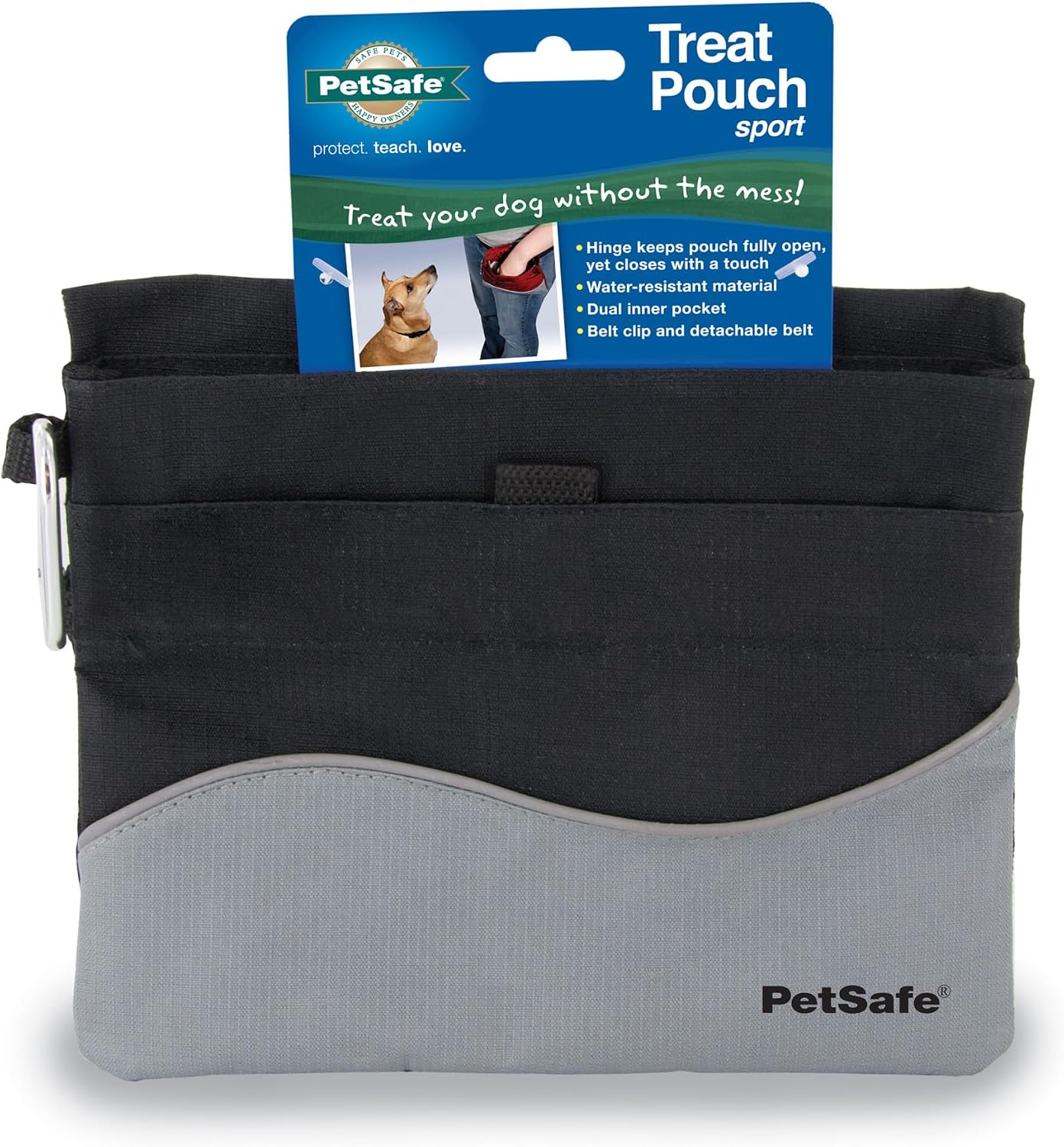
PetSafe Treat Pouch Sport, black, Standard
A belt pouch for the treats you hand to a greeter, or pay the puppy for looking at something new and staying loose. The Standard size is 7.5 inches long by 6.5 inches high. The pocket stays open while you feed. Fill it with small training treats, not the whole dinner. The five-minute session and the marker are the puppy training hub.

MayPaw rope leash, purple, 1/2 inch by 30 feet
A long line so the puppy can watch a person, a dog, or a street from a distance you choose, while you still hold the handle. This one is a 1/2-inch rope, 30 feet long, in purple, with a soft handle. Shorten it when the puppy stays relaxed. Do not tie a puppy out on it, and do not use 30 feet as the sidewalk leash. Outdoor come on a long line is the recall guide.
Questions owners ask
When should I start socializing a Golden Retriever puppy?
Inside the house, the week the puppy comes home. Anything public waits on the veterinarian. AVMA's critical period is 3 to 14 weeks. AVSAB's primary window is the first three months, and VCA's sensitive period is 3 to 16 weeks. VCA wants puppies with the mother and littermates until about 7 to 10 weeks. AVMA calls eight to ten weeks an ideal age to move to a new home. Those last two are different sentences. Your veterinarian and the source of the puppy set the move-in day.
Can I take my puppy out before the vaccines are finished?
AVSAB says yes. It calls socialization before full vaccination the standard of care, with its class rule: one set of vaccines at least seven days before the first class, a first deworming, and a current record after that. VCA says waiting for the last vaccine means missing the sensitive period it describes, and it still says to follow the clinic's reading of local disease risk. VCA's own class checklist wants vaccines and boosters current, a negative fecal test, ten healthy days in the new home, and a cleanable room. Dog parks and unknown dogs are out on both pages. The shot dates themselves are the puppy care guide. Follow your veterinarian on which of these outings are allowed.
Why do the guides disagree about 12 weeks, 14 weeks, and 16 weeks?
They are measuring different statements. AVSAB says the first three months. AVMA says 3 to 14 weeks. VCA says 3 to 16 weeks. The 1961 Science abstract says withdrawal from people increased after five weeks, and that socialization before 14 weeks was required in that isolation study. None of those sources prints the table on this page. The table is a practical order for owners.
Are dog parks a socialization plan?
No. AVSAB tells owners to avoid dog parks and other unsanitized, busy places where the other dogs' vaccines and health are unknown. VCA tells owners to avoid groups of unknown dogs, and it names dog parks. A growl or a snap from an unfamiliar adult can frighten a sensitive puppy even without an injury. Use one gentle, known, vaccinated dog, with that owner's permission.
What if my puppy is scared of people or noises?
End the outing. VCA's signs are a treat taken and then a retreat, trembling, refusing food or play, and trying to leave. Do not coax repeated approaches, and do not force the puppy to stay until the struggling stops. AVSAB wants veterinary guidance for a puppy who is already afraid. A high level of fear needs a professional plan. The behavior guide is the next page, after the clinic.
Do I stop at four months?
Keep going. AVSAB says puppies past three months still need socialization, and that varied experience should continue into adulthood. VCA says the same past 16 weeks, and it names adolescence, 6 to 18 months, as a time for calm, positive experiences. A teenage Golden who suddenly finds a familiar thing hard goes back to an easier distance. That regression is a reason to simplify the outing.
When is this a veterinary problem?
The same day, for fear or aggression that is more than a single startle, and for a missed vaccine that changes what the clinic allows. A quiet puppy, vomiting, watery or bloody stool, or a limp is a same-day call, as in the section above. The veterinarian sets the vaccine plan and decides whether public places are on hold. If a behavior problem needs medication, it comes from that exam.
Sources
The first three months, socialization before full vaccination as the standard of care, the seven-to-eight-week class rule with one vaccine set at least seven days prior and a first deworming, dog parks to avoid, and the behavior-problem comparison that cites Miller and colleagues, JAVMA 1996: AVSAB, puppy socialization position statement (2008).
The sensitive period of 3 to 16 weeks, staying with the litter until 7 to 10 weeks, twice-weekly new places, fear signs, dog parks and unknown dogs, the class checklist, and adolescence from 6 to 18 months: VCA Animal Hospitals, puppy socialization and fear prevention.
The critical period of 3 to 14 weeks, eight to ten weeks as an ideal age to move, and puppy classes: AVMA, selecting a pet dog.
Socialization, puppy classes, signs of fear, and happy veterinary visits on the new-puppy discuss list: AAHA, 2019 new-puppy checklist (PDF). Visit cadence and the vaccine series are the puppy care guide.
Withdrawal from people increasing after five weeks, and socialization before 14 weeks in that isolation study: Freedman, King, and Elliot, Science, 31 March 1961, volume 133, issue 3457, pages 1016 to 1017, doi:10.1126/science.133.3457.1016.
Higher retention, with no percentage printed in the abstract, among 248 adopted dogs who attended puppy socialization classes or were handled often, and a suggestion to consider classes at 7 to 12 weeks: Duxbury, Jackson, Line, and Anderson, JAVMA 2003, volume 223, pages 61 to 66, abstract.
P.S. Get the free Golden Retriever Owner Cheat Sheet — daily feeding, sleep, and care in one printable guide.
Get the Cheat Sheet when you join the newsletter — instant access in your welcome email.