
Golden Retriever Skin Problems
By JJ Allan (goldenretriever.hair)
The coat hides the skin. A Golden can look merely dusty, or just out of the water, while the skin underneath is scaling, infected, or growing a lump you will not feel until the hair is parted. Itch has its own page. Environmental allergy, food allergy, and the long workup live on the allergies guide. This page is the rest of the skin: the genetic scale bred into the Golden Retriever, ordinary dandruff that has a different cause, hot spots, bacterial and yeast infection, the parasites that still have to be ruled out, the thyroid pattern, and the lump that feels like fat.
This guide is general information, not veterinary advice. Scale, itch, odor, hot spots, and lumps are individual. Your veterinarian chooses the tests and any treatment. This page gives no medication doses. Call the clinic the same day for a moist sore that is spreading, a bad smell from the skin, a young dog with heavy scale, hair loss together with weight gain, or a new lump.
Parting the coat
Merck's page on topical treatment says the coat should be combed through for loose hair and undercoat before a medicated bath, and that good grooming can shorten a skin case. That combing is also how you see the skin. A Golden's feathering lies over the armpit, the groin, the ears, and the tail base. Those are the places moisture and scale collect. The grooming guide is the full brushing sequence. The shedding guide is the heavy shed. The best brushes guide compares tools. This page only needs the pass that reaches skin.
Stop when the comb scrapes, the skin turns red, or you find a moist patch. VCA's hot-spot page says a sore can hide under a mat, and that matted fur keeps water against the skin after a swim or rain. Pulling a mat out of inflamed skin makes the wound bigger. The hot spots guide takes it from there.

Hertzko dematting comb
A handled comb with two rows of long metal teeth, sold for mats and tangles. On a Golden, use it to lift a small section until you can see skin, then move on. Keep it off a sore, an ear flap that is already red, and any mat that is tight against inflamed skin. Those go to the clinic or a groomer the veterinarian is comfortable with. The brushes guide is the everyday slicker. This comb is the tool for the knot you cannot see through.
Ichthyosis in Golden Retrievers
A DNA result and a handful of flakes are not a diagnosis by themselves. Your veterinarian matches the test to the dog in front of them. This section gives no treatment dose.
Ichthyosis is a failure of the outer skin layer, so scale keeps forming. The UC Davis Veterinary Genetics Laboratory describes the Golden form as mild to moderate scaling, severe in some dogs, usually leaving out the head, the legs and feet, the paw pads, and the nose. Scales start whitish and darken to gray or black, small or large. Pigmented scale sticks in the coat and can make the dog look dirty. Signs have been seen as early as 3 to 6 weeks. In other dogs they stay quiet for months or years. The laboratory says early scale is easy to miss because this breed's version is often milder than ichthyosis in other breeds.
Both known variants are autosomal recessive. The laboratory's result names are N for normal, Ich1 for the first variant, and Ich2 for the second. A dog with N/N has neither variant. A dog with one copy, N/Ich1 or N/Ich2, is a carrier and is not expected to develop ichthyosis. A dog with two copies, Ich1/Ich1 or Ich2/Ich2, is expected to develop it, and the laboratory says the look can still vary. If two carriers are bred, the laboratory's prediction is that about 25 percent of the puppies will be affected and about 50 percent will be carriers. That is the Punnett square for a recessive trait. It is not a forecast for a particular litter until both parents have been typed. Affected dogs of either type should be examined. Results can be filed with the Orthopedic Foundation for Animals. The test is breed-specific. It does not read the ichthyosis variants of other breeds.
The PNPLA1 variant
The first variant is an insertion-deletion in PNPLA1, the patatin-like phospholipase domain-containing protein 1 gene. Grall and colleagues, Nature Genetics, 2012, used Golden Retrievers with a lamellar ichthyosis that resembles human autosomal recessive congenital ichthyosis. They found a homozygous indel that produces a premature stop codon in every affected Golden in that study, then found PNPLA1 mutations in two human families with the same class of disease. The paper's point is the gene and the epidermal lipid barrier.
UC Davis, summarizing that work, says 360 Golden Retrievers were typed and the variant matched disease status exactly, and that the same variant was absent in 300 healthy dogs from 25 other breeds. The laboratory also says the researchers reported the variant at high frequency in the breed, and it prints that frequency as 50 percent. Read that figure as a variant frequency from the study the laboratory is summarizing. It is not a count of Goldens who have scaling skin, and a dog with one copy is not affected. The laboratory's own advice to breeders, given that frequency, is to move away from the variant over generations rather than to dump carriers in a single season. Dogs with two copies still need a clinical exam, because the amount of scale varies.
The ABHD5 variant
Some Goldens with ichthyosis are not explained by two copies of the PNPLA1 variant. Kiener and colleagues, G3, 2022, studied 14 Golden Retrievers with nonepidermolytic ichthyosis who were not homozygous for the PNPLA1 mutation. Histology showed lamellar orthokeratotic hyperkeratosis and a mildly hyperplastic epidermis. The variant they identified is a 14-base-pair deletion in ABHD5, written c.1006_1019del, which shifts the reading frame. All 14 affected dogs were homozygous. The 11 parents who could be typed, obligate carriers, were heterozygous. The deletion was absent in 396 Golden Retrievers of European origin. The authors say the form, which they named Golden Retriever ichthyosis type 2, so far appears limited to North American dogs.
The clinical note in that paper matters, because it is not identical to the "spares the head" summary. Affected dogs had large white-to-gray scale, powdery to adherent, through the coat. Abdominal skin was mildly hyperpigmented. Thick white scale stuck to the inner surface of the ear flap. Experienced breeders told the authors that ICH2 scale was more severe and more adherent than PNPLA1 scale, and the epidermis on biopsy was thicker. UC Davis says the two diseases look similar clinically and on biopsy, with that breeder report of heavier ICH2 scale, and it sells the two tests separately. A dog can be clear of one and affected by the other. Order both if the question is "does this Golden carry a known ichthyosis variant?"
Ichthyosis is one cause of scale. Yeast, fleas, mites, and thyroid disease are others, below. A homozygous result in a dog who also itches still needs cytology and a parasite check. A clear result in a young dog with heavy pigmented scale does not retire the breed disease, because these two variants are the known ones, and the laboratory's description allows signs that show up late.
Scale that is not ichthyosis
Scale has many causes, and several need lab work: scrapings, cytology, blood tests. Your veterinarian makes the diagnosis before any shampoo or diet change. This page gives no doses.
Merck's seborrhea chapter calls primary seborrhea a very rare keratinization disorder: scale, with or without a greasy coat, and it is not itchy. Most animals with seborrhea have the secondary form. A disease underneath produces extra scale, crust, or oil, often with a superficial bacterial infection, a Malassezia infection, and hair loss. The usual underlying causes Merck names are hormone diseases and allergies. Staphylococcus or Malassezia on the surface often accounts for a large share of the itch, the bumps, the crust, and the scale. Cytology of the surface is one of the first steps. Merck adds that itch does not rule out a non-itchy cause, because pyoderma, Malassezia, or the scale itself can be intensely itchy. A lack of itch, on the other hand, helps rule out allergy and scabies.
VCA's seborrhea page describes too much sebum, the oily film that normally protects skin, so the skin is scaly, flaky, itchy, and red. The back, face, and flanks are typical, and folds are worse. Dry scale and oily scale usually show up together. VCA's inherited primary form is described in Cocker Spaniels, West Highland White Terriers, and Basset Hounds. The Golden Retriever is not on that list. Secondary seborrhea is the common one, and VCA's underlying list is thyroid disease, Cushing's disease, allergies, fleas, ticks, mange mites, Malassezia, bacterial infection, diets low in omega-3 fatty acids, heat and humidity, and obesity or joint disease that keeps the dog from grooming. The tests VCA names are bloodwork, cytology or biopsy, scrapings, cultures, and hormone assays. Treatment follows the cause. A fish-oil chew is not a diagnosis, and a food change during an allergy trial belongs on the allergies guide.
The two scale diseases can look alike. Ichthyosis often starts young, can spare the pads and the nose, and has a DNA test. Seborrhea from thyroid disease tends to arrive with the middle-aged pattern in the next section. Yeast scale smells and itches. A dog can have more than one of these at the same time. That is why the laboratory tells you to examine a genetically affected dog, and why Merck starts with a slide.
Hot spots
A moist sore needs the clinic. Clipping, cleaning, and any drug are the veterinarian's. This page gives no dose and no home recipe.
VCA calls these pyotraumatic dermatitis or acute moist dermatitis: red, inflamed, quick to appear, oozing, sometimes with pus. They can sit anywhere. The head, legs, and hips are the common sites, and a mat can hide one. The usual start is self-trauma. The dog scratches an itch hard enough to open the skin, then the lick makes the nerve endings itchier, which VCA calls the lick-itch-lick cycle. VCA notes that dogs with long, dense coats are prone to hot spots. VCA's example: a pinpoint of red when the owner leaves for work, and a raw patch the size of a pancake by the time they get home.
The itch that starts it, on that page, includes food and inhalant allergy, insect bites, fleas, Sarcoptes, Cheyletiella, ear infections, a primary skin infection, mats, water held in the coat after swimming or rain, boredom licking of the feet and forearms, pressure sores in a dog who lies down because of arthritis, and anal-gland pain under the tail. Merck's pyoderma chapter files acute moist dermatitis with the surface infections, next to fold pyoderma and bacterial overgrowth. VCA's treatment note describes the clinic visit: the hair is clipped, the lesion is disinfected, an oral antibiotic is considered if the infection looks deeper than the surface, and the dog goes home in an Elizabethan collar so the licking stops. Recurrence means the first itch is still there. The on-site care page is the hot spots guide. Ears that start a neck sore are the ear infections guide. Constant paw licking has its own licking-paws guide.
Drying is the part you can do before a sore exists. The swimming guide is the water. The summer care guide is the hot week. A towel that actually reaches the chest and the feathering matters more than another bath.

Dirty Dog Shammy, grey, 31 by 13 inches
A microfiber shammy with hand pockets. The product page lists this color at 31 by 13 inches, so a Golden is dried in sections: neck, chest, armpits, feathering, and the tail base. It is the after-swim and after-rain pass, while the coat is still holding water. It does not treat a hot spot that is already open. That dog is already on the way to the clinic.
Pyoderma and yeast
Odor, pustules, and dark thickened skin are a slide under a microscope, then a plan. Your veterinarian chooses any shampoo and any drug. This page gives no dose and no contact time.
Merck uses "pyoderma" for pus in the skin, usually a bacterial folliculitis or dermatitis. A simple case can follow one event, such as fleas. A complex case keeps returning and sits on top of allergy, a hormone disease such as hypothyroidism or Cushing's, a seborrheic disorder, parasites including demodicosis, follicular dysplasia, skin folds, or an immune-mediated disease. Depth is the other split. Surface pyoderma includes hot spots, fold infections, and bacterial overgrowth, which is redness with a large number of bacteria and little else to see. Superficial pyoderma enters the follicle opening and the epidermis. Epidermal collarettes, those spreading rings of scale, are part of that picture. Deep pyoderma is less common and more serious because it enters the dermis, with a higher risk of bacteria in the blood. Deep infection can follow any of the triggers above and is commonly tied to demodicosis. Interdigital furunculosis is a ruptured follicle between the toes, often from pressure, licking, demodicosis, or ringworm, and it is commonly infected on top of that.
Warm, moist skin carries more bacteria. Merck names lip folds, facial folds, neck folds, armpits, the skin between the toes, vulvar folds, and tail folds, plus elbows and hocks where pressure ruptures follicles. Anything that keeps the skin wet instead of dry invites overgrowth. Diagnosis is the lesion, plus bacteria on a slide, plus a check that the follicle disease is not demodex or ringworm. The same slide finds Malassezia, a common coinfection.
VCA's pyoderma page starts from a broken surface, chronic moisture, a change in the normal bacteria, poor blood flow, or a suppressed immune system. Fold infections have breed notes on that page for Spaniels, Pekingese, Pugs, Boxers, Bulldogs, and Shar-Pei. The Golden Retriever is not on that fold list. A Golden can still macerate an armpit or a lip fold, because Merck's risk is the moisture, not a wrinkle-breed title. VCA says pyoderma is often secondary to allergic dermatitis, in the abrasions the dog makes by scratching. The workup VCA lists can include blood tests for hypothyroidism or Cushing's, cytology, culture, and fungal culture.
VCA's yeast page is Malassezia pachydermatis, a fungus that normally lives on skin and causes dermatitis when it overgrows. The signs VCA lists are itch and redness, a musty odor, scale and crust, thickened "elephant" skin, dark pigment, and chronic or recurrent ear infections. Diagnosis is a sample: a scraping, a slide pressed on the skin, a swab, tape, or, when the case needs it, a biopsy. Treatment may be topical, oral, or both, and the underlying allergy or other skin disease has to be managed or the yeast returns. VCA says medicated shampoo is a vital part of many plans, and that the veterinarian sets how often and how long. Dogs with greasy skin may need a degreasing step before an antifungal shampoo. Ears are the ear infections guide. A musty paw is the licking-paws guide. Merck's seborrhea chapter is the reason to treat the infection before you decide the dog is allergic: the infection itself can drive a large share of the itch.
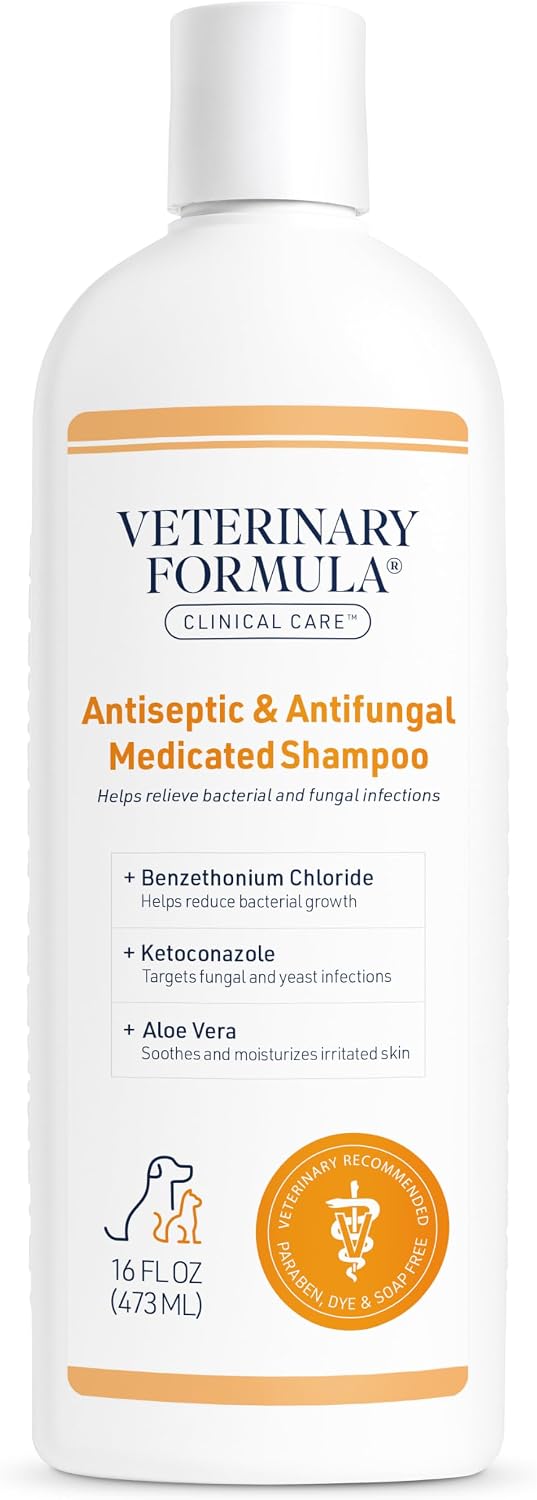
Veterinary Formula antiseptic and antifungal shampoo, 16 oz
A medicated shampoo. The product page describes benzethonium chloride against bacteria and ketoconazole against fungal overgrowth, and it says the bottle is for pets over 12 weeks of age. The bottle prints its own directions. Those directions are not a diagnosis, and they are not a schedule from this site. VCA says the veterinarian decides whether an antifungal shampoo belongs in the plan and how it is used. Skip it on a puppy under 12 weeks, skip it during a diet trial unless the clinic has already allowed it, and skip it as a substitute for a slide. The shampoo guide is the ordinary bath.
Fleas and mites
Scabies can spread to people and other dogs. If you suspect mites, call the clinic before boarding, daycare, or grooming. Your veterinarian chooses the parasite product and dose.
AVMA's external-parasite page says fleas, ticks, and mites are common, that an infestation can cause serious skin disease, and that preventives plus prompt treatment are how you limit the damage. It does not name a product for a Golden. Your veterinarian does.
Merck's flea-allergy chapter traces the itch to antigens in flea saliva. The pattern is itch and crusted bumps on the lower back, the tailhead, and the thighs, with hair loss from licking and chewing or from the infection that follows. Chronic cases can go bald, dark, and thickened in those areas. The self-trauma can become a hot spot. VCA's itching page puts flea allergy first among the common causes of itch, ahead of seasonal allergy, food allergy, contact reactions, and sarcoptic mange. The hot spots guide and the allergies guide split the follow-up. Which preventive, and which month of the year, is a clinic decision.
Sarcoptic mange causes a different, more urgent kind of itch. VCA says Sarcoptes scabiei burrows in the surface, any dog can get it at any age, and it is zoonotic: it can pass to people. The itch is intense. Hair loss shows up especially on the legs and belly, and the skin thickens and darkens. Merck's mange chapter calls canine scabies highly contagious between dogs, including by brushes, towels, and bedding. Signs can start 10 days to 8 weeks after contact. Lesions often begin on the belly, chest, ears, elbows, and hocks. People in the house who develop an itchy rash should tell their own clinician that a dog in the home is being checked for scabies. Merck also describes scabies incognito: a well-groomed dog who itches while scrapings stay negative because bathing has removed the crust that used to hold the mites. A negative scraping is not the end of that conversation.
Demodex is the follicle mite, and Merck is explicit that small numbers are normal flora and that the disease is not considered contagious. Puppies receive the mites from the dam while nursing, in the first 72 hours. Localized demodicosis is usually a dog under a year old: one to five small patches of hair loss, redness, and scale, often on the face or forelegs, with little itch, and most of those cases resolve on their own. A small percentage become generalized. VCA's demodex handout puts the common age under 12 to 18 months, when the immune system is still immature, and says adult dogs who develop it usually have a weakened immune system. Merck's adult-onset form is typically a dog older than about 3 years, sometimes as young as 1.5, and it is associated with immunosuppression from disease that includes lymphoma, malignant melanoma, Cushing's, hypothyroidism, or diabetes. In many adult cases no underlying disease is found. Deep bacterial infection is a common companion. Merck says corticosteroids are contraindicated, treatment continues until at least two negative scrapings a month apart, and dogs with juvenile-onset generalized demodicosis should not be bred. None of that is a drug name or a dose. The clinic chooses the product.
Hypothyroid skin
A low thyroid number on a screening panel is not a diagnosis. Illness and some drugs lower T4. Your veterinarian confirms the disease and sets the replacement. This page gives no dose.
Merck's owner page on the thyroid says more than 95 percent of canine hypothyroidism is destruction of the gland itself. It is most common from 4 to 10 years of age, in mid-size and large breeds, and the breeds Merck names first include the Golden Retriever, then the Doberman Pinscher, Irish Setter, Miniature Schnauzer, Dachshund, Cocker Spaniel, and Airedale Terrier. It occurs in both sexes. Spayed females may be at higher risk than intact females. The metabolic signs are mental dullness, less willingness to exercise, weight gain without a bigger appetite, and heat-seeking. Skin and coat changes are common: dryness, extra shedding, slow regrowth after a clip, and thinning or hair loss that usually matches on the two sides, sometimes with darker pigment over points of wear. In severe cases the skin thickens, especially on the forehead and face, with a puffy look and heavy folds above the eyes. Merck calls the combination, with a slightly drooping upper lid, a tragic expression. Neurologic signs, including megaesophagus, laryngeal paralysis, facial-nerve paralysis, and vestibular disease, are rare, and they may not resolve when the hormone is replaced. A therapeutic trial is one of the tools Merck lists, because other diseases and some drugs, including glucocorticoids, lower T4. Greyhounds, Scottish Deerhounds, and racing sled dogs run a lower T4 than other breeds. The Golden Retriever is not on that low-normal list.
The 2023 AAHA endocrinology guidelines put Golden Retrievers on the predisposition list with Beagles, Doberman Pinschers, and Great Danes, and they say the disease is commonly overdiagnosed. The skin signs in their classic group are alopecia, seborrhea, a dry coat and skin, hyperpigmentation, myxedema, and recurrent pyoderma or ear infection, beside the metabolic signs: weight gain without a bigger appetite, cold intolerance, exercise intolerance, and lethargy. AAHA confirms with a subnormal free T4, an elevated TSH, or both. About 20 to 40 percent of hypothyroid dogs have a low total T4 and a low free T4 with a normal TSH, and that pattern can also be nonthyroidal illness. A dog who is sick from something else should not be labeled hypothyroid on a low T4 alone. A dog with no signs and a low total T4 on a wellness panel is AAHA's second group: interpret the breed, the drugs, and the rest of the illness before you add a hormone. Recurrent skin or ear infection is a reason to ask about the thyroid. It is not, by itself, the diagnosis.
Merck says the replacement most often used is thyroxine, that coat and body weight are judged after 4 to 8 weeks, and that treatment is generally lifelong, with levels rechecked once or twice a year once the dose is stable. If the dog does not improve, Merck says another disease may be the real problem. The shedding guide already separates ordinary Golden coat from hair loss that has a medical cause. Slow regrowth after a summer clip belongs in that conversation, with the age and the weight, not as a standalone internet diagnosis.
Lumps
Feel does not name a tumor. A fine-needle sample or a biopsy does. Growth, ulceration, or a lump that multiplies is a prompt call. This page gives no drug protocol.
Merck's owner page on skin tumors starts from the only distinction that matters at home: benign and malignant tumors are separated in the laboratory. A fine-needle aspirate or a biopsy is how that happens. You cannot do it by watching the lump for a month.
Lipomas are benign fat tumors and are common. Merck says they generally occur in older, obese females, most often on the trunk and near the tops of the legs. The breeds at highest risk on that page are Doberman Pinschers, Labrador Retrievers, Miniature Schnauzers, and mixed-breed dogs. The Golden Retriever is not on that list. A Golden can still grow a lipoma, and the absence from the "most at risk" line is not permission to skip the sample. Lipomas are usually soft and they usually move under the skin. Some blend into the fat around them, so the edge is hard to find. Merck says a fine-needle aspirate is necessary to exclude tumors that mimic lipomas, and it names mast cell tumors as that mimic. Some lipomas grow. Some cannot be told from an infiltrative lipoma or a liposarcoma without tissue. Surgical removal is the cure Merck describes. Weight loss before surgery can make the edges easier to see. That is a surgeon's plan, not a diet you start in order to avoid the needle.
Mast cell tumors are the most common malignant skin tumor Merck describes in dogs. They occur at any age and most often at 8 to 10 years. Common sites are the limbs, especially the back of the thigh, the lower abdomen, and the chest. About 10 percent of cases have tumors in more than one place. They vary in size and speed. They can be soft or firm. They mimic lipomas, so the look and the feel do not diagnose them. Diagnosis is a fine-needle aspirate, an impression smear, or a biopsy. Merck says tumors larger than 1¼ inches (3 cm) at surgery are associated with shorter survival, and tumors near mucous membranes, the feet, the prepuce, or the underside are more likely to spread. Up to a quarter of dogs with mast cell tumors also have stomach ulcers from histamine release, so vomiting in a dog with a known mast cell tumor goes back to the clinic. The breeds Merck singles out as prone are Boxers and Pugs, often with multiple tumors, plus Rhodesian Ridgebacks and Boston Terriers. That list is not a Golden exemption. All mast cell tumors are treated as at least potential malignancies. Stage, margins, radiation, and chemotherapy are an oncologist's conversation.
A few other Merck entries do name the Golden Retriever, and they are easy to mix up with a lipoma if you only palpate. Fibromas are benign, firm or soft, often on the head and legs of older dogs, and Doberman Pinschers, Boxers, and Golden Retrievers are the breeds Merck puts at highest risk. Benign melanomas are more common in dogs than malignant melanomas, and the breed list includes Miniature and Standard Schnauzers, Doberman Pinschers, Golden Retrievers, Irish Setters, and Vizslas. Fibrosarcomas are invasive malignancies, often on the trunk and legs, and Golden Retrievers are on Merck's likely-breed list with Gordon Setters, Irish Wolfhounds, Brittany Spaniels, and Doberman Pinschers. Angiosarcoma of the skin (a malignant blood-vessel tumor) is separate. Merck says Irish Wolfhounds, Vizslas, Golden Retrievers, and German Shepherds are prone, and that in those breeds it is not the sun-associated form seen in short white coats. The practical line is the same for all of them. A new lump, a lump that is larger than the last time you measured it, or a lump that ulcerates gets a needle. The date you first felt it is the useful note.
| What you see | What the source says | What you do |
|---|---|---|
| Large pigmented scale, often starting young, pads and nose usually spared | UC Davis: Golden ichthyosis, recessive, PNPLA1 or ABHD5. Two copies are expected to produce disease. One copy does not. Kiener 2022: ICH2 scale can involve the ear flap and was absent in 396 European Goldens tested. | Ask about both DNA tests and an exam. Still rule out yeast, parasites, and thyroid disease if the dog itches or the scale is new in middle age. |
| Greasy or dry flakes, odor, dark thickened skin | Merck: most seborrhea is secondary, often with staph or Malassezia driving the itch. VCA: primary inherited seborrhea is described in other breeds. Yeast is a normal organism that overgrows. | Book cytology. A medicated bath waits on that result. The allergies guide is next if the itch remains after the infection is treated. |
| A moist red sore that grew in a day | VCA: pyotraumatic dermatitis, the lick-itch-lick cycle, sometimes from a pinpoint to a pancake-sized lesion between morning and evening. Merck: a surface pyoderma. | Call the same day. Stop the licking only with the collar the clinic chooses. The hot spots guide is the care page. |
| Symmetric hair loss, weight gain, heat-seeking, a middle-aged Golden | Merck and AAHA both list Golden Retrievers. Skin signs include dryness, symmetric alopecia, slow regrowth, darker wear points, recurrent infection, and sometimes a puffy face. AAHA says a low T4 alone overdiagnoses the disease. | Ask for free T4 and TSH in context, not a hormone on a single screening number. Coat change is judged over weeks, on the clinic's dose. |
| A new lump, soft or firm | Merck: lipomas are common and the highest-risk breeds named are not Goldens. Mast cell tumors mimic lipomas and are the most common malignant skin tumor in that chapter. Fine-needle aspiration separates them. | Have it sampled. Measure it and keep the date. Vomiting in a dog with a mast cell tumor goes back to the clinic. |
Allergies, without repeating the workup
Merck's atopic dermatitis chapter lists the Golden Retriever among predisposed breeds, and it says prevalence inside a breed depends on the genetic pool and the region. Itch is the characteristic sign. Onset is generally between 6 months and 3 years. There is no sex predisposition. The paws, face, ears, the flexural surfaces of the front legs, the armpits, and the abdomen are the frequent sites, and the map can vary by breed. Most of the visible lesions are from self-trauma and from secondary infection: hair loss, redness, scale, crusts, excoriations, thickened skin, and dark pigment. Staphylococcus and Malassezia commonly make the signs worse. Chronic ear disease can be the only sign.
Cornell's Riney Canine Health Center also lists Golden Retrievers, with an onset between 6 months and 3 years, and it says atopic dermatitis may affect as much as 10 to 15 percent of the dog population. That figure is Cornell's for dogs as a group. It is not a Golden Retriever rate. Cornell calls it lifelong, with no single test: the diagnosis is the history, the exam, a response to treatment, and the exclusion of fleas, sarcoptic mange, and bacterial and fungal infection of the skin and ears. Food allergy and flea allergy can sit beside it. The individualized plan, including immunotherapy, is the allergies guide.
The American College of Veterinary Dermatology says a primary veterinarian remains the dog's main clinician. A dermatologist is the added pair of hands when there is hair loss, scabs, or dandruff, a change in color or texture, odor from the skin or ears, constant licking or chewing, or a lot of head shaking, and when the case is not improving. You can be referred or you can call a board-certified veterinary dermatologist. Ask your own clinic which path they use.
| Question | Where it is answered |
|---|---|
| Food trial, pollen, immunotherapy, the drugs | The allergies guide. |
| A moist sore that appeared today | The clinic today, then the hot spots guide. |
| Ear odor and head shaking | The ear infections guide, and a thyroid question if it keeps returning. |
| Paws in the mouth all evening | The licking-paws guide, after parasites and infection are on the table. |
| Which brush, and whether to clip | The grooming guide, the brushes guide, and the shedding guide. |
When to call the vet
Call the same day for any of these:
- 🐾A moist, smelly, or rapidly enlarging sore. VCA's hot-spot page is the description of how fast that lesion grows. The hot spots guide is the companion page after the dog has been seen.
- 🐾Pustules, epidermal collarettes, a musty odor, or skin that is thickening and turning dark. Merck and VCA both put cytology ahead of a guess between bacteria and yeast.
- 🐾Heavy scale in a puppy or a young Golden, especially large flakes that darken and spare the pads and the nose. That is the ichthyosis pattern UC Davis describes, and it still needs an exam.
- 🐾Symmetric hair loss, a dull dry coat, slow regrowth after clipping, weight gain without a bigger appetite, or heat-seeking in a middle-aged Golden. Merck and AAHA both treat that cluster as a thyroid question, confirmed with the right blood tests.
- 🐾A new lump, a lump that ulcerates, or a lump that is larger than the measurement you wrote down. Merck says fine-needle sampling is what separates a lipoma from a mast cell tumor.
- 🐾Intense itch plus an itchy rash on a person in the household. VCA and Merck both say sarcoptic mange can pass to people.
- 🐾Vomiting in a dog who already has a mast cell tumor. Merck ties stomach ulcers to histamine release from those tumors.
- 🐾Trouble breathing, a swollen face, or collapse. That is an emergency service, not a paragraph on this page.
A single fleck of scale the week the heat came on can be the start of a shed. The shedding guide covers that coat. If the skin underneath is red, greasy, or odorous, the shed is not the whole story.
Questions owners ask
Do Golden Retrievers get ichthyosis?
Yes. UC Davis describes a breed form of congenital ichthyosis and tests two recessive variants. PNPLA1, reported by Grall and colleagues in 2012, is the first. ABHD5, reported by Kiener and colleagues in 2022, is the second, so far described in North American Goldens and absent in the 396 European Goldens those authors typed. One copy does not produce disease. Two copies are expected to, with a variable amount of scale. The laboratory's 50 percent figure is a variant frequency it attributes to the original PNPLA1 study, not a count of dogs with clinical disease.
Is dandruff the same thing as ichthyosis?
They are different. Merck says primary seborrhea is rare and is not itchy, and that most flaky animals have secondary seborrhea from hormone disease, allergy, parasites, or infection. VCA's inherited primary seborrhea list is other breeds. Ichthyosis scale often starts young and has a DNA test. Yeast scale itches and smells. A middle-aged dog with new scale, weight gain, and symmetric hair loss is a thyroid question. Dogs can have more than one of these.
What does a hot spot look like?
VCA describes a red, oozing, painful patch that can appear within hours, sometimes hidden under a mat, often on the head, legs, or hips. Merck classifies acute moist dermatitis as a surface pyoderma. The lick-itch-lick cycle is the engine, and the first itch may be allergy, fleas, an ear, a mat, or a sore joint. Care after the exam is the hot spots guide. Drying the coat, in sections, is the prevention this page can recommend without a drug.
Can thyroid disease look like a skin problem?
Yes. Merck lists Golden Retrievers among the breeds most often affected, usually from 4 to 10 years, with dryness, extra shedding, slow regrowth, symmetric hair loss, darker skin at wear points, and sometimes a puffy face. AAHA adds recurrent pyoderma and ear infections, and it warns that hypothyroidism is commonly overdiagnosed. A low total T4 during another illness is not the diagnosis. Free T4 and TSH, read with the signs, are the confirmation AAHA describes. Coat change is judged over 4 to 8 weeks on the clinic's replacement dose.
Can I tell a lipoma by feel?
You can suspect one. Merck says you cannot prove one. Lipomas are common soft movable fat tumors of older dogs, and the breeds Merck names as highest risk are Dobermans, Labradors, Miniature Schnauzers, and mixes. Mast cell tumors, the most common malignant skin tumor in that chapter, can feel soft and can mimic a lipoma. Goldens are on Merck's lists for fibromas, benign melanomas, fibrosarcomas, and skin angiosarcoma. A fine-needle sample is the step those facts share.
When is itch an allergy workup?
After parasites and infection are in the plan, and when the pattern fits. Merck and Cornell both list Golden Retrievers, with onset often between 6 months and 3 years, on the paws, face, ears, and underside. Cornell's 10 to 15 percent figure is for dogs as a group. The diet trial and the drugs are the allergies guide. ACVD says a dermatologist joins the case when the skin, the coat, or the ears are not improving under your own veterinarian.
What if people in the house are itching too?
Tell the clinic, and tell the person's clinician, that sarcoptic mange is on the list. VCA says the mite can pass from dogs to people. Merck says the itch in the dog can be intense while scrapings stay negative, especially if the dog is bathed often. Demodex is the other mite: Merck says small numbers are normal and the disease is not considered contagious. The two are not interchangeable, and the scrapings are how the clinic tells them apart.
Sources
Golden Retriever ichthyosis phenotype, autosomal recessive inheritance, PNPLA1 and ABHD5 as the two tested variants, carrier results, the 25 percent and 50 percent litter prediction for two carriers, the 360-dog concordance summary, the variant absent in 300 dogs of 25 other breeds, and the 50 percent variant frequency attributed to the original study: UC Davis Veterinary Genetics Laboratory, congenital ichthyosis 1 and 2. The PNPLA1 indel, a premature stop in affected Goldens, and the human ARCI families: Grall and colleagues, Nature Genetics, 2012. Nature Genetics.
ABHD5 c.1006_1019del in 14 North American Goldens with nonepidermolytic ichthyosis who were not homozygous for the PNPLA1 mutation, perfect cosegregation in that family, absence of the allele in 396 European Goldens, ear-flap scale, and the breeder report of more severe adherent scale: Kiener and colleagues, G3, 2022. PubMed 34791225.
Primary versus secondary seborrhea, infection as a driver of itch, and cytology: Merck Veterinary Manual, seborrhea. Grooming before topical therapy: Merck, principles of topical treatment. Surface, superficial, and deep pyoderma, hot spots as surface pyoderma, and Malassezia on cytology: Merck, pyoderma. Flea-saliva antigens, the tailhead pattern, and hot spots from self-trauma: Merck, flea allergy dermatitis. Sarcoptic mange, including contagion and negative scrapings in groomed dogs, and demodicosis, including the juvenile and adult forms: Merck, mange. Breed predisposition, onset, and lesion map of atopic dermatitis: Merck, atopic dermatitis. Hypothyroidism age, Golden Retrievers among commonly affected breeds, skin signs, and the limits of a low T4: Merck, thyroid disorders in dogs. Lipomas, mast cell tumors, and the Golden Retriever entries for fibroma, melanoma, fibrosarcoma, and angiosarcoma of the skin: Merck, tumors of the skin in dogs.
Hot spots and the lick-itch-lick cycle: VCA, hot spots. Clipping, disinfection, and an Elizabethan collar at the clinic: VCA, hot spot treatment. Pyoderma as a secondary infection and the fold-breed list: VCA, pyoderma. Seborrhea, primary and secondary: VCA, seborrhea. Malassezia signs and why the veterinarian sets shampoo use: VCA, yeast dermatitis. Sarcoptic mange and zoonosis: VCA, sarcoptic mange. Demodex as the follicle mite of young dogs: VCA, demodectic mange. Common causes of itch: VCA, pruritus.
Golden Retrievers on the hypothyroidism predisposition list, dermatologic signs, overdiagnosis, and confirmation with free T4 and TSH: AAHA, 2023 selected endocrinopathies, categorical approach.
Atopic dermatitis in dogs as a group, the breeds including Golden Retrievers, and diagnosis by exclusion: Cornell Riney Canine Health Center, atopic dermatitis. When to involve a board-certified veterinary dermatologist: ACVD, frequently asked questions. Fleas, ticks, and mites as a cause of skin disease: AVMA, external parasites.
P.S. Get the free Golden Retriever Owner Cheat Sheet — daily feeding, sleep, and care in one printable guide.
Get the Cheat Sheet when you join the newsletter — instant access in your welcome email.