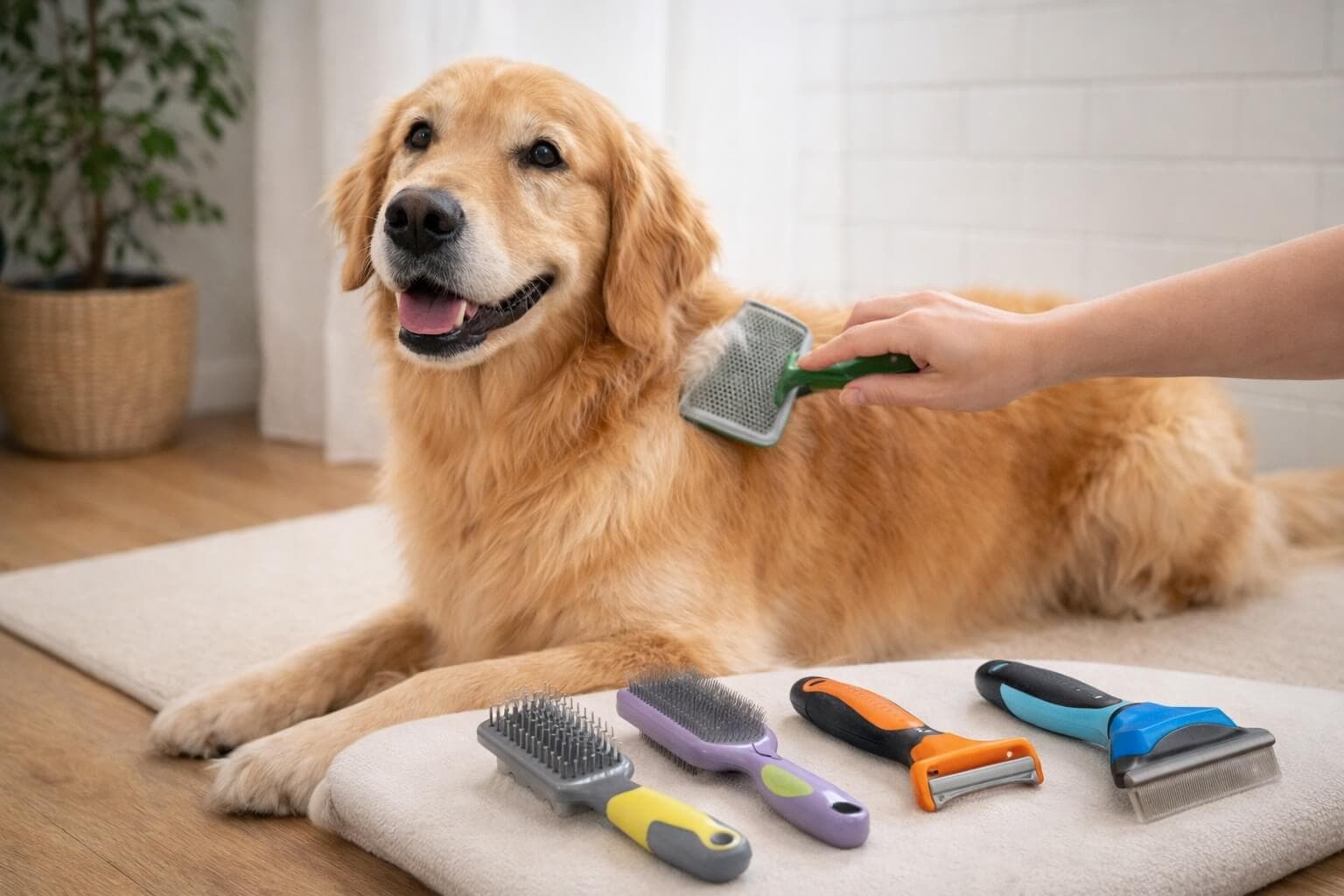
Best Brush for a Golden Retriever
By JJ Allan, goldenretriever.hair
Last updated November 24, 2026
Quick answer: A Golden Retriever’s double coat is not a one-brush job. VCA Animal Hospitals describes many retrievers as having a thick outer coat of guard hairs and a fine undercoat, with two heavy seasonal sheds a year, in late spring and late fall, when much of the undercoat comes out in clumps. The American Kennel Club, quoting Nancy Talbott, Director of Education for the Golden Retriever Club of America, says a Golden sheds moderately throughout the year and heavily once or twice a year. For the main work, Talbott tells owners to use a pin brush about once a week in a regular shed, and about once a day when the coat is blowing, then finish the feathering with a metal comb. A slicker brush is a common second tool for loose hair and light tangles, and an undercoat rake helps when loose undercoat is coming out in handfuls. The Hertzko Self-Cleaning Slicker Brush is one of the brushes we use. For loose undercoat, we also use the FURminator Grooming Rake and the Mars Coat King 20-blade rake. Use a light touch, stop if the skin looks sore, and check with your veterinarian if you see bald patches, redness, or a sudden change in shedding.
Sources checked November 24, 2026.
This guide is general information, not veterinary advice. Brushing needs vary by coat, age, and skin condition, so check with your veterinarian if shedding changes suddenly, if you see redness, bald patches, or sores, or before you add a sharper grooming tool. Contact a veterinarian promptly if the skin is inflamed, painful, or bleeding, or if hair loss looks patchy rather than a normal shed.
Quick answer: start with more than one brush
The question people type most often is some version of “what is the best brush for a Golden Retriever?” The honest answer is that no single brush reaches every layer of this coat.
A Golden has a longer, water-repellent topcoat over a soft, dense undercoat. That undercoat is the hair that ends up on the floor. VCA groups many retrievers with other breeds that have an outer coat of guard hairs and a fine insulating undercoat, and says those breeds often go through two heavy sheds a year, in late spring and late fall, when much of the undercoat falls out in clumps. The AKC, quoting Talbott, describes the same pattern in slightly different words: moderate shedding through the year, and a heavy shed once or twice a year.
Those two layers are why a kit works better than a single “best brush.” A pin brush or a slicker handles the everyday pass. A metal comb finds what the brush missed in the feathering. An undercoat rake earns its keep when loose undercoat is coming out in handfuls. The shedding guide covers what a normal shed looks like, and when hair loss needs a veterinarian. The grooming guide puts brushing in the rest of the routine, including ears, nails, and baths.
The Hertzko Self-Cleaning Slicker Brush, the FURminator Grooming Rake, and the Mars Coat King 20-blade rake are tools we use, and they are on our grooming products page. The pin brush, steel comb, and grooming vacuum on this page are tools we recommend. Maker claims in the cards come from the companies’ own pages.
What kind of brush a Golden Retriever needs
Start with the coat in front of you, not with a product name.
The AKC’s own grooming list for a Golden is short: a pin brush, and a metal comb with medium to wide teeth. Talbott’s method is specific. Back-brush the entire body with the pin brush to loosen dead undercoat and collect debris such as twigs or foxtails, then brush the coat in the direction it grows. Use the comb on the feathering behind the ears, on the chest, on the legs, and on the tail. For tangles, she recommends spraying the coat with water or a coat conditioner; a smooth coat can be brushed dry.
VCA’s brush advice is written for coat types, not for this breed alone. It says combs or stiff bristle brushes suit dogs with medium-length hair that sheds, “such as retrievers,” that long-toothed combs or brushes with rows of offset tines help on long coats and during a seasonal shed, and that slicker brushes work well for curly, non-shedding coats such as poodles. It also says de-shedding brushes help remove dead, loose undercoat without harming the topcoat, and that whatever tool you choose, you should be gentle and avoid excessive pulling on tangles.
Those two sources do not contradict each other so much as they start from different lists. GRCA’s practical warning, through the AKC, is not to rely on a bristle brush as the main tool, because it will not get through a thick Golden coat. A bristle brush can still be a finishing pass after the undercoat work is done. It is not the brush to grab when the coat is blowing.
A useful starter kit for most adult Goldens looks like this:
- 🐾A pin brush for the main, through-the-coat pass.
- 🐾A slicker brush for loose hair and light tangles, especially in the feathering.
- 🐾A metal comb to check the ears, chest, legs, and tail.
- 🐾An undercoat rake for the weeks when loose undercoat is coming out in clumps.
You do not have to buy every tool on day one. If you buy only two things, a brush that can reach the coat (a pin brush or a slicker) and a steel comb will get you through a quiet week. Add a rake when the shed ramps up.
The Andis 65730 Stainless-Steel Comb, 7-1/2-Inch, is one of the combs we recommend for that finishing check. It is a plain 7-1/2-inch stainless steel comb, which sits in the same role the AKC’s Golden grooming guide gives a metal comb with medium to wide teeth: the ears, chest, legs, and tail. If the comb snags, stop and work the tangle loose instead of pulling through it.
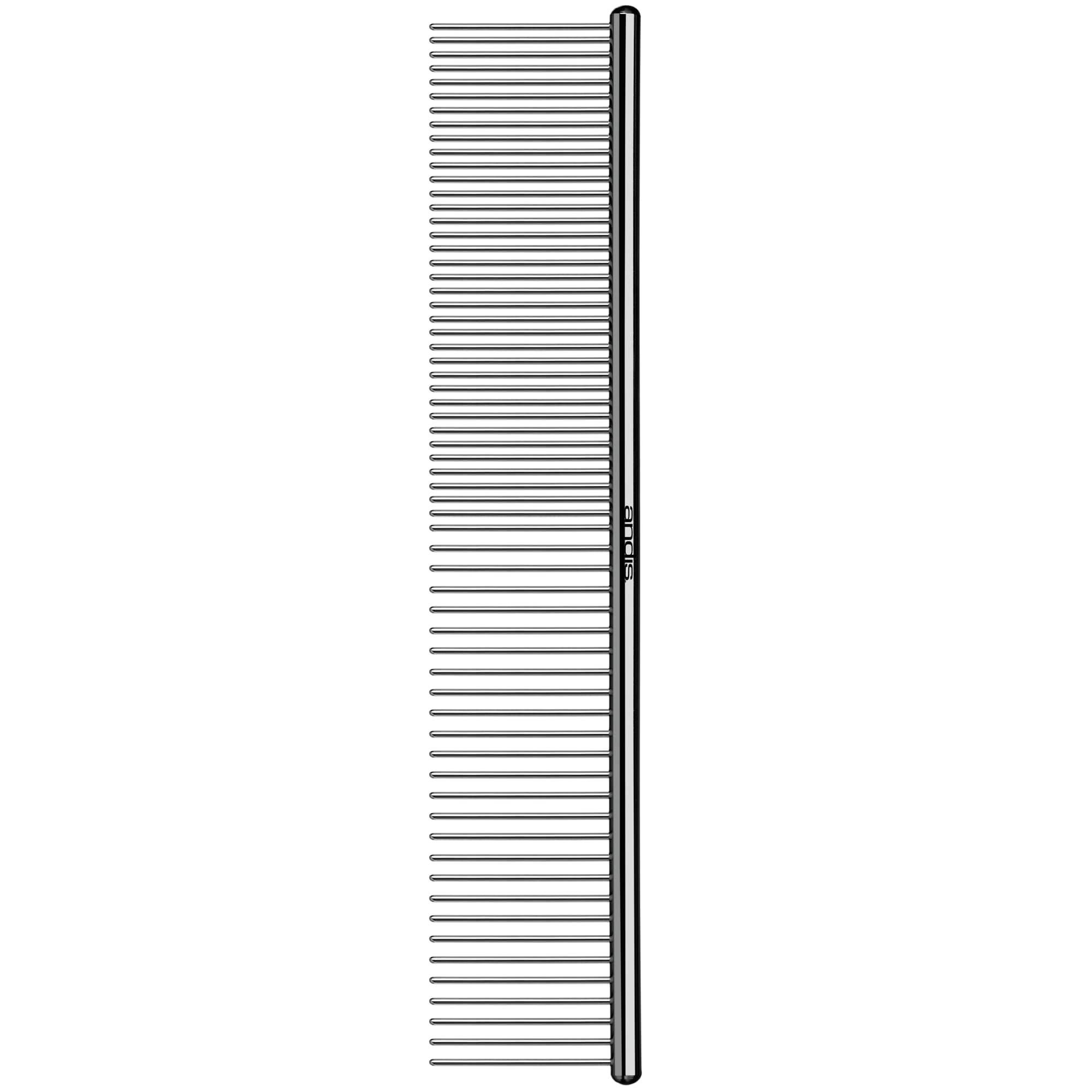
Andis Stainless-Steel Comb, 7-1/2-Inch (65730)
This is one of the combs we recommend for the feathering behind the ears, on the chest, on the legs, and on the tail. It is a 7-1/2-inch stainless steel comb, model 65730. Use it as the last pass after the pin brush or slicker. If it catches, go back to that spot with your fingers or the slicker rather than forcing the teeth through a mat.
Slicker brush or pin brush?
This is one of the questions people actually search, and the useful answer is “both, for different jobs.”
A pin brush has longer, spaced pins, often with rounded or polished tips, set in a pad. On a Golden, it is the everyday through-the-coat tool in Talbott’s routine: a back-brush to loosen dead undercoat, then a pass in the direction the hair grows. That is also why a pin brush shows up in “best brush” roundups that follow the AKC and GRCA, even though many shoppers type “slicker brush” first.
The Chris Christensen Original Series 27 mm Oval Pin Brush is one of the pin brushes we recommend for that everyday pass. The maker’s page says to use the 27 mm pins for medium to long coats, and that the stainless steel pins have ground and polished tips. It also describes a lightweight beechwood body with an oval head, made in Germany. Those are the company’s claims.
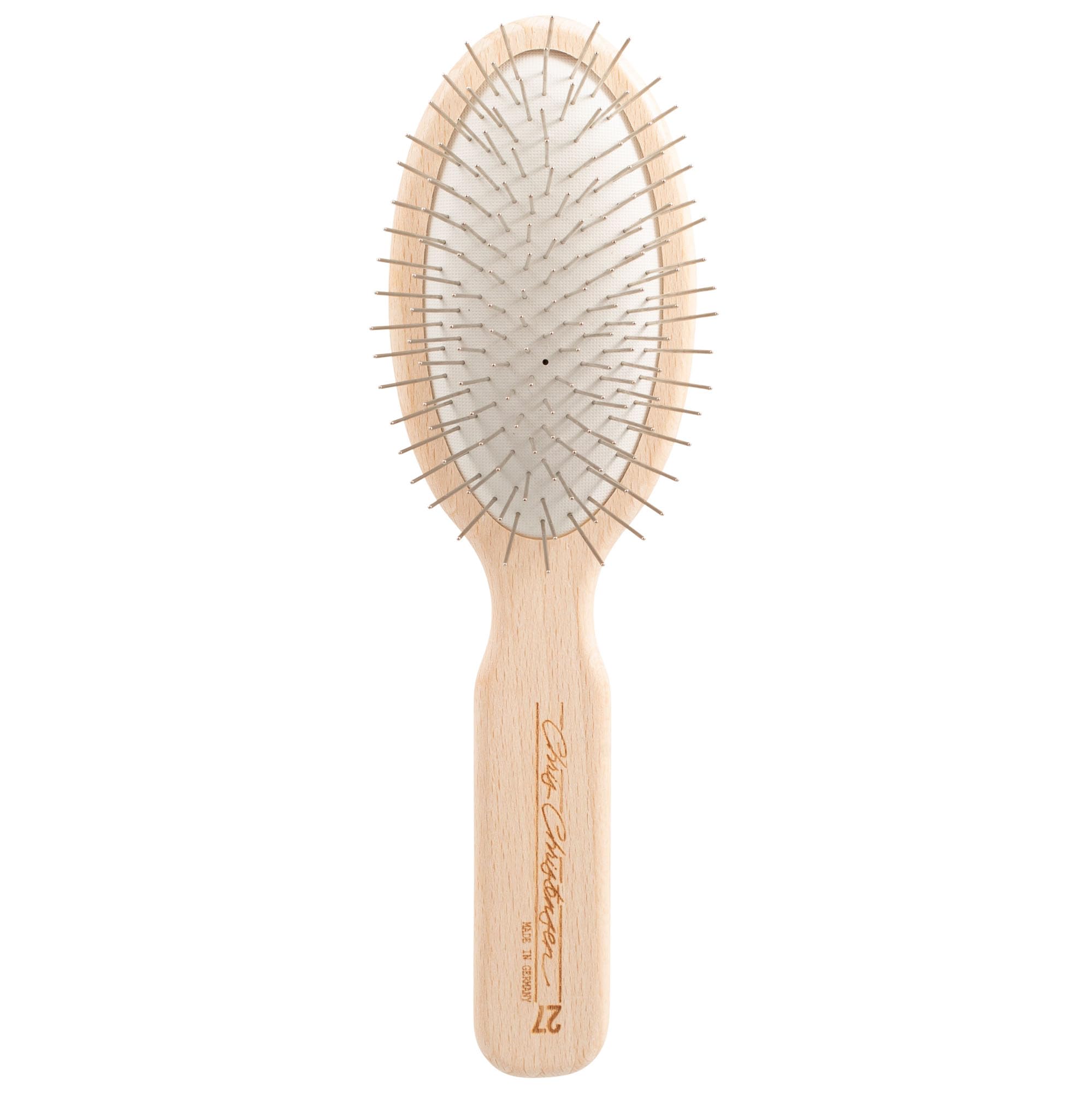
Chris Christensen Original Series Oval Pin Brush, 27 mm
This is one of the pin brushes we recommend for the main pass on a Golden. The maker’s page says 27 mm pins are for medium to long coats, and that the stainless steel pins are ground and polished so they glide. It lists a solid beechwood body with an oval head, and says the brush is made in Germany. Use it to back-brush and then brush with the grain, and finish with a comb.
A slicker has fine, bent wire pins set close together. It is good at lifting loose hair and working through small tangles, especially in the longer feathering behind the ears, on the backs of the legs, and under the tail. Use a light touch. Pressing a slicker hard into the skin can scratch, which is why short, gentle strokes matter more than leaning on the handle.
The Hertzko Self-Cleaning Slicker Brush is one of the brushes we use for that slicker job. The maker’s page says this self-cleaning slicker is meant for pets with long or short hair, and that it removes loose fur, tangles, and mats. It also says the bristles retract with a button push so the collected hair comes off the brush, and that the design is meant to be gentle on the skin. Those are the company’s claims. On a Golden, treat it as a slicker for loose hair and light tangles, not as a substitute for a pin brush, a comb, or a rake when the undercoat is coming out in handfuls. If a tangle will not ease out, stop and work it with your fingers or go to a groomer rather than dragging the wires through a mat.
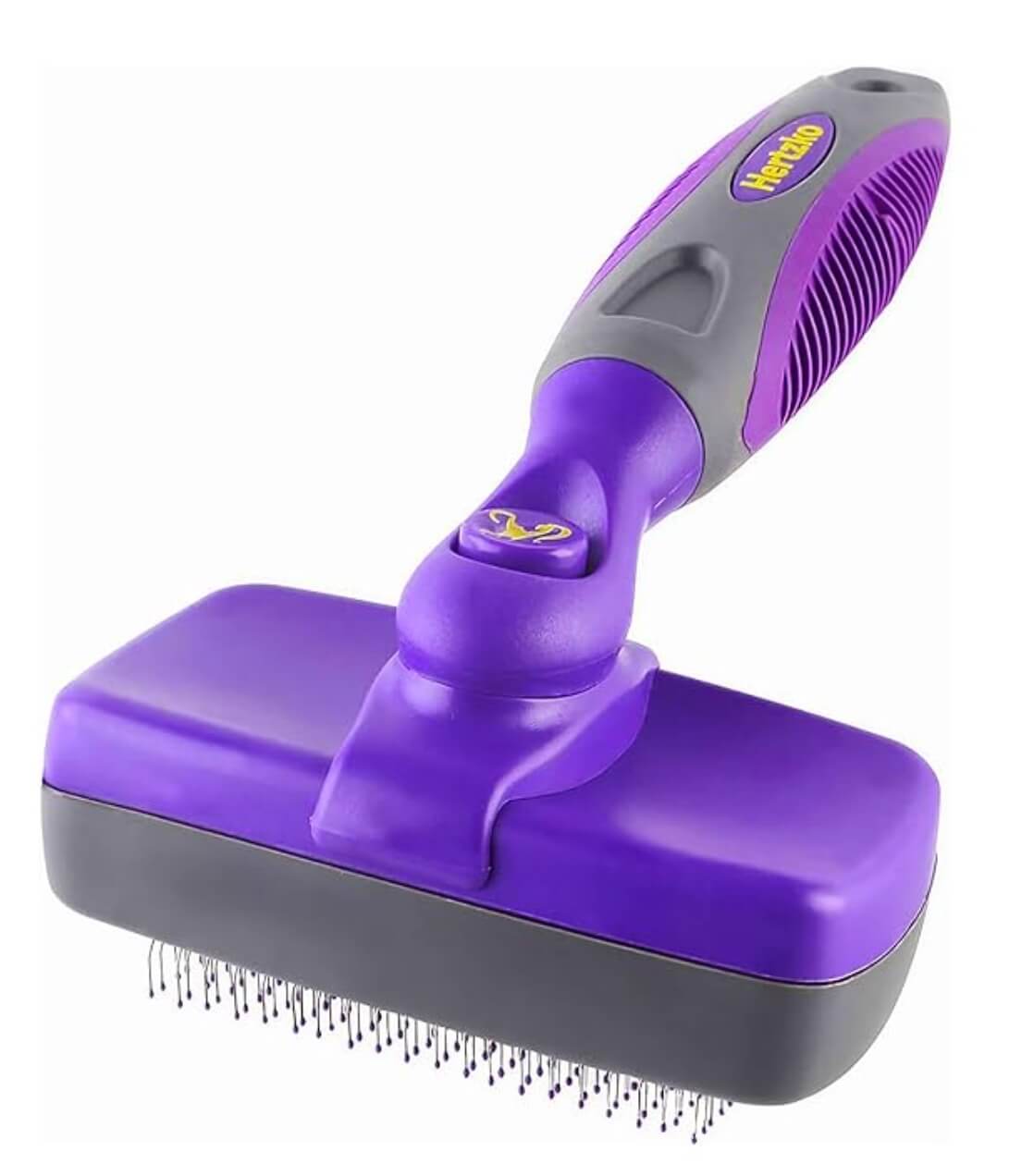
Hertzko Self-Cleaning Slicker Brush
This is one of the brushes we use for everyday loose hair and light tangles on a Golden. The maker’s page describes a self-cleaning slicker for long or short hair that removes loose fur, tangles, and mats. It says the bristles retract with a button push so the collected hair comes off the brush, and that the brush is designed to be gentle on the skin, with an ergonomic handle. Use light strokes, especially on the feathering, and do not lean on the wires to force a mat. Pair it with a pin brush and a comb rather than using it as the only tool in the house.
If your Golden has a very full coat, a pin brush with longer pins can reach closer to the skin than a short slicker. If the feathering knots easily, the slicker will get more use. Either way, finish with the comb. If the comb glides through the feathering, you are done. If it snags, go back to the tangle instead of calling the job finished.
Shedding tools: undercoat rakes and deshedding blades
Search traffic for this page also clusters around “Golden Retriever shedding brush,” “undercoat rake,” and “deshedding.” Those are not all the same tool.
An undercoat rake has one or two rows of metal teeth, sometimes of different lengths, sometimes set to rotate as you pull. The job is to reach through the topcoat and lift loose undercoat during a heavy shed. The AKC’s Golden grooming article is about pin brushes and combs for the regular routine; a rake is the extra tool for the weeks when a brush cannot keep up. The site’s summer shedding guide makes the same split: a slicker for loose coat and surface tangles, and a rake used gently for loose undercoat.
The FURminator Grooming Rake is one of the rakes we use. It is a rake with rotating metal teeth, not the company’s blade-style deShedding tool. The maker’s page says the rake removes loose hair from the undercoat and helps prevent tangles and mats, and that it is meant for dogs and cats with thick fur or dense double coats. The same page says to stroke gently in the direction of hair growth, start at the head and work back, use extra care near the stomach, legs, genitals, and anus, and avoid excessive strokes in a single area, which can irritate fur and skin. It suggests about 5 to 10 minutes a session, with more frequent use during a heavy shed or when there are more tangles. It also says to look for sores, bruises, and skin problems as you go, and to get veterinary treatment before you resume brushing if you find them. Those are the maker’s directions. Follow them, and stop sooner if your dog flinches or the skin looks pink.
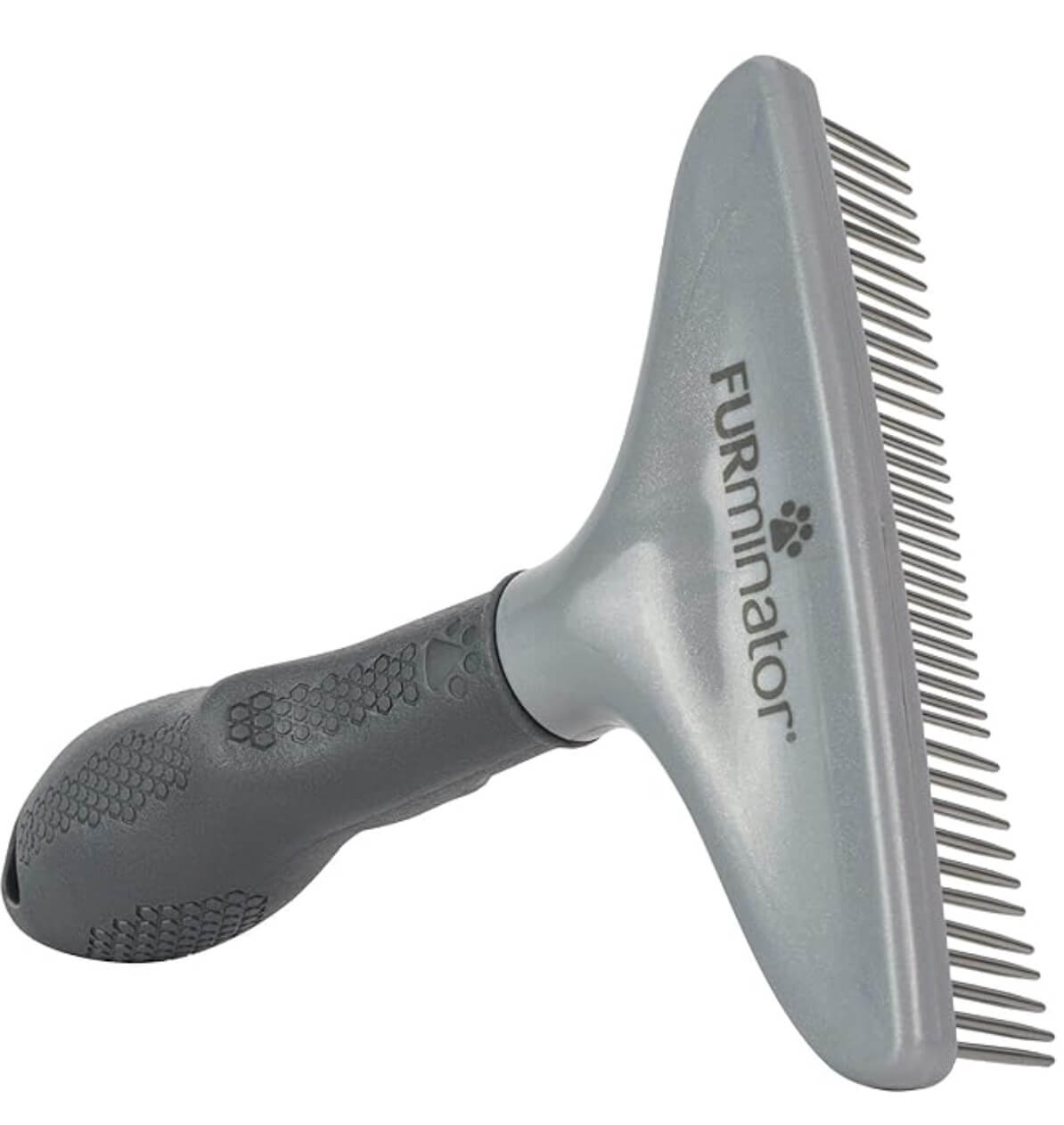
This is one of the rakes we use for loose undercoat on a Golden. The maker’s page says rotating metal teeth remove loose undercoat hair and help prevent tangles and mats on thick fur or dense double coats. It tells owners to brush in the direction of hair growth, to use extra care on the stomach and legs, to avoid excessive strokes in one area, and to aim for about 5 to 10 minutes a session, more often in a heavy shed. This rake is not the same tool as a FURminator deShedding blade. Use it on loose coat, then stop when the teeth stop picking up hair.
A blade-style deshedding tool is a different design, with a metal edge that sits in a comb of teeth. Some owners like that kind of tool in a coat blow. Others skip it because it is easier to over-groom or to nick the topcoat if you press or repeat the same stroke. There is no study in the sources for this page that settles that debate. VCA’s general line is that de-shedding brushes can remove dead, loose undercoat without harming the topcoat when they are used as intended, and that you should still be gentle. If you use a blade, use fewer long, light strokes, keep it off sore or sensitive skin, and stop when you are lifting less hair, not when the coat looks thin.
Do not use a rake or a blade as a shortcut that replaces weekly brushing. And do not keep going over a thin or pink patch because the pile of fur looks satisfying. The undercoat is insulation. Pulling out more than the loose hair can leave the coat patchy and the skin irritated. If that happens, or if your dog starts to avoid the brush, stop and check with your veterinarian.
Mats, tangles, and a dematting rake
Goldens pick up burrs, grass awns, and small knots in the feathering, in the armpits, and in the “pants” behind the back legs. Small tangles can usually be eased out with fingers, a slicker, or a comb. Talbott suggests misting a tangled coat, or using a coat conditioner, so the hair slips instead of breaking.
VCA’s rules are stricter once a tangle becomes a mat. Brush or comb out a small tangle or a fresh burr. If a large clump of burrs or grass awns has formed a mat, you may have to cut the clump out, and you have to be extremely careful not to cut the skin. VCA says to use clippers for that job, never scissors, and that severe or extensive mats belong with a groomer or a veterinarian. If a mat has already irritated the skin, that is a veterinary visit, not a harder pull with a rake. Brush burrs and tangles out before a bath, because tangles can become nearly impossible to remove once they are wet. The AKC says the same thing in the other direction: always brush before bathing.
The Mars Coat King 20-blade rake is one of the rakes we use when you need a dematting undercoat tool with more blades than a simple rake. The maker’s page lists the blunt 20-blade Coat King as model 99M-55020, and describes the original Mars Coat King as a trimming curry comb, undercoat brush, or undercoat comb for shedding season, used for gentle coat care. Those are the company’s claims. This is still a tool to use with a light hand, in the direction of hair growth, on loose or lightly tangled coat. It is not a reason to carve through a tight mat next to the skin.
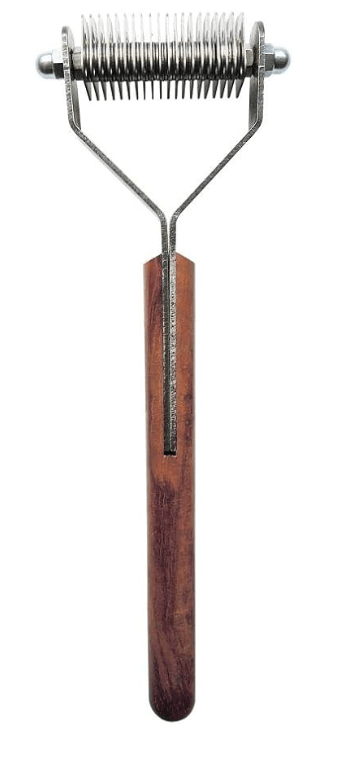
Mars Coat King Dematting Undercoat Grooming Rake Stripper Tool (20-Blade)
This is one of the rakes we use for shedding-season undercoat work and light dematting. The maker’s page identifies the blunt 20-blade Coat King as model 99M-55020 and describes it as an undercoat brush or undercoat comb for shedding season, used for gentle coat care. Work in the direction the hair grows, keep the strokes light, and leave tight mats next to the skin for a groomer or a veterinarian. VCA says clippers, not scissors, are the tool if a mat has to be cut.
If you are not sure whether you are looking at a mat or a clump of already loose undercoat, pause. Loose undercoat often comes away in tufts with almost no pull. A mat is anchored at the skin and hurts when you lift it. When in doubt, get help rather than pulling harder.
How often should you brush a Golden Retriever?
Talbott’s split, via the AKC, is the one to start with. In a regular shed, brush about once a week. In a heavy shed, brush with a pin brush about once a day so the dead hair comes off the dog instead of the house. The shedding guide uses the same rule in shorter form: weekly when the coat is quiet, daily when undercoat is coming out in clumps. The grooming guide says at least once a week, and daily during heavy shedding.
VCA does not give a Golden-specific calendar. It says all dogs benefit from regular brushing, to remove loose hair and dead skin cells, keep the coat free of dirt, debris, and external parasites, and spread natural skin oils along the hair shafts. Dogs with long, silky, or curly coats need daily brushing to keep hair from matting, especially around the ears, in the armpits, and along the back of the legs. During a big shed, daily brushing also cuts the amount of loose hair and dander in the home, and it can reduce the hair a dog swallows while self-grooming. VCA also says to inspect the coat every day for tangles under the armpits, in the groin, and behind the ears, and to check for burrs after a run in grass or woods.
Those ranges can sit next to each other without being forced into one number. A quiet adult coat can do well on a careful weekly session that includes the comb test. A coat blow, a long-feathered dog that mats easily, or a week of swimming and hiking can turn that into a daily job. The test is the coat, not the calendar: if you are still finding clumps, tangles, or a house full of hair the next morning, brush sooner. If the skin looks red or the dog is sore, stop and call your veterinarian instead of adding another session.
Brushing is also how you see lumps, fleas, ticks, and sore spots early. The AKC notes that regular grooming of the coat, feet, teeth, ears, and eyes helps you visit the veterinarian sooner if something shows up. That is as much a reason to pick up a brush as the hair on the sofa.
How to brush a Golden Retriever
Set aside a calm stretch of time and work in sections, down to the skin. Skimming the topcoat leaves the undercoat in place and gives you a shiny dog that still sheds on the couch.
A practical sequence looks like this:
- 🐾Start at the head or a shoulder and part the coat so you can see the skin. Brush from the skin outward, then move to the next section. That line-brushing habit is the one the grooming guide uses.
- 🐾Use the pin brush for the main pass: back-brush to loosen dead undercoat and pick up twigs or foxtails, then brush in the direction the hair grows, following Talbott’s method.
- 🐾Use a slicker lightly on the feathering and on any small tangles you can ease out.
- 🐾In a heavy shed, use an undercoat rake on the thicker areas, such as the neck, chest, and rear, with long, light strokes in the direction of hair growth. Do not carve at the same spot.
- 🐾Finish with a metal comb on the ears, chest, legs, and tail. If the comb snags, go back to that spot.
- 🐾Check the armpits, groin, and behind the ears every time, which is where mats start.
Talbott says to brush before a bath, and VCA says to remove burrs and tangles before the dog gets wet. After a bath, wait until the coat is fully dry before you do the serious undercoat work. The AKC, again quoting Talbott, says to towel dry, let the dog air dry for a few minutes, then use a cooler canine dryer if you have one, blowing air up against the skin in the opposite direction the hair grows, and follow by brushing the other way. Do not use a hot human dryer on the coat.
Keep sessions short enough that the dog still wants to come back. FURminator’s 5-to-10-minute suggestion for its rake is a useful ceiling for that one tool, not a rule that every brush session must fill a timer. A weekly pin-brush and comb session on a large dog will often take longer than that, especially if you are also checking ears and paws. Stop if the dog is done, and pick the session up later.
If you find redness, dandruff, greasiness, bald patches, or a coat that looks dull for reasons that are not just dirt, treat that as a health question. VCA says a healthy animal does not shed excessively and has a shiny coat, free from dandruff or greasiness, and that a dull, dry coat can be a sign of something else, including nutrition or pain. That is not a diagnosis, and it is not a reason to buy a different brush first. Check with your veterinarian.
A grooming vacuum is not a substitute for a pin brush, a slicker, a comb, or a rake. The Neakasa P1 Pro Pet Grooming Kit & Vacuum is one of the kits we recommend when you want a vacuum that collects loose fur as you work. It is a white vacuum unit with a hose and attachments, including a clipper-style head. Use it as a cleanup tool alongside the brushes above, and stop if the dog is uncomfortable or the skin looks sore.

Neakasa P1 Pro Pet Grooming Kit & Vacuum
This is one of the kits we recommend for collecting loose fur during a grooming session. It is a vacuum kit with a hose and several attachments, not a pin brush or a slicker. It does not replace the weekly or daily brushing routine above. Keep the session calm, and check with your veterinarian if the skin looks irritated.
What brush to use on a Golden Retriever puppy
A Golden puppy is still learning to be touched, and the adult undercoat is not fully in. The AKC’s first step for grooming this breed is to train the dog to let you touch the body, including the head, ears, mouth, and feet, and to set a routine you can keep. Short, calm sessions with a soft slicker or a pin brush are enough at the beginning. Praise the puppy for standing or lying still. End the session before it turns into a fight.
You usually do not need an undercoat rake or a dematting tool until the coat fills in and starts to shed in earnest. A sharper tool in a thin puppy coat is a way to scratch skin, not a way to get ahead of adult shedding. Keep the strokes light, and stay especially gentle on the face, ears, belly, and legs.
If a young puppy already has mats, sore skin, bald spots, or a shed that looks uneven, skip the product aisle and ask your veterinarian. Puppies can have parasites, skin disease, or other problems that a brush will not fix. Once the adult coat comes in, move toward the weekly-or-daily split above, and add a rake when loose undercoat starts to come out in clumps.
A bath still follows the same rule as it does for adults: brush first, use a shampoo made for dogs, and dry the coat thoroughly. The shampoo guide covers what to use in the tub. For the rest of a grooming visit, including nails, see the nail trimming guide and the grooming guide.
Coat type can change how much work this is. Some Goldens carry a straighter, flatter coat; others are wavier or heavier in the feathers. The coat types guide is the place for that difference. The tools do not change as much as the time you spend on the feathering and the comb test.
Related Golden Retriever guides
- 🐾Golden Retriever shedding guide — what a normal shed looks like, and when hair loss needs a veterinarian.
- 🐾Golden Retriever grooming guide — brushing in the full routine, including ears, nails, and baths.
- 🐾Golden Retriever summer shedding — managing a heavy shed in warm weather.
- 🐾Golden Retriever coat types — how coat texture changes the work.
- 🐾Best shampoo for Golden Retrievers — what to use after you have brushed, and before the dog is fully dry.
- 🐾Golden Retriever nail trimming guide — the other half of a grooming session.
Quick answers
What is the best brush for a Golden Retriever?
A Golden Retriever does not have one best brush. The coat is a thick, water-repellent topcoat over a soft undercoat, and different tools do different jobs. The American Kennel Club, quoting Nancy Talbott of the Golden Retriever Club of America, points to a pin brush for the main work and a metal comb on the feathering behind the ears, chest, legs, and tail. A slicker brush is a common second tool for loose hair and light tangles. An undercoat rake helps when loose undercoat is coming out in clumps. The Hertzko Self-Cleaning Slicker Brush, the FURminator Grooming Rake, and the Mars Coat King 20-blade rake are brushes we use. The right mix still depends on your dog and, if the skin is sore or the shed looks unusual, your veterinarian.
Is a slicker brush or a pin brush better for a Golden Retriever?
Use them for different jobs, not as rivals. Talbott’s method, via the AKC, is to back-brush the body with a pin brush to loosen dead undercoat and collect debris, then brush in the direction the hair grows. A slicker has fine, bent wires that help lift loose hair and work through light tangles, especially in the feathering. VCA Animal Hospitals names combs or stiff bristle brushes for medium-length shedding coats such as retrievers, and describes slickers as a good fit for curly, non-shedding coats such as poodles. GRCA’s advice, through the AKC, is not to rely on a bristle brush as the main tool, because it will not get through a thick Golden coat. Many owners keep both a pin brush and a slicker, then finish with a comb.
How often should you brush a Golden Retriever?
For a regular shed, Talbott says to brush about once a week. When the coat is blowing, she says to use the pin brush about once a day so the dead hair comes off the dog instead of the house. The site’s shedding guide and grooming guide use the same split: weekly when the coat is quiet, daily when undercoat is coming out in clumps. VCA says all dogs benefit from regular brushing, that long, silky, or curly coats need daily brushing to prevent mats, and that daily brushing during a big shed also cuts the loose hair and dander in the home. Check the coat every day for tangles, burrs, and sore spots, and ask your veterinarian if shedding changes suddenly or the skin looks red or bald.
What is the best shedding brush for a Golden Retriever?
There is no single shedding brush that replaces a weekly or daily routine. The AKC says Goldens shed moderately all year and heavily once or twice a year. An undercoat rake reaches the loose undercoat during those heavier weeks. The FURminator Grooming Rake is one of the rakes we use; the maker says its rotating metal teeth remove loose undercoat hair and help prevent tangles on thick or dense double coats. The Mars Coat King 20-blade rake is another of the rakes we use; the maker describes the blunt 20-blade Coat King as an undercoat tool for shedding season. A blade-style deshedding tool is a different design. Use any rake or blade gently, in the direction the hair grows, and stop if the skin looks irritated.
Do you need a comb for a Golden Retriever?
Yes. The comb is how you find what the brushes missed. Talbott, via the AKC, says to use a metal comb on the feathering behind the ears, the chest, the legs, and the tail. If the comb snags, stop and work the tangle loose with your fingers or a slicker instead of yanking through it. VCA says to be gentle and to avoid excessive pulling on tangles, and that severe mats belong with a groomer or veterinarian. A medium-to-wide-toothed steel comb is the tool the AKC lists alongside a pin brush in its Golden grooming kit.
Are undercoat rakes or deshedding tools bad for Golden Retrievers?
Not if you use them on loose coat, with a light touch, and stop when the tool stops picking up hair. The risk is over-grooming the same spot, which can irritate skin. FURminator’s own instructions for this grooming rake say to stroke in the direction of hair growth, use extra care near the stomach and legs, and avoid excessive strokes in a single area. The maker suggests about 5 to 10 minutes a session, and more often during a heavy shed. VCA says de-shedding brushes can remove dead, loose undercoat without harming the topcoat when used as intended, and that you should be gentle. If you see thin patches, redness, or a dog that flinches, stop and check with your veterinarian. A rake with teeth is not the same tool as a blade-style deshedding tool.
What brush should you use on a Golden Retriever puppy?
Start with a soft slicker or a pin brush and short, calm sessions so the puppy learns to be handled. The AKC’s Golden grooming guide says to begin by training the dog to let you touch the body, including the head, ears, mouth, and feet. A dense adult undercoat is not in place from day one, so you usually do not need an undercoat rake until the coat fills in and starts to shed in earnest. Keep the strokes light. If a young puppy has sore skin, bald spots, or mats you cannot ease out, ask your veterinarian before you add a sharper tool.
How do you brush a Golden Retriever?
Work in sections, down to the skin, rather than skimming the topcoat. Talbott’s sequence is to back-brush the body with a pin brush to loosen dead undercoat and pick up twigs or foxtails, then brush in the direction the hair grows, and comb the feathering. For tangles, she suggests misting the coat with water or a coat conditioner; a smooth, dry coat can be brushed dry. Always brush before a bath, because loose hair and tangles are harder to work out once they are wet. VCA says the same about burrs and tangles, and says to use clippers, not scissors, if a mat has to be cut, or to go to a groomer or veterinarian when mats are severe. Stop if the skin looks sore.
Should you use a bristle brush on a Golden Retriever?
Not as the main brush. Talbott, via the AKC, says not to use a bristle brush for regular shedding work, because it will not get through a thick Golden coat. VCA does list combs or stiff bristle brushes for medium-length shedding coats such as retrievers, so a bristle brush can still be a finishing tool after the undercoat work is done. It is not a substitute for a pin brush, a slicker, a comb, or a rake when the coat is blowing.
Should you shave a Golden Retriever to reduce shedding?
No. Shaving does not stop a Golden from shedding, and it removes the coat that insulates the dog and protects the skin. Talbott’s line for this breed, in the AKC grooming guide, is not to shave or clip the coat, including the feathers. VCA says dogs should not be shaved to the skin unless a veterinarian recommends it for a medical reason, and that a shaved dog has a higher risk of overheating and sunburn. Brush out what is already loose instead, and ask your veterinarian if hair loss looks patchy or the skin is inflamed.
Sources
- 🐾Double coat, moderate year-round shedding and a heavy shed once or twice a year; pin brush weekly in a regular shed and daily in a heavy shed; back-brush then brush with the grain; comb the feathering; do not rely on a bristle brush as the main tool; brush before bathing; do not shave or clip the coat: American Kennel Club, How to Groom a Golden Retriever, quoting Nancy Talbott, Director of Education for the Golden Retriever Club of America.
- 🐾Retrievers as a thick-coated, undercoated type with two heavy seasonal sheds in late spring and late fall; benefits of regular and daily brushing; inspecting the coat for tangles, burrs, lumps, and parasites; brush types by coat, including combs or stiff bristle brushes for retrievers, slickers for curly non-shedding coats, and de-shedding brushes for loose undercoat; gentle handling; mats, clippers rather than scissors, and professional or veterinary help for severe mats; brush before a bath; do not shave to the skin unless a veterinarian recommends it: VCA Animal Hospitals, Grooming and Coat Care for Your Dog and VCA, Choose the best brush for your pet. See also VCA, Grooming tips to keep dogs and cats cool in summer.
- 🐾On-site brushing frequency and tool split: Golden Retriever shedding guide and Golden Retriever grooming guide.
- 🐾Maker claims and directions: Hertzko self-cleaning slicker; FURminator Grooming Rake; Mars Coat King blunt, including the 20-blade 99M-55020.
- 🐾Pin-brush size, ground and polished stainless pins, beechwood body, and the 27 mm recommendation for medium to long coats: Chris Christensen Original Series Oval Pin Brushes.
If this guide helped you, join the newsletter for the free Golden Retriever Owner Cheat Sheet and ongoing care updates.
JJ Allan has many years of hands-on experience caring for and training Golden Retrievers
P.S. Get the free Golden Retriever Owner Cheat Sheet — daily feeding, sleep, and care in one printable guide.
Get the Cheat Sheet when you join the newsletter — instant access in your welcome email.