
Golden Retriever Car Travel
By JJ Allan (goldenretriever.hair)
A Golden Retriever in the car is a passenger. The useful setup is a dog who is restrained in the back seat, with a plan for heat and for a stomach that does not like the road. The American Veterinary Medical Association names two behaviors as the ones that put a pet, and the driver, at risk: leaving the animal in the vehicle, and letting the animal ride loose. A trip to the park, the trail, or the clinic is still a car ride. The hiking guide covers the trail. This page covers the seat on the way there.
Many Goldens learn that the car means a walk or a person they like. That habit is worth keeping. It does not make a loose dog safe in a stop, a turn, or a parked car with the windows down an inch. If the errand does not need the dog, the AVMA's first question is whether the dog should come at all. Home is the safer answer for a grocery stop.
This guide is general information, not veterinary advice. Every dog is different, so check with your veterinarian before changing your Golden's diet, starting a supplement or medication, or trying a new treatment, and see a vet right away if symptoms are severe or sudden.
Where a Golden should sit
The AKC's comfort article puts the dog in the back seat so an airbag is not what meets the dog. The AVMA lists what a loose pet can do in a collision: be crushed by a deployed airbag, or be thrown out through a window or the windshield. A large dog across a lap blocks the driver's view. A dog who can reach the footwell can reach the pedals. The AKC's hot-car article makes the same driving point: an unrestrained dog can climb into a lap, block a brake or an accelerator, be hit by an airbag, or be thrown into the windshield.
A head out an open window looks like the whole point of the ride. The AVMA still calls it a risk: flying debris, being thrown out on a turn or a stop, or jumping. The AKC adds eyes, ears, face, and mouth, and a dog who sees something to chase. AVMA News quotes a veterinary criticalist who advises against the open window because debris and the force of the air can abrade the eyes. Close the rear windows. The dog can see the road through the glass.
The pickup bed is a separate problem. The AVMA says driving with a dog unrestrained in the bed is dangerous and illegal in many states. Debris, a fall, a jump, and traffic are the injuries it names. A tether that seems like a fix can tangle, injure, or choke the dog. If a truck bed is the only option, the AVMA wants a secured, ventilated kennel of the right size, not a loose dog and not a rope. AVMA policy, quoted in that news article, says the preferred transport in an open cargo area is a properly secured, size-appropriate, ventilated kennel that can hold a climate the dog can live in.
Inside a passenger car there is no federal rule that a dog must be buckled. AVMA News quotes Dr. Elisa Mazzaferro, a veterinary criticalist: there are recommendations, but there are no rules. She compares an unrestrained animal to a phone as a distraction, and she says there are no laws aimed at that distraction. The same article cites the National Highway Traffic Safety Administration: in 2020, 3,142 people were killed in crashes resulting from distracted drivers. That number is all distracted driving. NHTSA does not, in the figures AVMA News reports, count how many of those crashes involved a pet, and it does not publish a dog-seat-belt standard. Restraint in the cabin is the safety recommendation from the AVMA and the AKC. The truck-bed restriction is the part the AVMA describes as law in many states.
What to restrain the dog with is narrower than a store shelf. AVMA News says pet harnesses, kennels, and seat belts have no federal performance standard, and that the Center for Pet Safety is the nonprofit that publishes test results for this equipment. A label that says crash-tested is the manufacturer's claim until that model is on the Center for Pet Safety list. The AKC's hot-car article points owners toward equipment crash-tested and certified by that center.
The Center for Pet Safety result for the Sleepypod Clickit Range is a harness tested in November 2024. It passed. The rating there is 5 star. The protocol is CPS-001-014.01, the test number is V241364F, and the test dog weighed 110 pounds. Sizes run from small through extra large. Sleepypod sells it. Measure the rib cage just behind the front legs and use the maker's chart. A Golden who weighs more than the test dog is outside what that test showed, even if the chest tape looks right. The AVMA's fit rule still applies: the harness works with the seat belt and holds the dog upright, in the back seat. A harness built for a walk is a different object.
A crate is the other AVMA option. It has to be big enough for the dog to stand up, turn around, and lie down comfortably. Put it as near the center of the vehicle as you can, and secure it so it cannot slide. A wire folding crate that is not anchored is a box in a crash, not a restraint. Call a kennel crash-tested only when the Center for Pet Safety has certified that model. Getting the dog used to the crate or the harness before the first real trip is VCA's advice on its motion-sickness page, because an anxious dog can hurt itself and can cause a wreck.
A dog who will not jump in because the hips hurt is a different problem from a dog who has never been trained. The arthritis guide is the page for that joint. A ramp is for loading. It is not the restraint once the door shuts.
Read the ride in front of you
| What you see | What it often means | What to do |
|---|---|---|
| A puppy or young dog who drools, smacks the lips, paces, or vomits once the car moves. Still bright at home. | VCA says motion sickness is more common in young dogs, and that puppies often outgrow it by about a year. The balance parts of the inner ear may still be developing. An adult can have the same signs from never having been conditioned to the car. | Short, pleasant trips. Stop if the dog is visibly anxious. Ask the veterinarian before any medicine. The amount is the clinic's, not a human label. |
| The dog rides on a lap, between the front seats, or loose where a foot can reach a pedal. | The AVMA's loose-pet risks: a blocked view, pedals that do not work as the driver intends, and a body that an airbag or a windshield can hit. | Pull over and move the dog to a restrained place in the back. A hammock on the seat is not that place by itself. |
| The head, or more of the dog, is out an open rear window. | Debris and air against the eyes, a fall on a turn, or a jump if something outside moves. The AVMA, the AKC, and the criticalist quoted by AVMA News all treat this as a preventable injury. | Close the window. Keep the restraint on. The view through the glass is the safe version of the same ride. |
| The dog is alone in a parked car. The windows may be cracked. The stop was supposed to be short. | The AVMA's heat numbers start immediately. Interior temperature can rise about 20°F in 10 minutes and almost 30°F in 20, cracked windows included. The AKC says a car parked in 70°F weather can reach 100°F in 20 minutes. | Get the dog out. If the dog is not yours, contact local authorities. Do not wait out a "quick" errand. |
| A dog loose in a pickup bed, or tied to the bed with a leash. | The AVMA calls the loose dog dangerous and illegal in many states. A tether can tangle, injure, or choke. | Move the dog into the cab, restrained, or into a secured ventilated kennel if the bed is truly the only place. A rope is not the kennel. |
| Vomiting or diarrhea on a longer trip, or a dog who only looks sick when the destination is the clinic. | VCA lists vomiting and defecation among the motion-sickness signs, and also says middle-ear disease, vestibular disease, and some medicines can cause the same picture. A car that only goes to the vet becomes the scary place. | Stop, offer water when the dog can keep it, and call if the dog is flat, bloody, or not recovering. The diarrhea guide is the stool page. The conditioning plan is below. |
Heat, cold, and a parked car
The AVMA's research summary, drawn from work on children in vehicles, is a timetable, not a vibe. The interior can rise about 20°F in 10 minutes and almost 30°F in 20 minutes. At one hour it can be more than 40°F hotter than the air outside. On a 70°F day, that is more than 110°F inside. The table on the AVMA page is more exact: 19°F at 10 minutes, 29°F at 20 minutes, 34°F at 30 minutes, 43°F at 60 minutes, 45 to 50°F from one to two hours, and 50 to 55°F from two to four hours. The rise is basically the same whether it is 70 or 110 outside. Cracking the windows makes no difference.
The AKC's hot-car article states the same physics in a single scene: the inside of a vehicle parked in 70°F weather can reach 100°F in 20 minutes, and on very hot days the interior can climb to 140°F in less than an hour. The AKC cites the AVMA for the finding that a cracked window changes those figures very little. A car with the windows cracked heats up at almost the same rate as a car with the windows up. The AKC also says hundreds of pets die from car-related heatstroke each year. That is the AKC's figure, not a count from NHTSA.
An engine left running is not the workaround. The AKC's answer is that engines fail, air conditioning shuts off, and theft is a real risk. Another adult who stays with the dog, with the air conditioning actually running, is the version the AKC allows when the dog has to be in the car during a stop. The default is still to leave the dog at home.
The law is not one sentence in every state. The AKC says 31 states have various laws restricting people from leaving pets unattended in vehicles. Some ban the practice. Others protect officers or citizens who break in to rescue a pet. Those details differ by state. If you see a dog shut in a hot car, the AKC says to contact local authorities. Many places let emergency responders intervene. Do not invent a break-in.
Cold is the other half of the same AVMA warning. A chilly car is not much better than leaving the dog outdoors. Young, old, ill, or thin pets are the ones the AVMA says should never be left in a cold car. An older Golden's ordinary care is the senior care guide. Hot-weather walking, pavement, and cooling are the heat safety guide. The parked-car rule does not relax in October or in the shade.
On a moving trip, plan the stops so the dog is never the one left behind while you go inside. Water and a toilet break belong at those stops. The AKC suggests stopping every few hours on a long ride, with poop bags, because a dog who drinks will need to go. Carry the records and any prescribed medicine. AVMA News says a criticalist has owners identify emergency clinics along the route and at the destination before a long trip.
Motion sickness
VCA describes two overlapping problems. Motion sickness is more common in younger dogs than in adults. The inner-ear structures that handle balance may not be fully developed, and puppies often outgrow it by about a year. In adults, the nausea is often a lack of practice, or a car that means the clinic and nothing else. A frightening first ride can stick. Whining, pacing, heavy drooling, lip smacking, lethargy, vomiting, and defecation are the signs VCA lists. Middle-ear or inner-ear disease, vestibular disease, and some medicines can cause the same signs, so a dog who is suddenly sick in the car still deserves a call if the pattern is new or severe. Stress diarrhea after a trip is also on VCA's diarrhea list. The diarrhea guide is where that stool decision lives.
The conditioning VCA describes is slow on purpose. Put the dog in the car, start the engine, and sit without moving for a few minutes. The next day, back out of the driveway and return. Praise, and a food reward for calm behavior. Then a trip around the block. Work up to 20 or 30 minutes. VCA says this can take days or weeks. Do not scold a dog who howls or whines. Visible anxiety is the signal to stop and try another day. Forcing the dog through it teaches the car as a bad place. Keep the cabin cool and quiet. Soft music is VCA's suggestion. A shirt or blanket that smells like home, and a toy the dog gets only in the car, give the ride a scent and a job that are not the vet's office.
The AKC wants the same idea from the destination side: short trips to a park, a class, or somewhere the dog already likes, so the car is not only the clinic or the groomer. A helper on the early rides can sit with the dog. Before you leave, walk or play. The AKC's line is that a tired passenger settles. The exercise guide is the ordinary walk. A hard run in July heat is not the warm-up. The heat guide is the limit on that day.
Food is where the two sources do not use the same clock, so they stay separate here. The AKC says not to feed right before the ride. Schedule the meal several hours ahead, and leave time after a meal stop before the car moves again. VCA says that if withholding food is not too stressful, an empty stomach for up to 8 hours can reduce nausea and extra stops. A puppy, a dog who panics when breakfast is skipped, or a dog on a prescribed feeding plan needs the veterinarian's instruction. Do not average the two articles into a new rule. Water stays available when the dog can take it. VCA likes fresh water whenever possible. The AKC wants a portable dish and a stop every few hours.
Medicine is a veterinary decision. VCA names three anti-nausea drugs a veterinarian may consider: maropitant (Cerenia), a prescription drug made for veterinary use; dimenhydrinate (Dramamine or Gravol); and meclizine (Antivert or Bonine). VCA's own instruction is to ask the veterinarian whether any of them fits that dog, and to get the correct dose and the correct schedule from the clinic. VCA also says these drugs help nausea. They do not treat anxiety. Get the amount and the timing from the veterinarian. Do not take a dose off a human box. If the dog is afraid as well as nauseous, VCA says a veterinarian may consider a separate prescription for anxiety, and that some of those medicines have to be started days before the trip. Follow that plan. VCA also says to ask before any non-prescription calming product, including pheromone sprays and supplements. A product from the cabinet is not a trial you run on the highway.
Gear that does one job
Match the object to the job. The four items below are the loading, the upholstery, the water, and a travel kennel. None of them replaces that restraint decision.
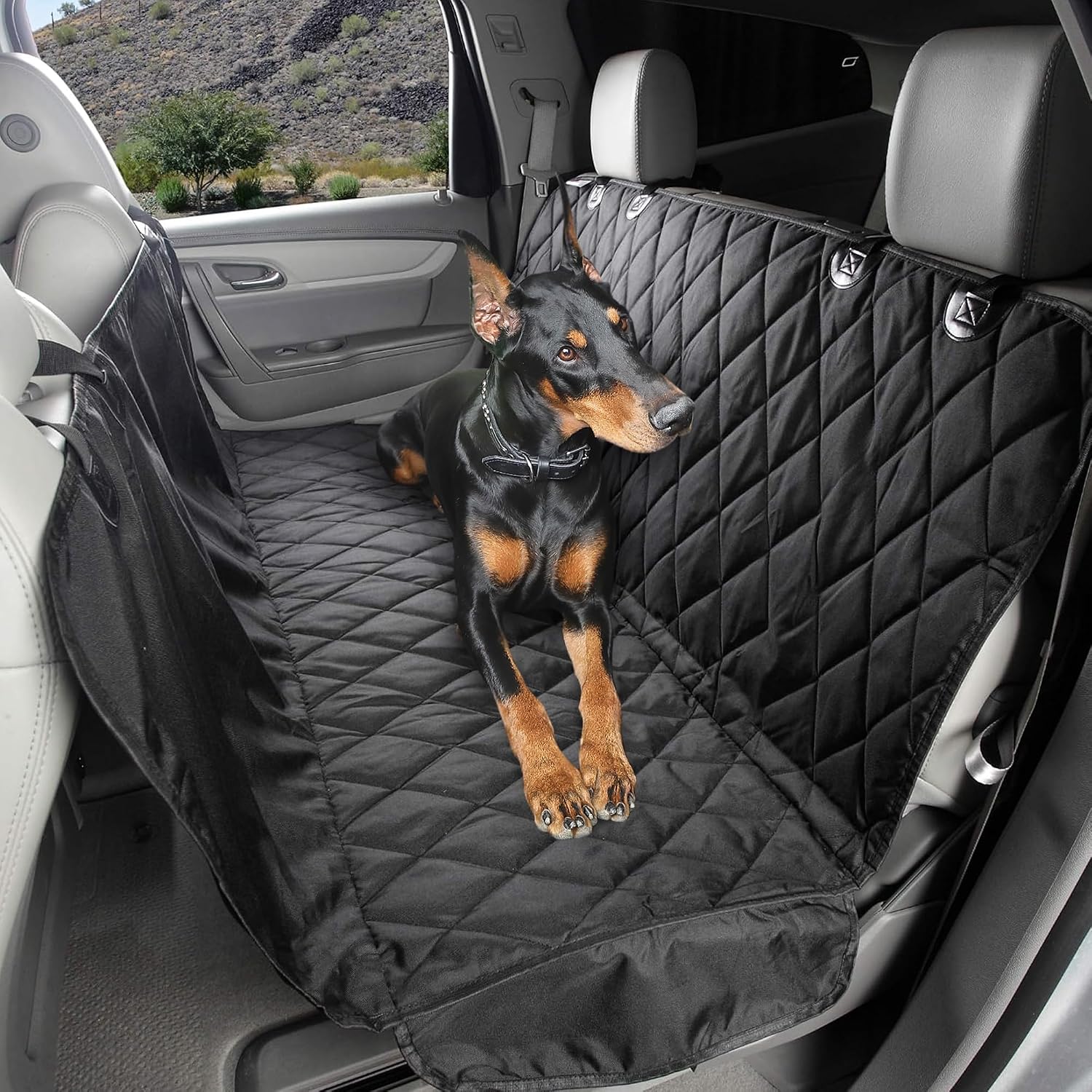
4Knines hammock-style rear seat cover, black, extra large
4Knines describes this as a 60-inch hammock-style cover for the back seat of cars, trucks, and SUVs, made to keep dirt, spills, and hair off the upholstery. Measure the bench before you buy a 60-inch cover. The AKC treats a seat cover as upholstery protection and still wants the dog restrained. If the cover blocks a buckle the seat belt needs, it is the wrong cover for that car. 4Knines says the material is not chew-proof, so a dog who is left alone with it can eat it. A hammock does not hold a Golden in a stop.
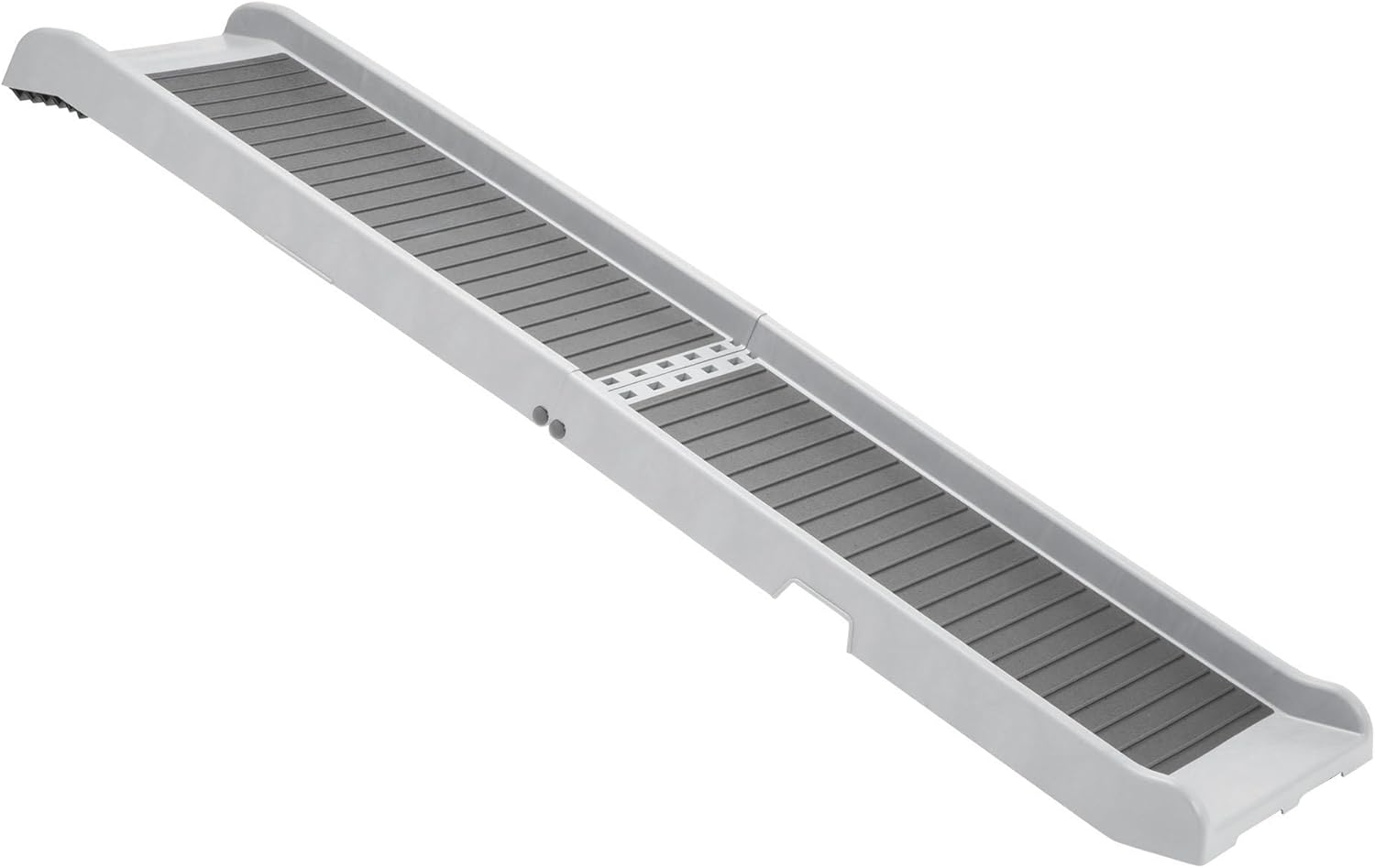
WeatherTech PetRamp, 67 x 15 inches, for dogs up to 300 pounds
A folding ramp with a traction surface for getting a large dog into the car, or onto a couch or a bed. It is a loading tool. It is not a restraint, and it does not make the front seat acceptable. Practice on a quiet day, with a person beside the ramp, before a clinic trip. A Golden who hesitates because the hips hurt should be read with the arthritis guide, not pulled up the ramp by the collar.
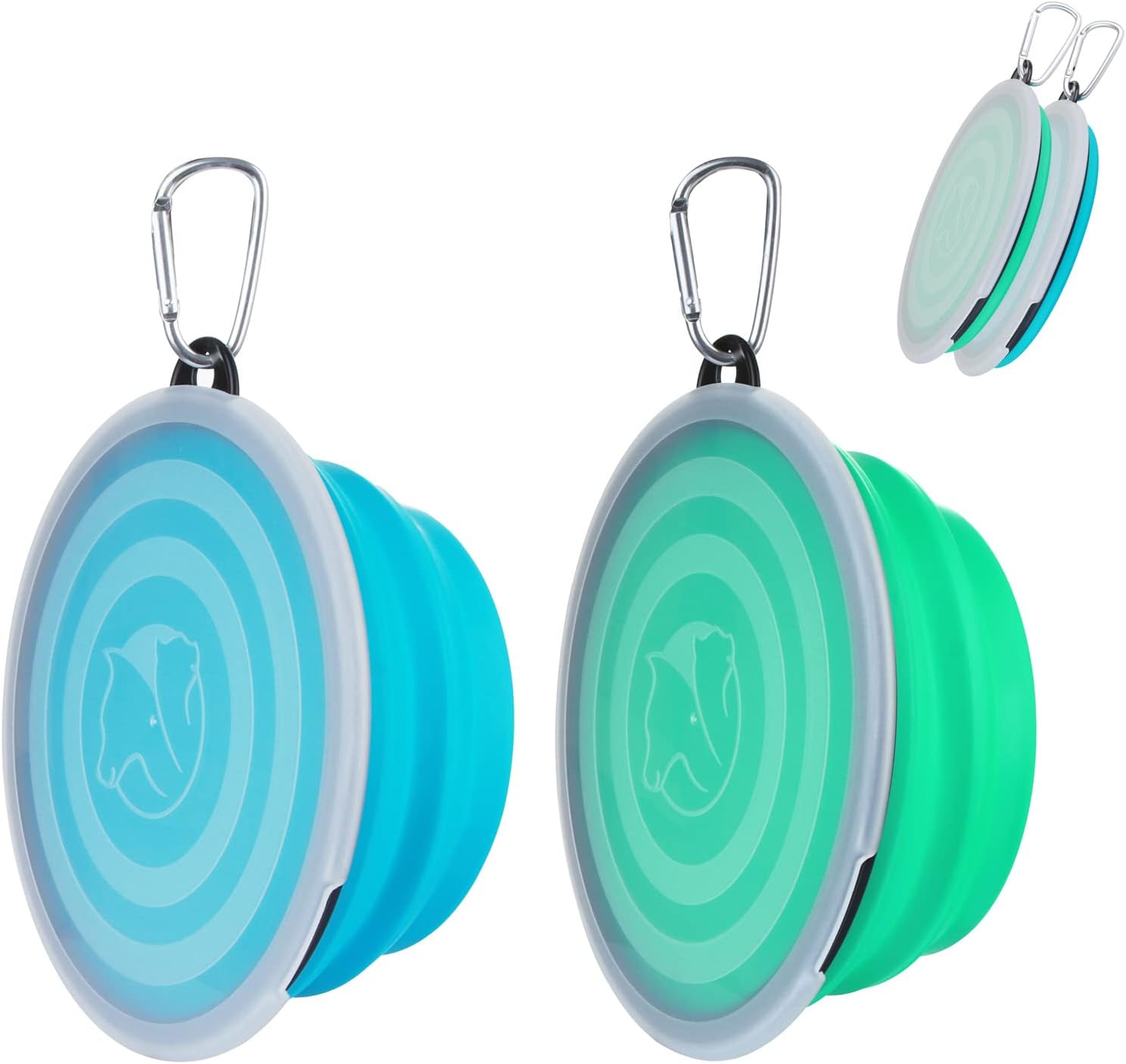
SLSON collapsible travel bowls, large, light blue and green, two pack
SLSON's large size is 6.8 by 4.9 by 2.9 inches when open and holds 34 ounces, about 4.2 cups. That is a rest-stop bowl for a Golden, not a full day's water. SLSON says the lids are not airtight and are not leak-proof. They keep dust off. Fill the bowl when you are stopped, offer the drink, and pack it dry. The AKC's break every few hours is the schedule. Hot-day water rules live in the heat safety guide.
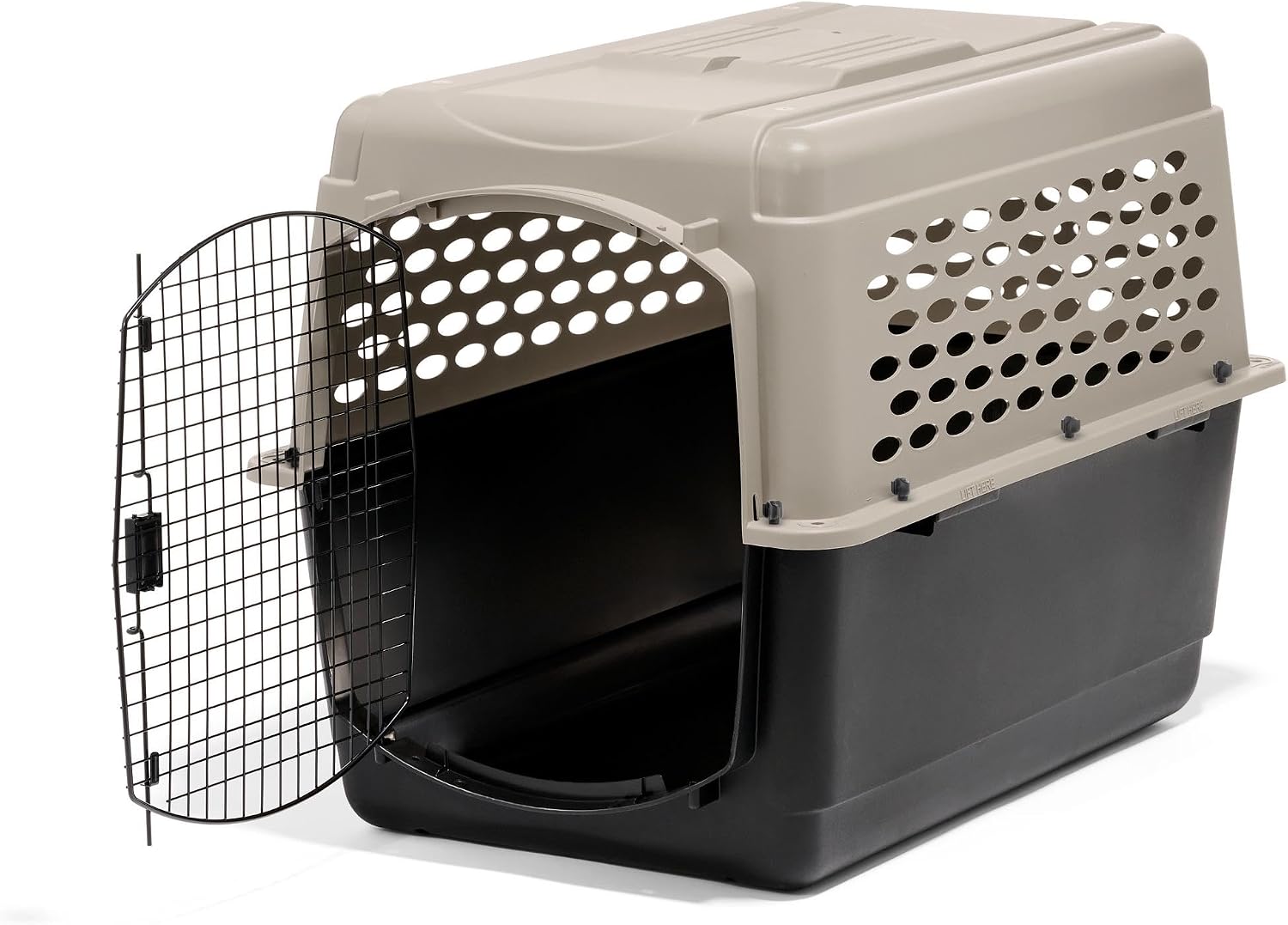
Petmate Vari Kennel, 40 inches, taupe and black
Petmate rates this hard-sided kennel for dogs of 70 to 90 pounds, with interior dimensions of 36.2 inches long, 24.7 inches wide, and 28.8 inches high. The AVMA's test is the dog in front of you: room to stand, turn around, and lie down. A taller Golden can fail that test inside the weight range. Petmate says the kennel meets most airline cargo specifications. Confirm a flight with the airline. In a car, put it near the center and secure it so it cannot slide. Petmate does not present this kennel as Center for Pet Safety crash-tested equipment. It is a travel kennel you anchor, not a loose crate in the cargo area and not a wire pen.
Questions owners ask
Can I leave my Golden in the car if I crack the windows?
No. The AVMA says cracking the windows makes no difference, at any outdoor temperature, for any length of time. On a 70°F day the interior can pass 110°F. The AKC's version of the 20-minute mark is 100°F inside a car parked in 70°F weather. Shade does not cancel the timetable. If the dog is not yours, contact local authorities rather than waiting to see if the owner comes back.
Does a seat hammock count as restraint?
It protects the upholstery. The AVMA wants that harness on the seat belt, holding the dog upright, or a crate the dog can stand, turn, and lie down in, secured near the center of the vehicle. A cover that blocks the buckle is in the way of the actual restraint.
Can a Golden ride in the front seat?
The AKC puts the dog in the back seat so an airbag is not the surface the dog hits. The AVMA says an unrestrained pet in a collision may be crushed by a deployed airbag or thrown through the glass, and a dog on a lap blocks the driver's view. The back seat, restrained, is the setup both describe.
Is it safe to let a Golden hang their head out the window?
The AVMA, the AKC, and the criticalist quoted by AVMA News all say to stop the practice. Debris and the air itself injure eyes and faces. A turn or a stop can throw the dog out. A dog can also jump. Close the rear windows and leave the restraint on.
Can my Golden ride in the bed of a pickup?
Loose, no. The AVMA says an unrestrained dog in a pickup bed is dangerous and illegal in many states, and that a tether can tangle, injure, or choke. If the bed is unavoidable, use a secured, ventilated kennel of the right size. Inside the passenger cabin, AVMA News is equally plain that restraint is a recommendation rather than a federal buckling rule. The recommendation is still to restrain the dog.
What should I give for motion sickness, and how much?
Ask your veterinarian. VCA lists maropitant (Cerenia), dimenhydrinate, and meclizine as anti-nausea options and tells owners to get the dose and the schedule from the clinic. Those drugs address nausea, not fear. The veterinarian sets the amount and the timing. Do not copy a human label. If anxiety is part of the ride, that is a second conversation with the same veterinarian, sometimes started days before you leave. VCA's training steps, the empty-stomach advice, and the short pleasant trips come first.
How do I teach a puppy that the car is safe?
VCA's order is engine on and parked, then out of the driveway and back, then around the block, then up to 20 or 30 minutes, with praise and a food reward, and a stop on the day the puppy is clearly afraid. The AKC adds destinations the puppy likes, a helper for the first rides, and a walk before you leave. Puppies often outgrow the nausea by about a year. A puppy who only rides to the clinic learns the clinic. Skip the meal immediately before the ride. The clock for that meal is the veterinarian's if the puppy is on a set feeding plan.
Sources
Never leave a pet alone in a parked vehicle, cracked windows make no difference, the interior temperature timetable from 19°F at 10 minutes to 50–55°F at two to four hours, cold-car risk for young, old, ill, or thin pets, loose pets and pedals, laps, airbags, and windows, a walking harness versus a crash-tested vehicle harness that holds the dog upright, crate size and placement, pickup beds illegal in many states, tethers that can choke, and a secured ventilated kennel if a truck bed is unavoidable: AVMA, pet safety in vehicles.
No federal restraint rule for pets in cars, NHTSA's 2020 count of 3,142 deaths in crashes resulting from distracted drivers, the Center for Pet Safety as the nonprofit publishing test results, airbag and window injuries, and the AVMA policy preferring a secured ventilated kennel in an open cargo area: AVMA News, data and safety regulations for pets and vehicles.
A car parked in 70°F weather reaching 100°F in 20 minutes, 140°F in less than an hour on very hot days, cracked windows, 31 states with laws on unattended pets in vehicles, contacting local authorities, an engine left running, airbags and windshields, Center for Pet Safety certification, open windows, and pickup beds: AKC, dogs in hot cars. Meals several hours ahead, exercise before the trip, short pleasant rides, water and potty breaks every few hours, the back seat rather than the front, closed rear windows, and asking a veterinarian about nausea medicine: AKC, keeping a dog comfortable during car rides.
Motion sickness more common in young dogs and often outgrown by about a year, the sign list, ear and vestibular disease, the parked-car-to-20-minutes training sequence, withholding food for up to 8 hours when that is not too stressful, and the instruction to ask a veterinarian for the dose of maropitant, dimenhydrinate, or meclizine: VCA Animal Hospitals, motion sickness in dogs.
Sleepypod Clickit Range, tested November 2024, passed, 5 star, protocol CPS-001-014.01, test number V241364F, test dog 110 pounds, sizes small through extra large: Center for Pet Safety, Sleepypod Clickit Range.
P.S. Get the free Golden Retriever Owner Cheat Sheet — daily feeding, sleep, and care in one printable guide.
Get the Cheat Sheet when you join the newsletter — instant access in your welcome email.