
Golden Retriever Cold Weather
By JJ Allan (goldenretriever.hair)
A Golden Retriever can enjoy a cold day and still get into trouble on it. The American Veterinary Medical Association says the belief that fur makes dogs and cats resistant to cold is untrue. Thick-coated dogs handle cold better than short-coated ones. No pet should be left outside for a long stretch in below-freezing weather. Frostbite and hypothermia are on the list for every dog, including this one.
This page is the winter half of weather safety. The heat-safety guide is the hot half. Paws that crack, burn, or collect ice are here in brief, and the paw care guide is the rest of the year. Nothing here is a drug dose. If the dog is weak, confused, or may have licked antifreeze, salt, or ice melt, the next step is a veterinarian, not a longer walk.
This guide is general information, not veterinary advice. Every dog is different, so check with your veterinarian before changing winter routines or using a new paw product, and see a vet right away if your Golden is weak, confused, limping, or may have swallowed salt, ice melt, or antifreeze.
How cold a Golden actually tolerates
AVMA says cold tolerance varies with coat, body fat, activity, and health. Long-haired and thick-coated dogs tend to tolerate cold better, and they are still at risk. Very young and very old pets, and dogs with diabetes, heart disease, kidney disease, or a hormonal problem such as Cushing's disease, have a harder time holding body temperature. Arthritis can worsen in the cold, and icy footing is where an older dog slips.
The American Kennel Club's winter-coat article quotes Dr. Jolee Stegemoller, a veterinarian. She says there is no exact temperature that is too cold for all dogs. She looks at whether the dog has a double coat, and she uses Husky, Malamute, and Labrador Retriever as the examples, plus medical concerns such as being underweight, heart disease, and arthritic joints. A Golden is a large double-coated retriever in that same family of coats. She is not publishing a Golden-only study. Her practical line is this: if the wind chill is below 20°F, keep play to 15 to 20 minutes, then let the dog warm up inside. She also says that if a person can be out and enjoy the weather in the right clothes, most dogs can be out too. That is a judgment, not a promise that a wet Golden can match a person in a parka.
VCA's winter safety tips are stricter and they are written for dogs in general, not for this breed alone. That page says precautions start when the temperature drops below 32°F, and that at 20°F or lower even a short walk can be risky once wind chill is included. It suggests limiting walks to 5 to 10 minutes below 20°F, with a coat and booties. Those two published windows, 5 to 10 minutes and 15 to 20 minutes, do not agree. Use the shorter end for a puppy, a senior, a thin dog, a clipped dog, a wet dog, or a dog with heart or joint disease. A healthy adult who is moving can have a brief active outing in that cold and then go in. Neither number is a reason to leave any Golden outside.
The ASPCA's cold-weather tips put it in one sentence: if it is too cold for you, it is probably too cold for your pet, so keep the animal inside. Cars in cold weather can hold the cold the way a refrigerator does. Do not leave a Golden in one. The car travel guide is the rest of that problem.
| Conditions | What a published source says | How to use it for a Golden |
|---|---|---|
| Above freezing, dry air, dog moving | AVMA: thick coats tolerate cold better than short coats, and tolerance still varies by dog. AKC: large dogs with thick coats are generally protected, and there is still no universal cutoff. | A healthy adult can usually take a normal walk. Watch wind. Dry the dog after. End it if the dog slows, shivers, or lifts a paw. |
| Below 32°F (0°C) | VCA's winter page: this is when to take precautions. AVMA: do not leave a pet outside for long periods below freezing. | Shorter outing. Paw check. Wipe feet, legs, and belly. Puppies and seniors get less time than a fit adult. |
| At or below 20°F, especially with wind chill | VCA: even short walks can be risky, and that page suggests 5 to 10 minutes plus a coat and booties. AKC's Dr. Stegemoller: wind chill below 20°F means 15 to 20 minutes of play, then warm up inside. She says a double coat and the dog's health change the picture. | Use the shorter end for a puppy, senior, thin, wet, clipped, or sick Golden. A healthy adult who is trotting can have a brief active outing, then go in. Do not leave the dog standing outside. |
| Wet coat, standing still, or weather you would not stay out in | ASPCA: if it is too cold for you, it is probably too cold for your pet. VCA: wet or damp skin is more vulnerable to frostbite. AVMA: a wet sweater or coat can make a dog colder. | Inside. Dry the dog. A jacket does not replace the door. |
The table is a set of published cautions, not a thermometer that fits every Golden. AVMA says to ask your own veterinarian if you need help setting your dog's limits.
What the coat does, and what it does not
The breed was developed as a retrieving gundog in Scotland's cool, wet climate. That history is in the history guide. The coat that came with the job is a dense undercoat under longer guard hairs. The coat types guide is how feathering and density vary by line. None of those lines is a husky, and AVMA's own example of a cold-bred coat is the husky, with the same warning attached: do not leave the dog out.
ASPCA says never shave a dog down to the skin in winter, because a longer coat provides more warmth. On a long-haired dog, a tidy trim that keeps ice balls and salt from clinging is the cut they describe, including the hair between the toes. A shaved Golden loses the insulation the breed has. The grooming guide is the rule against shaving, in summer and in winter.
Mats are a winter problem of their own. A mat holds moisture against the skin. Brush so the undercoat can do its job, using the grooming guide. AVMA says you can reduce ice balls by clipping the hair between the toes. That is a tidy, not a shave. The paw guide shows the trim.
VCA's frostbite page says paws, ears, and tail are the usual sites, and a wet or damp dog is more vulnerable there. AVMA says a wet sweater or dog coat can make the dog colder, so have a dry one if you use one at all. Towel the chest, belly, feathering, and feet when you come in. A Golden who swam or rolled in slush is not insulated until that water is out of the coat. The swimming guide is the water itself. Winter ponds that look frozen are a separate hazard: AVMA says stay off them, because you cannot know whether the ice will hold, and a dog through the ice can drown.
Paws: ice, salt, and ice melt
AVMA's walking page says icy paths slip, broken ice cuts feet, and a path that is cold enough can frostbite the feet. A sudden limp on a walk may be a cut or a ball of ice between the toes. Check before you decide the dog is being dramatic.
VCA's winter-prep page says salt and other melting chemicals have varying toxicity depending on the ingredient and the amount swallowed. They can burn pads. If the dog then licks the feet, the mouth can burn too. Wipe with a damp towel after any exposure, and read the label of whatever you put on your own steps.
ASPCA's list is the same job in more detail. Massage petroleum jelly, or another paw protectant your veterinarian is fine with, into the pads before you go out. Wash and dry the feet and stomach after the walk. Look for cracks and for redness between the toes. Booties, if the dog will wear them, keep salt and sand out from between the toes. Use a pet-friendlier ice melt on your own property when you can. Ice melt can still be dangerous if it is eaten, so the jug stays closed and up.
Booties are a barrier, not a personality. AVMA says if you use them, they have to fit. A boot that twists, rubs a dewclaw, or comes off in the street is not protection. Practice indoors for a few minutes before the first salted walk. If the dog still fights them after those indoor tries, skip the shoes and use wax plus the wipe.
A wax on intact pads is the step that does not depend on the dog agreeing to shoes. It is not a treatment for a pad that is already split or bleeding. That pad goes to the clinic.
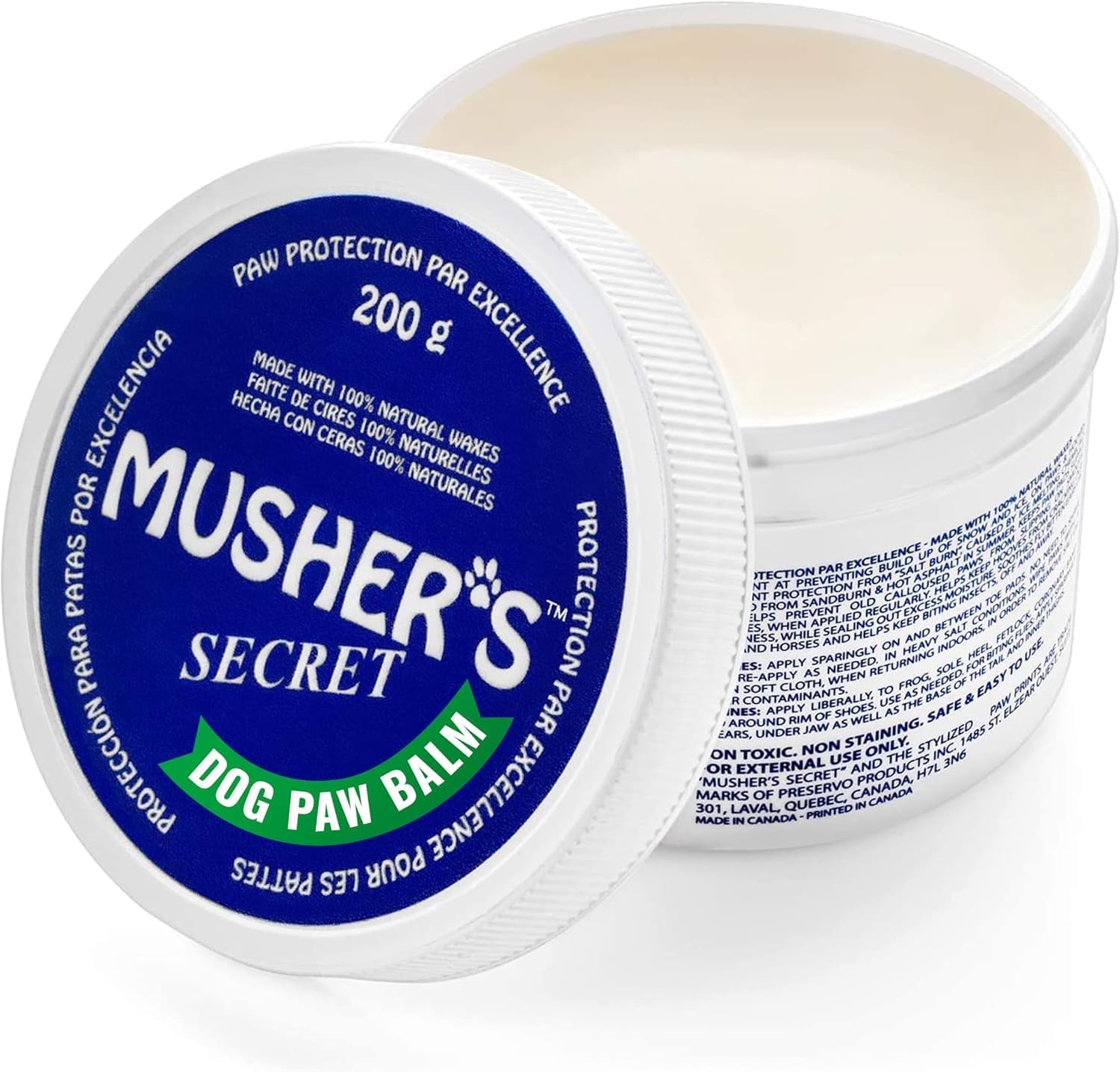
Musher's Secret paw wax, 60 gram tin
This is a wax barrier for intact pads, the kind sled dogs have used in snow. Rub a thin layer into the pads, and between them when snow is balling up, before a salted or icy walk. It is not a medicine, and it is not for a pad that is split, bleeding, or infected. Those need the clinic. If it smears onto the floor, you used too much. The paw care guide is the rest of the year, including nails and the hair between the toes.
On your own steps, AVMA suggests a pet-safe de-icer on your own property instead of ordinary salt. Pet-safer melts are for the concrete you control. They are not a reason to skip the wipe, and they are not a snack. AVMA still says de-icers can make a pet sick if swallowed, and to keep the dog off areas where they have been spread when you can.
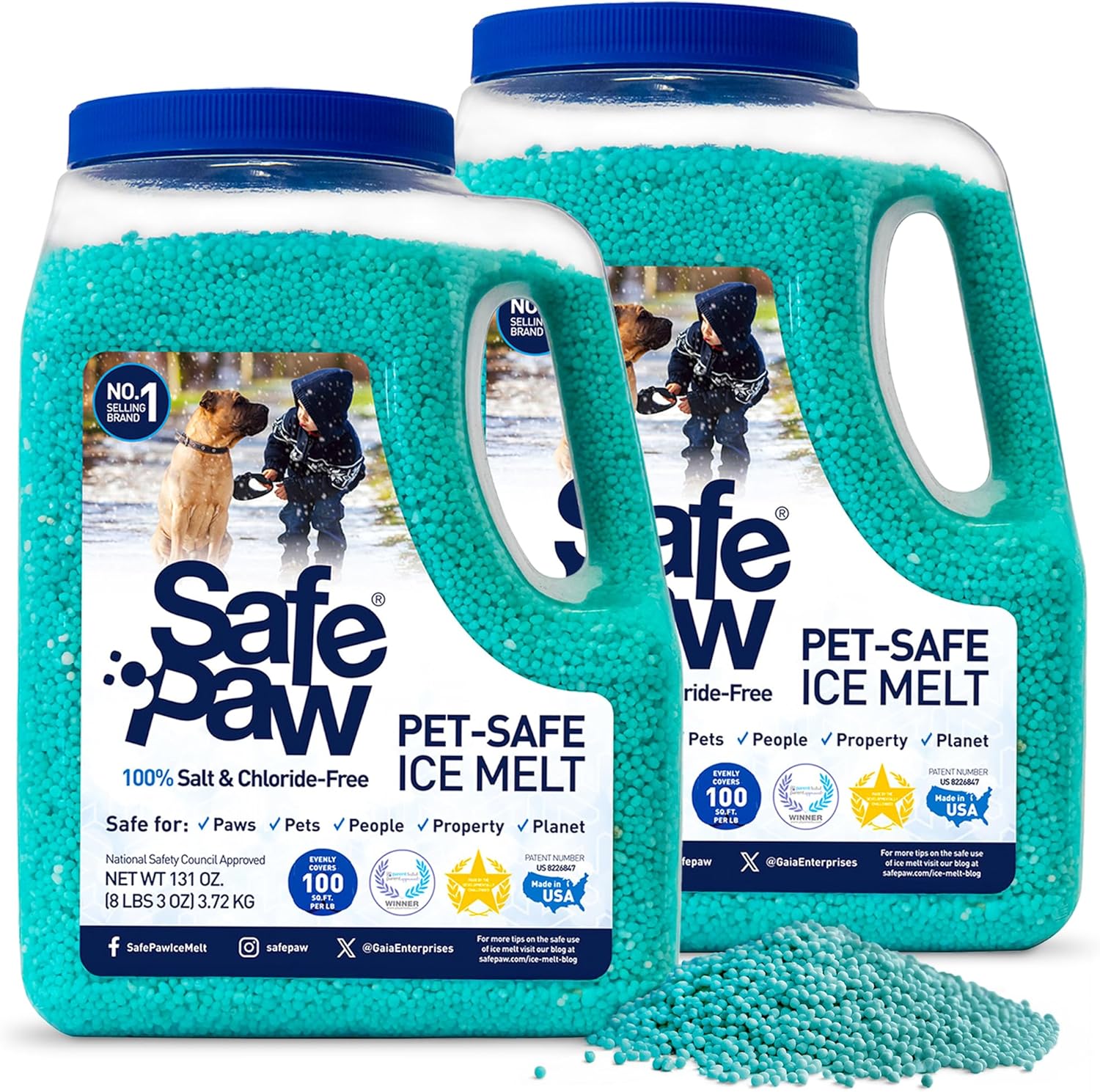
Safe Paw salt-free ice melt, two 8-pound jugs
This is a salt-free, chloride-free melt for your own steps, walk, and patio, sold as a pet-safer swap for rock salt. Spread it on the surface you need clear. Keep the jug closed and out of reach. It is not food. AVMA still says swallowed de-icer can make a dog sick. Wipe the feet, legs, and belly after the walk anyway.
Antifreeze
AVMA says clean up antifreeze spills quickly and keep the containers away from pets, because even small amounts can be deadly. VCA's winter page says antifreeze, also called ethylene glycol, tastes sweet, and a small amount can cause permanent, fatal kidney damage. Store it closed and out of reach. Wipe spills at once. If any is swallowed, go to emergency care so treatment can start. Do not wait to see if the dog seems fine. Do not try a home remedy, and do not give a human pain reliever.
ASPCA says the same about spills, and it suggests considering a product that uses propylene glycol rather than ethylene glycol when you buy coolant. That is a purchasing choice, not permission for a dog to drink either one. Ice-melt chemicals belong in the same locked-up category. If you think any of it was swallowed, call your veterinarian or ASPCA Poison Control at (888) 426-4435.
The puddle is not only in the driveway. It rides in on paws and gets licked off the belly on the rug. That is why the wipe happens before the nap.
Hypothermia and frostbite
AVMA's cold-weather page treats these as "get inside now" signs: whining, shivering, anxiety, slowing down or stopping, weakness, or searching for a warm place to burrow. That is the end of the walk, not a reason to push through because you are close to the park. The same page says frostbite is harder to see and may not be obvious for a few days. If you suspect hypothermia or frostbite, call a veterinarian immediately.
VCA's temperature page puts numbers on it, and it warns that you cannot tell from looking. A normal dog temperature is about 100.0°F to 102.5°F (37.7°C to 39.2°C). A reading below 99°F (37.2°C) is an emergency on that page. Hypothermic pets may be lethargic, less alert, and they may shiver. Those same signs happen with other illnesses, so the number is how you know, if you already have a way to take it safely. A dog who has collapsed does not wait on a thermometer.
The AKC hypothermia article uses the same 99°F line for the start of mild hypothermia, then clinical bands: mild at 90 to 99°F, moderate at 82 to 90°F, and severe under 82°F. Those bands are for the clinic's picture of how low the core temperature has gone. They are not a home scale for deciding to wait. The article says bring the dog somewhere warm and contact a veterinarian immediately. It also says a wet or damp dog is more vulnerable to frostbite, which matches VCA.
VCA's frostbite signs are: skin that is pale, gray, or bluish; tissue that feels cold or brittle; pain when you touch it; swelling; licking or chewing at the spot; blisters or ulcers; and skin that turns black. As it thaws it can become red and painful. Ears, paws, and the tail tip are the usual places, and the change can take days, especially on an ear or a tail the dog is not walking on. Dogs with heart disease, diabetes, or anything else that cuts blood flow to the feet are at higher risk.
If you are already on the way to the clinic, VCA's first-aid limits are the ones that prevent a second injury. Get the dog to a warm, dry place. Warm the body slowly with dry towels or blankets. Do not rub or massage frostbitten skin. Do not use a heating pad or a hair dryer. If you warm a frozen patch outdoors, do not let it freeze again. If you warm a frostbitten area with water, use water you can comfortably put your hand in. VCA's range is 98.6°F to 113°F (37°C to 45°C). Pat dry. Do not give pain medicine unless the veterinarian tells you to. Acetaminophen and aspirin can be toxic to dogs. The clinic decides on pain control. Severe cases can need tissue removed. The clinic decides when.
When to call the vet
Call an emergency clinic, and poison control if a chemical is involved, for any of these:
- 🐾Any amount of antifreeze may have been swallowed, even if the dog still looks normal.
- 🐾The dog licked salt or ice melt and is vomiting, weak, or painful in the mouth.
- 🐾Collapse, confusion, a dog who will not get up, or breathing that is shallow and slow. AVMA's walking page names muscle stiffness, shallow slow breathing, and collapse as the severe hypothermia picture, and it says that needs immediate care.
- 🐾A temperature you have measured below 99°F (37.2°C).
- 🐾Ears, paws, or tail that look pale, gray, blue, blistered, or black, or that the dog will not let you touch.
- 🐾A limp that is still there after you have melted the ice from between the toes and rested the dog.
Call the regular clinic the same day for a pad that is cracked and bleeding, redness that spreads, a smell from the feet, or a senior who is much stiffer after a cold walk than usual. Shivering that stops within a few minutes of being inside, dried off, and wrapped in a blanket usually means the outing ended in time. Shivering that continues, or a dog who stays dull, is the call.
While you drive, wrap the dog in dry towels warmed in the dryer. Do not pour hot water on the feet. Do not rub. Do not offer a human pain tablet.
Puppies, seniors, and a coat when one is actually useful
AVMA groups the very young and the very old together: they get cold faster, and they regulate temperature less well. The puppy care guide is the age where a long hike was already a bad idea. In the cold, that hike gets shorter. A puppy who is shivering on a potty trip is done.
Seniors pick up two extra problems. Arthritis hurts more in the cold, and ice is where they fall. The arthritis guide is the joint page. AKC's Dr. Stegemoller says puppies and seniors of every breed are more susceptible than a healthy adult, and that dogs with arthritis may benefit from a coat. She tells you to ask your veterinarian before you decide your own dog needs one.
ASPCA reserves the sweater recommendation, in that article, for a short-haired dog: a coat with a high collar, covering from the base of the tail to the belly. A Golden is not that dog on a mild day. A Golden who has been shaved, who is underweight, who is old and stiff, or who is clearly bothered on a short outing is the Golden who might wear one. AKC says a jacket has to let the dog walk, run, and toilet, and it should not be so loose that the dog can get tangled. Measure the back and the chest. Dr. Stegemoller adds that coats collect hair and stay damp, and a damp coat put away wet can grow bacteria. It comes off indoors, and it gets washed.
A coat is not a substitute for being inside. AVMA is explicit that clothing does not replace proper care, and that pets are safer where the temperature can be controlled.
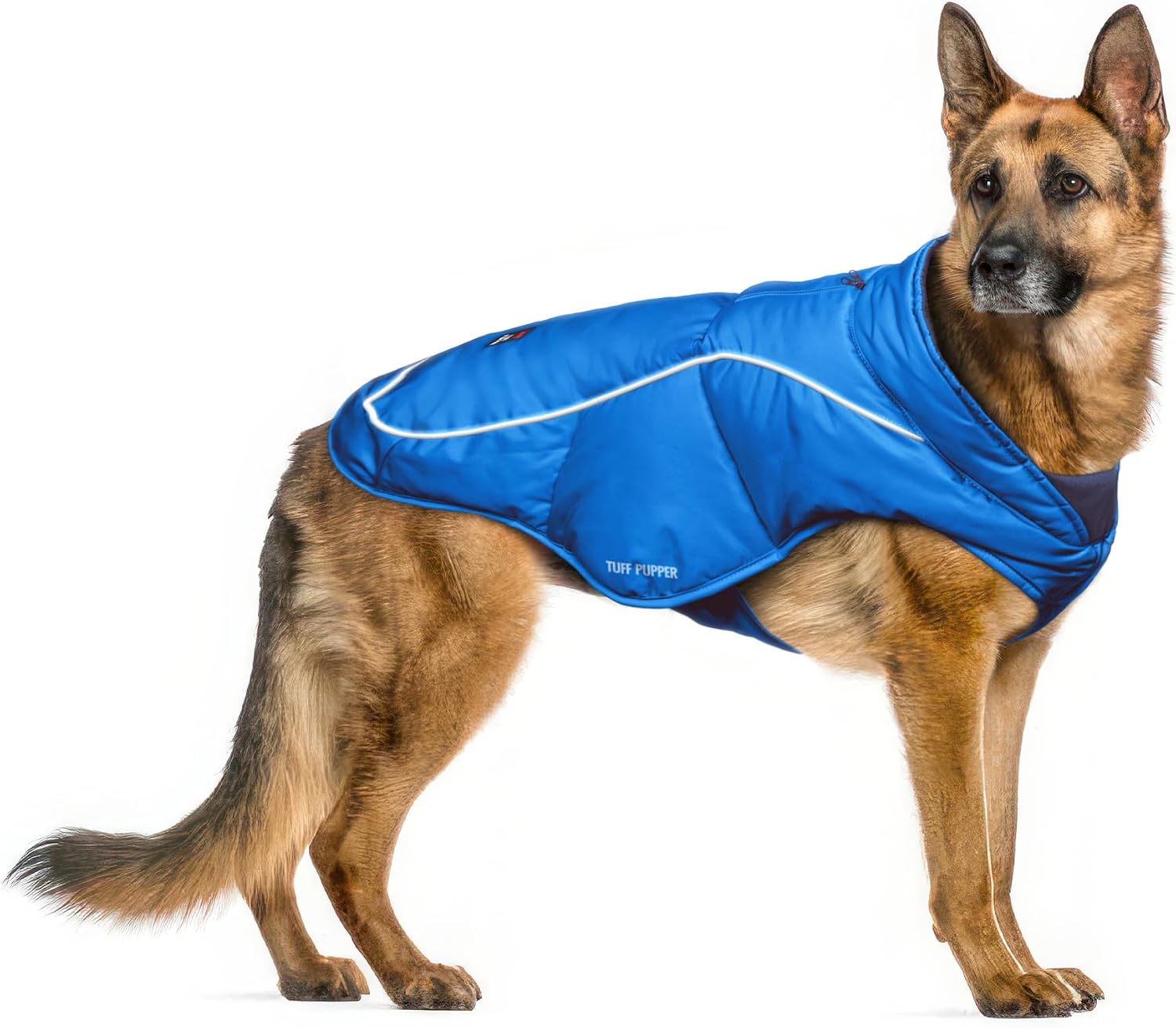
Tuff Pupper insulated winter coat, blue, X-large
This is a padded, reflective coat with a harness opening and belly straps, in an X-large. Measure the back and the chest against the size chart before you assume it fits your Golden. The XL is a 34 to 45 inch chest and a 32 inch back. Many female Goldens fit the Large (30 to 36 inch chest, 26 inch back) better. It is for a dog who is bothered by the cold, a puppy, a senior, a thin dog, or a dog whose coat was clipped. A healthy adult on a short, dry walk often does not need it. Take it off when it is wet. AVMA says a wet coat can make a dog colder, and it does not replace coming inside. The heat-safety guide is why this same dog should not be wearing it in July.
Exercise, and the part that happens in the house
A Golden who loses the whole walk for three months gets restless, and often heavier. The exercise needs guide and the exercise chart are the age totals. On a mild winter day, a healthy adult can keep a normal walk if the table above still says yes. On a day at or below 20°F, trade one long outing for two short ones, or for one short one plus work indoors. Brisk movement is safer than standing still while you talk. The hiking guide is the long day, and it waits for weather that is not this page's bottom row.
Indoors, use what the dog already knows. Five minutes of the obedience guide is real work. A scatter of kibble in the grass of a snuffle mat, or a handful hidden in a room for the dog to find, spends a nose that would rather be outside. The behavior guide is what shows up when that energy has nowhere to go. Keep the footing boring and grippy. Ice is outside. A wet floor inside is the senior's other fall.
ASPCA says more dogs are lost in winter than in any other season, because snow covers scent. ASPCA says never let the dog off leash on snow or ice, especially in a storm. A light helps drivers see the dog on a dark sidewalk. It does not replace the tag, the leash, or a fence. The yard and fence guide is the boundary. Dusk walks are when the light earns its place.

Blazin light-up collar, large, blue
This is a rechargeable nylon collar with lights along the strap, in the large size, for a dark winter walk. That large size is the one meant for a bigger neck. Measure before you order, and keep an ID tag on the dog. ASPCA's winter advice is a tag and a leash, especially in snow, because scent disappears and more dogs are lost in this season. The light helps a driver see you. It is not a coat, and it is not a reason to stay out longer.
ASPCA also says pets burn extra energy staying warm and may need a little more food in winter. That note fits an animal who is actually spending hours in the cold. A Golden who lives in a heated house and takes shorter walks does not automatically get a bigger bowl because the month changed. Extra food without extra work is how winter weight arrives. The weight guide is the check. Water stays available and unfrozen. A bowl of ice is not a drink.
Sleep off the draft. ASPCA wants a warm bed up off a cold floor. That is comfort, not treatment.
Questions owners ask
Can Golden Retrievers handle cold weather?
Better than a short-coated dog, and not well enough to live outside. AVMA says thick coats tolerate cold better and that no pet should be left out for long periods below freezing. A healthy adult can usually walk and play when it is merely chilly and dry. Wind, wet fur, age, and illness shrink that window.
How cold is too cold for a walk?
There is no single number. VCA says take precautions below 32°F, and that at 20°F or lower even a short walk can be risky with wind chill. That page suggests 5 to 10 minutes below 20°F. AKC's Dr. Stegemoller suggests 15 to 20 minutes of play when the wind chill is below 20°F, then a warm-up inside, and she says a double coat and the dog's health change the advice. Use the shorter end for a puppy, a senior, or a dog who is thin, wet, clipped, or sick. If you would not stand out there, bring the dog in.
Does my Golden need a winter coat?
Often no, for a healthy adult on a short dry walk. AKC says large dogs with thick coats are generally protected, and that puppies, seniors, arthritic dogs, and dogs with clipped coats are the ones who may need a layer. AVMA says a coat is for a short-coated dog or a dog who seems bothered, and a wet coat can make the dog colder. Measure the back and chest. Take it off indoors. It does not replace the house.
How do I protect paws from salt and ice?
Wipe or wash the feet, legs, and belly after every walk. AVMA suggests clipping the hair between the toes so ice has less to grab. A thin layer of paw wax on intact pads, or booties that actually fit, is the barrier before you leave. On your own steps, a pet-friendlier melt is better than rock salt, and the dog still should not eat it. Bleeding cracks and a limp that remains after the ice is gone are a veterinary visit.
What does hypothermia or frostbite look like?
Shivering, whining, slowing down, weakness, or trying to burrow are AVMA's signs to go inside. Weakness, confusion, collapse, or slow shallow breathing are the emergency picture. VCA says a body temperature below 99°F is an emergency, and that you cannot be sure from looking alone. Frostbite favors ears, paws, and the tail: pale, gray, or blue skin, pain, blisters, or skin that later turns black. It can take days to show. Do not rub it, and do not use a hair dryer or a heating pad.
Are puppies and seniors different in the cold?
Yes. AVMA says the very young and the very old handle temperature swings less well, and that arthritis is worse in the cold. AKC says the same about puppies, seniors, and arthritic dogs, and that they are the dogs who may benefit from a coat. Give them shorter outings, dryer towels, and a grippy path. A senior who is much stiffer after one cold walk should be seen.
What if my dog licked antifreeze or ice melt?
Treat antifreeze as an emergency even if the dog looks normal. AVMA says even a small amount can be deadly. VCA says a small amount of ethylene glycol can cause permanent kidney damage, and the dog needs emergency care. Call your veterinarian or ASPCA Poison Control at (888) 426-4435. For ice melt and rock salt, vomiting, weakness, or a burned-looking mouth after a walk is also a call, not a bowl of milk or a human pain tablet.
Sources
No pet left outside for long periods below freezing, thick coats tolerating cold better without removing the risk, arthritis and age and chronic disease as reasons to shorten time outside, paw checks and ice balls, clipping hair between the toes, wiping feet, legs, and belly, pet-safer de-icers, antifreeze spills, frozen ponds, wet sweaters making dogs colder, and the signs that mean get inside and call: AVMA, cold weather animal safety. Ice, cuts, frostbite on a cold path, coats for a short-haired or cold-sensitive dog, and immediate care for stiffness, shallow breathing, or collapse: AVMA, walking or running with your dog.
No single temperature for every dog, double coats as a factor, wind chill below 20°F and 15 to 20 minutes of play, and coats for puppies, seniors, arthritic dogs, and clipped coats: American Kennel Club, does my dog need a winter coat, quoting Dr. Jolee Stegemoller. Hypothermia beginning when body temperature falls below 99°F, the mild, moderate, and severe bands, wet fur and frostbite, and contacting a veterinarian immediately: American Kennel Club, hypothermia in dogs.
Precautions below 32°F, risk at 20°F and lower, the 5 to 10 minute suggestion, coats and booties, cars in cold weather, frostbite on ears, tail, and toes, and antifreeze as a small-amount kidney emergency: VCA, dog winter safety tips. Salt and ice-melt burns on pads and in the mouth, and wiping feet: VCA, preparing your pets for winter. Normal temperature 100.0°F to 102.5°F, below 99°F as an emergency, and shivering as a possible hypothermic sign that still needs a reading: VCA, taking your pet's temperature. Frostbite sites, delayed signs, what not to do while you travel, and no pain medicine unless a veterinarian prescribes it: VCA, frostbite in dogs.
If it is too cold for you, it is probably too cold for your pet. Paw protectant before you leave, pet-friendlier ice melt, washing feet and stomach, not shaving to the skin, antifreeze spills, propylene glycol as a coolant choice, ID tags, leashes in snow, and Poison Control at (888) 426-4435: ASPCA, cold weather safety tips.
P.S. Get the free Golden Retriever Owner Cheat Sheet — daily feeding, sleep, and care in one printable guide.
Get the Cheat Sheet when you join the newsletter — instant access in your welcome email.