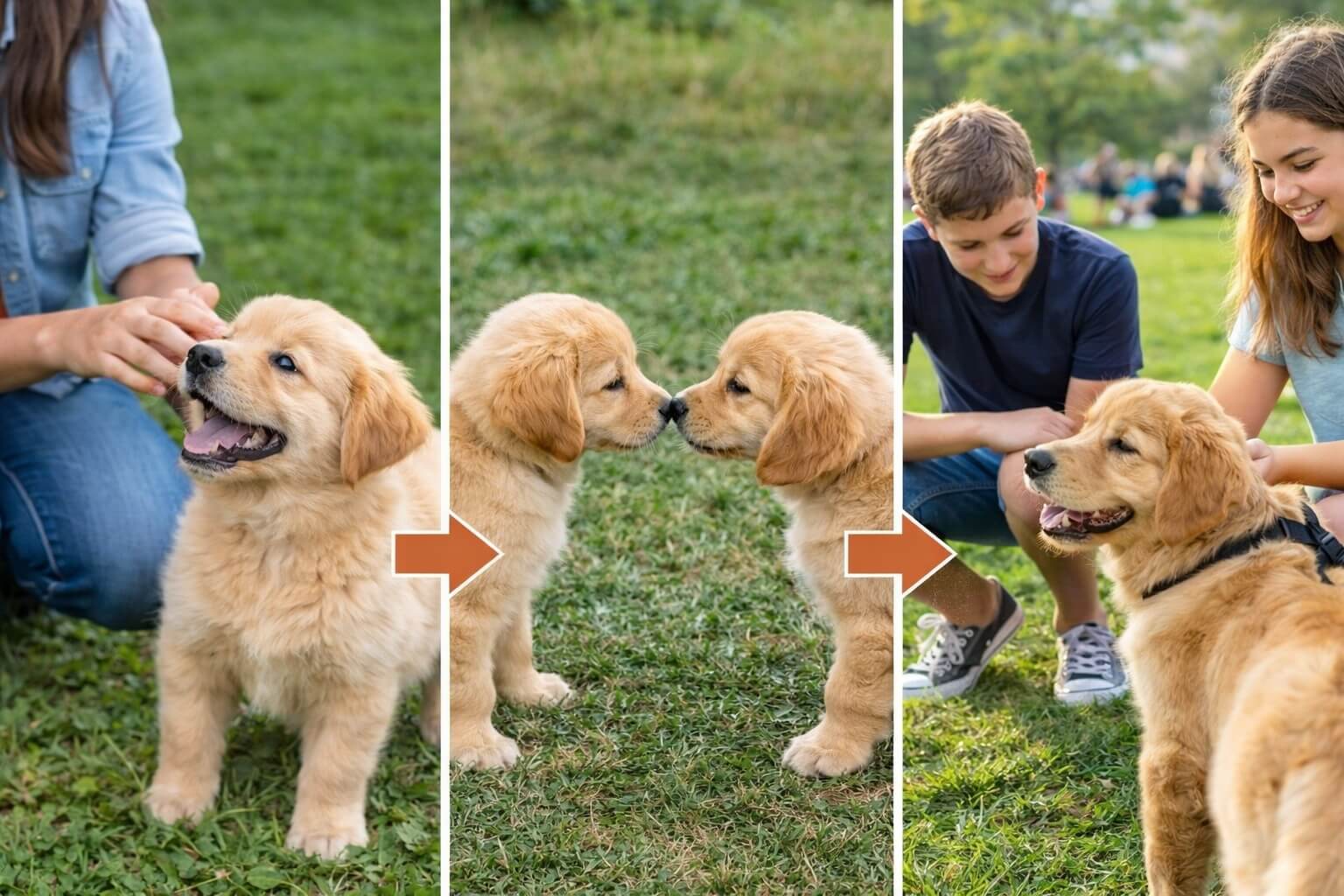
Golden Retriever Socialization Timeline (Puppy Stages by Age)
GoldenRetriever.hair
Socialization is critical during early puppy development. Positive, controlled exposure helps prevent fear, anxiety, and behavior problems; the chart below maps golden retriever socialization by age—for the full plan, see the Golden Retriever Socialization Guide.
Quick Answer: Puppy Socialization by Age
- 🐾8–12 weeks: Introduce new people, household sounds, and calm environments at home first; keep outings short and positive, following your vet’s guidance on disease risk vs. socialization.
- 🐾3–4 months: Expand to new surfaces, low-key public spots, and controlled greetings—still one small step at a time.
- 🐾4–6 months: Reinforce confidence with structured, predictable setups (e.g., polite greetings, familiar routes with new variables).
- 🐾6+ months: Keep going—socialization isn’t a checkbox; continue variety and positive experiences through adolescence.
Rule of thumb: If your puppy won’t take treats or shuts down, the situation is too much—create distance and try an easier version tomorrow.
Golden Retriever Socialization Timeline Chart
Typical puppy socialization stages for Golden Retrievers, aligned with our Socialization Guide (including the ~3–16 week sensitive period). Adjust for your puppy’s personality and health.
| Age | What to Introduce | How to Do It | What to Avoid |
|---|---|---|---|
| 8–12 weeks | Family handling, household noises, car rides (brief), visitors at puppy’s pace, different floor textures at home | Short sessions; high-value treats; let the puppy choose to approach; calm praise | Dog parks, crowded events, unknown sick dogs, being passed hand-to-hand, “tough love” exposure |
| 3–4 months | More people types (hats, wheels at distance), quiet public spaces, gentle known dogs with owner permission, mild novel sounds | Increase difficulty slowly; distance + duration control; leash calm in easy settings first | Long overstimulating outings, off-leash chaos, forcing meet-and-greets, ignoring fear signals |
| 4–6 months | Varied walking routes, polite stranger greetings, car routines, low-stress “real life” situations | Reward calm behavior; small wins; repeat successes before leveling up | Flooding (too many new things at once), punishment when scared, rough play with unknown dogs |
| 6+ months | Ongoing novelty and manners in adolescence; environments you’ll use as an adult (vet, pet-friendly stores if appropriate) | Keep a positive association; teens may need easier reps again—normal | Assuming socialization is “done”; skipping exercise/training balance (energy by age) |
For people, dogs, sounds, and places in more detail, read the full Golden Retriever Socialization Guide.
Why Socialization Is Important
- 🐾Reduces fear and anxiety by teaching “new” usually means safe, not threatening.
- 🐾Helps prevent behavior problems such as leash reactivity, avoidance, and fear-based barking—topics we cover in the Behavior Problems Guide.
- 🐾Builds confidence so your Golden can think instead of panic in new situations.
- 🐾Improves adaptability to visitors, travel, vet visits, and everyday life changes.
Signs of Poor Socialization
Often linked to too little positive exposure, bad experiences, or overwhelming outings:
- 🐾Fear of new people, dogs, or environments
- 🐾Excessive barking, lunging, or leash reactivity
- 🐾Avoidance, hiding, or shutdown (won’t take treats)
- 🐾Defensive behavior when cornered or scared
Slow down, add distance, and seek a qualified positive trainer for serious reactivity.
How to Safely Socialize a Golden Retriever
Golden retriever puppy socialization works best when you stack easy wins: short, pleasant reps beat rare “big days” that scare your pup.
- 🐾Introduce new experiences gradually – Distance, duration, and intensity one at a time.
- 🐾Use positive reinforcement – Treats, praise, and play during and after calm curiosity.
- 🐾Avoid overwhelming situations – Busy festivals and rough dog piles can create fear, not confidence.
- 🐾Repeat exposures consistently – Familiar routes with small new variables often beat constant novelty.
Pair exposure with basic skills from the Puppy Training Guide (sit for greetings, attention on you).
FAQ: Golden Retriever Socialization Timeline
When should you start socializing a Golden Retriever puppy?
Start as soon as your puppy is home, often around 8 weeks, with gentle handling, household sounds, and family. Then widen the world slowly, following your veterinarian’s advice on balancing socialization and vaccination risk.
What happens if you don’t socialize a puppy?
Puppies may be more prone to fear, anxiety, and difficult behavior (reactivity, avoidance, stress in new places). Genetics and later training still matter, but early positive exposure is hard to replace.
Can you socialize a dog after 6 months?
Yes. Dogs can keep learning and adapting, but progress is often slower, and scary experiences can be harder to undo. Go at the dog’s pace; serious fear may need a professional.
How much socialization does a puppy need?
There’s no magic number—quality beats quantity. Aim for a few short, positive new experiences per week your puppy can handle, and dial back if they’re overwhelmed (see our Socialization Guide).
Related Guides
Helpful guides
- 🐾Golden Retriever Puppy Training Guide – Cues, housebreaking, and combining training with outings.
- 🐾Golden Retriever Behavior Problems Guide – When fear or excitement shows up as problem behavior.
Next steps
- 🐾Golden Retriever Puppy Training Schedule – Daily training rhythm by age.
- 🐾Golden Retriever Energy Levels by Age – Why adolescence can feel extra intense.
Conclusion
Early socialization matters: consistent, gentle, positive experiences build confident adult Goldens more reliably than rushed outings. Keep exposing your dog thoughtfully as they mature—depth and examples are in the Socialization Guide.
P.S. Get the free Golden Retriever Owner Cheat Sheet — daily feeding, sleep, and care in one printable guide.
Get the Cheat Sheet when you join the newsletter — instant access in your welcome email.