Golden Retriever Puppy Biting Aggressively (Is This Normal?)
GoldenRetriever.hair
By GoldenRetriever.hair
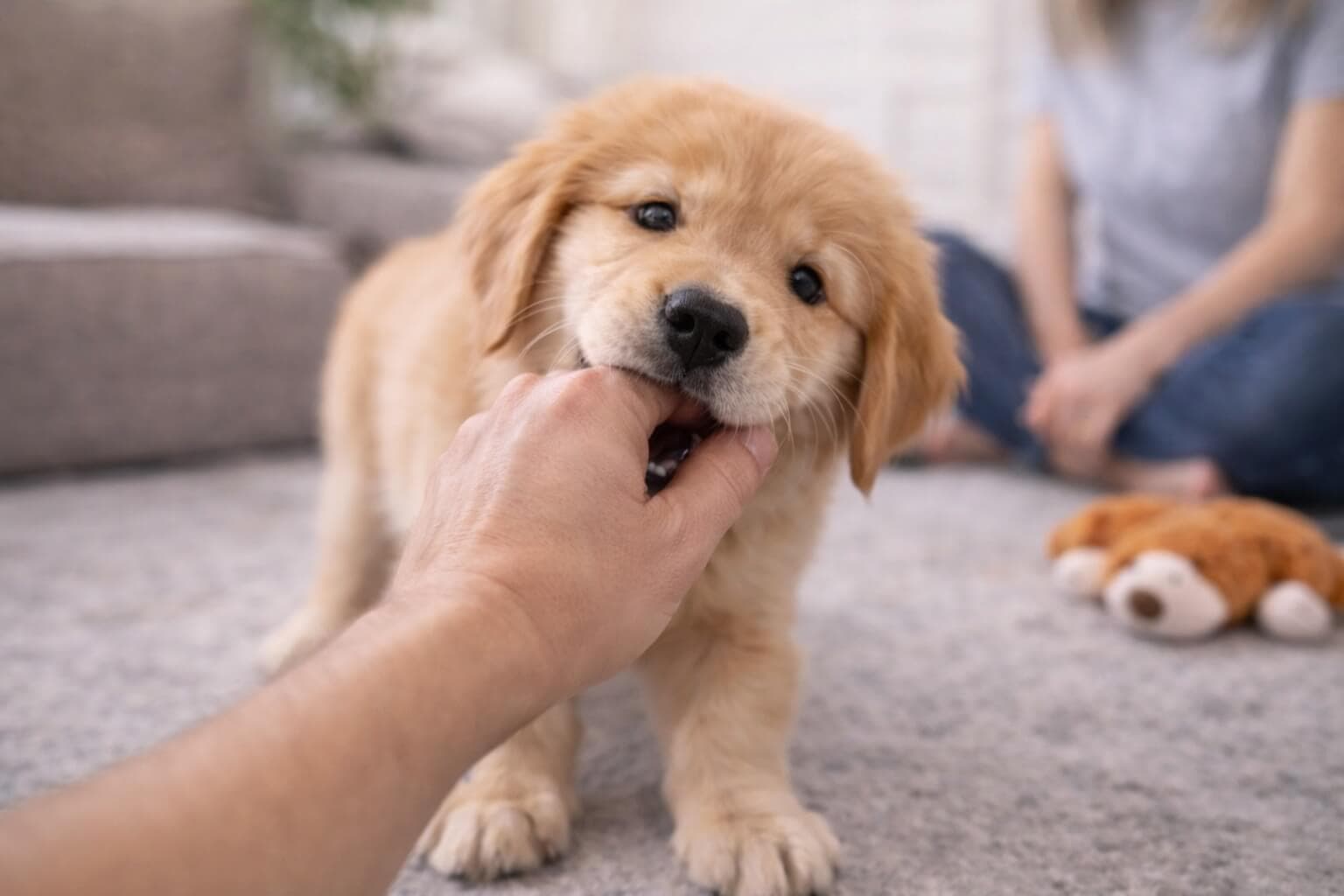
If your Golden Retriever puppy is biting hard, growling, or seeming aggressive, it can feel alarming — especially for new owners. The good news: what looks like aggression is almost always normal puppy behavior — even when it feels intense or out of control. It’s usually part of teething, play, and learning boundaries — not true aggression. This guide explains what’s normal, what’s not, how to respond in the moment, and how to teach calmer habits over time.
For a full overview of normal biting behavior and training basics, see our Golden Retriever puppy biting guide. For how biting intensity tends to change over weeks and months, pair this page with our puppy biting timeline chart and teething timeline chart.
Quick Summary
- 🐾Most “aggressive” puppy biting is normal mouthing, not true aggression
- 🐾It is usually driven by teething, overstimulation, fatigue, or lack of bite inhibition
- 🐾True aggression is less common and usually includes stiffness, fear, guarding, or lack of recovery
- 🐾Consistent redirection, reverse timeouts, naps, and calm structure usually improve it
- 🐾Many Golden Retriever puppies show noticeable improvement by 4–6 months
Table of Contents
- 🐾Quick Summary
- 🐾Quick Answer: Is Aggressive Puppy Biting Normal?
- 🐾Does This Mean My Golden Retriever Puppy Is Aggressive?
- 🐾Golden Retriever Puppy Biting by Age
- 🐾Why Golden Retriever Puppies Bite So Hard
- 🐾Signs the Biting Is Normal
- 🐾Play Biting vs Real Aggression
- 🐾Signs the Biting May Be a Bigger Problem
- 🐾Common Triggers for “Aggressive” Biting
- 🐾What to Do in the Moment When Your Puppy Bites Hard
- 🐾How to Stop Aggressive Puppy Biting
- 🐾How Long This Phase Usually Lasts
- 🐾Mistakes That Accidentally Make Biting Worse
- 🐾When to Be Concerned
- 🐾When to Get Help From a Trainer or Vet
- 🐾FAQ
Quick Answer: Is Aggressive Puppy Biting Normal?
Yes — in most cases. Golden Retriever puppies often bite hard, growl, snap at air, and act “ferocious” during play. That combination can look like aggression to humans, but it is usually normal puppy mouthing and play — especially in a mouthy, social breed that matures a little more slowly than you might expect.
What makes it feel scary is the volume: Goldens are strong for their size, vocal when excited, and persistent when overstimulated. They are also learning bite inhibition (how hard is too hard) through trial and error. Until that skill develops, even “play” bites can hurt.
However, biting is not “automatically harmless” just because the puppy is young. You should take it seriously as a training and safety issue if:
- 🐾the behavior is escalating rather than improving with consistent guidance,
- 🐾it is paired with fear, freezing, guarding, or repeated targeting of vulnerable people,
- 🐾or it regularly breaks skin or causes injury.
👉 This phase is temporary — with the right approach, it usually improves quickly — but temporary does not mean “ignore it.” Structure now prevents habits later.
Does This Mean My Golden Retriever Puppy Is Aggressive?
In most cases, no. When owners say “aggressive biting,” they usually mean intense mouthing: hard bites, vocal play, frantic energy, and little “off switch.” That pattern is common in puppies that are:
- 🐾overtired,
- 🐾overstimulated,
- 🐾teething,
- 🐾practicing play with a species (humans) that reacts dramatically.
True aggression in young puppies is less common than social media threads suggest — but it can exist, especially when fear, pain, or resource guarding is involved. A single loud growl during tug is not, by itself, a diagnosis of aggression. Context matters: what happened right before, what the body looked like, and whether the puppy could disengage calmly.
Why normal biting can feel intense
- 🐾Puppies explore with their mouths the way toddlers touch everything.
- 🐾Goldens are often high contact: they want closeness, which puts teeth near skin.
- 🐾Excitement and fatigue look similar in puppies — both can increase biting.
What would be more unusual (not impossible, but worth extra attention)
- 🐾Biting that reliably appears with stiff, still posture and no play recovery.
- 🐾Biting that locks onto a person who is not interacting, or that chases to bite when someone tries to leave calmly.
- 🐾Biting paired with resource guarding that worsens despite careful management.
If you are unsure, it is reasonable to start with the training steps in this guide and keep notes (time of day, triggers, what helped). That log is incredibly useful if you later speak with a trainer or your veterinarian.
Golden Retriever Puppy Biting by Age
Biting is normal across puppyhood, but the “why” shifts as your Golden matures.
8–12 Weeks
- 🐾Lots of mouthing while exploring.
- 🐾Frequent “shark mode” when overstimulated.
- 🐾Teething is ramping up; gums are sensitive.
3–5 Months
- 🐾Teething peaks for many puppies; chewing and biting often feel worse before they get better.
- 🐾Play gets stronger as coordination improves.
- 🐾This is a prime window for teaching bite inhibition and consistent redirection.
5–8 Months
- 🐾Many puppies improve noticeably — not because the urge disappears overnight, but because impulse control and routines start to click.
- 🐾Adolescence can bring occasional “regressions.” Energy surges and testing behaviors can look like renewed biting; stay consistent.
What This Means Practically
If your puppy is “worse” at 4 months than at 9 weeks, that can still be normal if the biting is primarily play- or fatigue-driven and responds to the strategies below. If you want a simple visual reference for how biting intensity often trends over time, use our puppy biting timeline chart.
Why Golden Retriever Puppies Bite So Hard
Teething
Between roughly 8–16 weeks (and sometimes a bit beyond), many puppies experience intense teething. Chewing and biting can relieve gum pressure. If you want a week-by-week lens on teeth and chewing, our teething timeline chart pairs well with this section.
No Bite Inhibition Yet
Puppies do not start life knowing human skin is sensitive. They learn soft mouth through:
- 🐾consistent feedback (calm pauses, redirection),
- 🐾predictable consequences (play ends when biting targets people),
- 🐾repetition over many days — not one “perfect lesson.”
High Energy & Excitement
Golden Retrievers are typically social and energetic. When excitement climbs, mouthing often climbs with it — especially if play is unstructured or goes too long.
Breed Traits (Without Overclaiming)
Goldens are often persistent and people-focused. That is a wonderful trait in adult dogs, but it can make puppy biting feel “nonstop” because the puppy keeps re-engaging you.
Signs the Biting Is Normal
Normal play biting and intense mouthing often include:
- 🐾Loose, wiggly body language between bursts.
- 🐾Play bows (front end down, hind end up) or bouncy movement.
- 🐾Interest in continuing interaction after a brief reset — the puppy is not trying to end access to you; they are trying to keep the game going (in a rude puppy way).
- 🐾Recovery after redirection when you are consistent: the puppy can switch to a toy or settle with guidance.
- 🐾Context dependence: worse when tired, zoomy, or right before naps — then noticeably calmer after rest.
If most biting happens when your puppy is clearly “wired,” you are very likely dealing with a training and management puzzle — not a verdict on your puppy’s temperament.
Play Biting vs Real Aggression
This is the section most owners need twice: once when they are scared, and again when they are calibrating whether to seek professional help.
| Signal | Normal Play Biting | More Concerning Aggression |
|---|---|---|
| Body language | Loose, wiggly, bouncy | Stiff, tense, frozen |
| Tail | Wagging, moving freely | Still, rigid, tucked, or unusually high and tight |
| Trigger | Play, excitement, fatigue, teething | Fear, guarding, handling sensitivity, conflict |
| Recovery | Can usually redirect or reset | Escalates, stays locked on, hard to interrupt |
| Goal | More interaction and play | Control distance, protect resource, stop approach |
Side-by-Side: Body Language
More consistent with normal play biting
- 🐾Weight shifts side to side; movement looks “bouncy.”
- 🐾The puppy may mouth clothing or hands but can be redirected to a toy with practice.
- 🐾After a pause, the puppy often re-approaches softly or accepts a toy swap.
More reason to slow down and seek guidance (especially if persistent)
- 🐾Frozen stiffness before a bite, or a sudden shift from stillness to contact.
- 🐾Hard staring at a person’s face or hands without play signals.
- 🐾Repeated bites aimed at hands that are not moving (not roughhousing).
Facial Expression and Vocalizing
Play vocalizing can sound dramatic. Look for soft eyes and relaxed ears between sounds — not every growl during tug is “aggressive.”
More concerning patterns include:
- 🐾a tight face with pinned ears held in place (not quick ear flicks),
- 🐾vocalizing paired with forward stiff approach and no interest in toys offered calmly.
Play Style
Normal play often includes give-and-take: chasing, pouncing, and re-engaging after short breaks.
Higher concern includes:
- 🐾biting that escalates when you try to leave calmly,
- 🐾biting that targets clothing removal (pants legs) in a frantic, non-play way repeatedly,
- 🐾biting that appears when the puppy is cornered or cannot escape.
Recovery After Redirection
This is one of the most practical tests:
- 🐾Normal: With consistency, redirection becomes easier over days/weeks. The puppy learns a pattern.
- 🐾Concerning: Redirection repeatedly fails and the puppy returns to targeting people with escalating intensity despite calm, consistent handling.
Guarding, Fear, and Freezing
Resource guarding can look like “aggression” because it happens around food, chews, or toys. It is a separate training topic from play biting, but it matters because the management is different. If you suspect guarding, avoid “testing” the puppy by reaching for the item; instead, seek guidance and use safe trade-up routines.
Fear biting may involve retreat or freeze before contact, or biting when approached in a specific context (not generalized wild play). If biting appears strongly linked to fear, prioritize distance and safety and involve a professional sooner.
“Seeks More Play” vs “Controls Access”
Seeks more play: The puppy is annoying, mouthy, and persistent — but the goal looks like interaction.
Tries to control access: The puppy uses biting or blocking to prevent you from moving, taking an item, or entering space — especially if paired with stiff posture. That pattern deserves a careful plan and often professional support.
👉 Most Golden puppies fall into the play biting category, not aggression — but “most” is not “all,” and your safety plan should still be serious.
Signs the Biting May Be a Bigger Problem
You do not need a perfect label to decide it is time to escalate support. Treat these as yellow or red flags, especially when multiple appear or they worsen:
- 🐾Biting paired with fear (cowering, trembling, repeated avoidance) or panic.
- 🐾Resource guarding that intensifies: stiffening, hard stares, escalating warnings around food or chews.
- 🐾Biting that does not improve over several weeks of consistent training and management.
- 🐾Biting that regularly breaks skin, causes bruising, or targets children or elderly household members in ways you cannot supervise safely.
- 🐾Biting that happens when the puppy is handled for normal care (gentle collar touches, calm handling) despite gradual conditioning attempts.
If you are on the fence, it is still reasonable to book a single consult with a qualified trainer or ask your veterinarian for a behavior referral — especially if children are involved.
Common Triggers for “Aggressive” Biting
Triggers rarely exist alone; they stack. Think tired + excited + teeth + inconsistent rules = shark mode.
- 🐾Overstimulation: long play sessions, rough wrestling, fast movements, high voices.
- 🐾Overtired puppies: the classic “zoomies then bite” arc — like a toddler meltdown.
- 🐾Inconsistent household reactions: one person laughs, another yells, another wrestles — the puppy learns biting gets big reactions.
- 🐾Teething discomfort: more chewing, more mouthing, more frustration.
- 🐾Rough play habits: using hands as toys teaches “hands are bite objects.”
- 🐾Hunger or overly large meals (sometimes): a cranky puppy can be a hungrier puppy; feeding schedules matter — see our puppy feeding schedule chart if you want a simple age-based meal structure.
- 🐾Under-exercised mental needs: boredom can turn mouthiness into a default hobby.
If evenings are worst, read the FAQ on night biting — it is one of the most common patterns.
What to Do in the Moment When Your Puppy Bites Hard
Think short, boring, safe. Your goal is not to “win a debate” with a puppy; it is to change the consequence of hard biting.
- 🐾Stop moving as much as you can. Fast flailing hands often trigger more chasing and biting.
- 🐾Trade for a toy if you can do it calmly — present the toy at the mouth level so it is easier to choose than your sleeve.
- 🐾If biting continues, stand up and remove attention for 10–30 seconds (a micro-reset). If needed, step behind a baby gate or close a door briefly (reverse timeout): you leave, not as punishment drama, but as a clear consequence.
- 🐾Separate and reset if the puppy is too tired: a chew in a pen/crate/ex-pen with something calm (not a lecture) can prevent 10 more minutes of escalation.
- 🐾Around children: an adult should body-block and remove the child calmly rather than expecting kids to “train” the puppy. Teach kids to become boring trees: folded arms, quiet voice, no chasing. For more household rhythm (naps, potty timing, calm windows), our potty training schedule chart can help you structure the day even if potty training is not your main issue.
What not to do in the moment
- 🐾Do not hit, shake, or grab the muzzle — it increases fear and risk, and it does not teach bite inhibition.
- 🐾Avoid yelling as your primary tool; many puppies experience loud voices as exciting.
- 🐾Avoid alpha rolls or intimidation-based methods; they are unnecessary for Goldens and can damage trust.
How to Stop Aggressive Puppy Biting
Golden Retrievers are not naturally aggressive dogs, but normal puppy biting can become a long-term habit if it is rehearsed without consistent boundaries.
This is the operational section: calm mechanics, repeated daily, with realistic expectations.
For a broader training foundation (sit/down focus, impulse control basics), use our basic obedience training guide alongside biting work — it helps puppies learn that brains earn rewards, not just teeth.
1. Immediate Redirection
Always have a toy within reach in high-bite zones (living room, kitchen). When your puppy bites:
- 🐾Offer the toy at mouth level.
- 🐾Praise when teeth are on the toy, not you.
2. End Play Calmly When Biting Escalates
If biting continues after one redirection attempt:
- 🐾stand up,
- 🐾disengage,
- 🐾remove attention briefly.
👉 Puppies learn: hard biting on people ends the fun.
3. Reverse Timeouts (You Leave)
If your puppy keeps jumping and biting your pants:
- 🐾step away behind a gate,
- 🐾wait until the puppy is calmer,
- 🐾re-enter with a toy ready.
Consistency matters more than intensity.
4. Consistent Household Rules
Everyone should agree on:
- 🐾no hand-wrestling,
- 🐾what “too hard” means in your home,
- 🐾what happens next (toy first, then end play).
Mixed messages create persistent biting.
5. Rest / Nap Schedule
Overtired puppies bite more. Build in:
- 🐾predictable naps,
- 🐾quiet chew time,
- 🐾shorter play bursts.
If your puppy is constantly “on,” read when Golden Retrievers calm down for a realistic maturity lens — it helps owners tolerate the middle weeks without panic.
6. Avoid Overstimulation
End play before the shark phase. A good rule of thumb:
- 🐾several short sessions beat one long chaotic session.
7. Chew Toys During Teething
Give legal outlets: rubber chews, safe ropes sized for puppies, food-stuffed toys for calm licking. Rotate toys so novelty stays high.
Recommended Chew & Training Tools
These are practical tools many owners use for redirection and calm rewards — not magic fixes.
Disclosure: This section contains affiliate links. As an Amazon Associate, GoldenRetriever.hair earns from qualifying purchases at no extra cost to you.
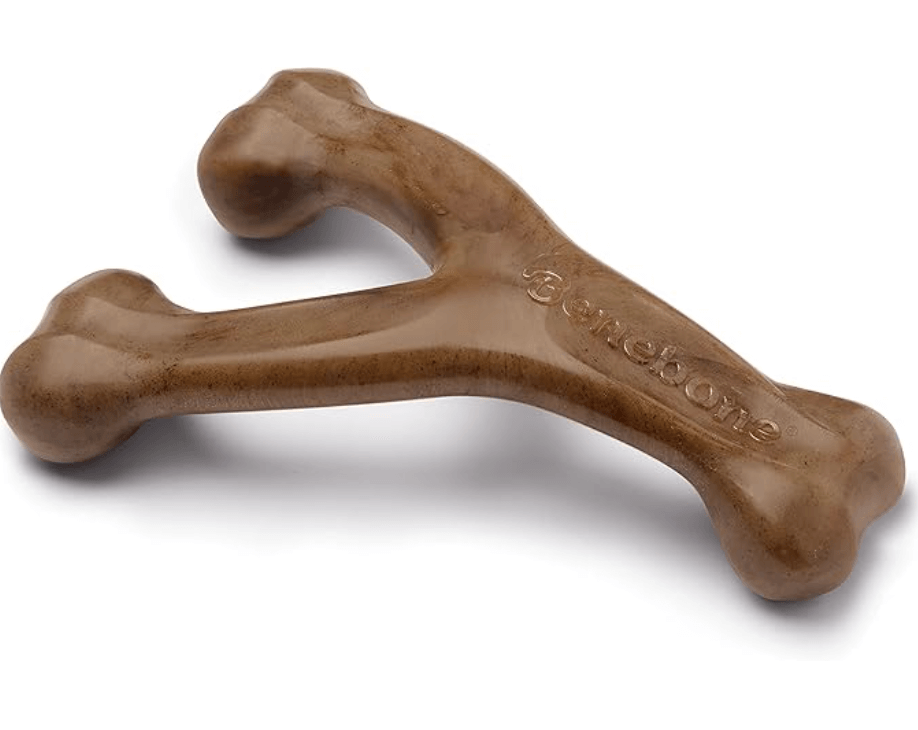
Best for: redirecting mouthing onto a legal chew
Benebone Wishbone Durable Dog Chew Toy
A harder nylon chew for swapping “hands/clothes” to a legal toy. Size to the current label; it is not a match for every powerful chewer or a baby-tooth teething solution.
Supervise use; inspect and replace when worn. If your puppy still has baby teeth, start with the softer Benebone Puppy line.

Best for: quick calm rewards without huge calories
Zuke’s Mini Naturals Training Treats
Small, soft pieces are easier to use during frequent reps (sit, check-in, four paws on the floor).
Use tiny pieces so rewards support training rather than replacing meals.
Follow the package feeding guidance and your vet’s advice for your puppy’s age and size.
These tools do not replace training — they make redirection and calm repetition easier.
8. Reward Calm Behavior
Catch your puppy doing something right:
- 🐾lying down quietly,
- 🐾choosing a toy independently,
- 🐾checking in with you without jumping.
Use tiny treats and soft praise.
9. Keep Sessions Short
Training works best in small reps: 2–5 minutes, many times per day, especially for young puppies.
10. Realistic Expectations for Progress
You should see incremental improvement: fewer “worst” episodes per week, faster recovery after redirection, slightly softer mouth over time. Progress is rarely a straight line.
How Long This Phase Usually Lasts
There is no single calendar date for every puppy, but many Goldens show noticeable improvement between 4–6 months as teeth, routines, and impulse control mature — aligned with what many owners describe on our puppy biting timeline chart.
That does not mean “zero mouthing” by a birthday. It means fewer intense episodes, faster recovery, and more predictable behavior when you manage triggers.
If biting intensity is still climbing after consistent training for many weeks, treat that as a signal to review triggers, household consistency, and possibly professional support — not as a failure.
Mistakes That Accidentally Make Biting Worse
Some mistakes are obvious (rough wrestling). Others are subtle: whatever reliably follows biting tends to get repeated if the puppy finds it rewarding — including drama, chase games, and mixed messages.
- 🐾Hand wrestling and “cute” nipping games that teach teeth-on-skin as play.
- 🐾Inconsistent reactions (sometimes laughter, sometimes panic) that accidentally reward drama.
- 🐾Yelling that sounds like joining the game.
- 🐾Chasing the puppy when they grab something — many puppies learn biting gets a fun chase.
- 🐾Letting biting continue until everyone is frustrated — frustration makes timing worse.
- 🐾Physical corrections that increase fear or defensiveness.
- 🐾Big reactions (high voice, fast movement) right after hard biting — exciting for many puppies.
- 🐾Giving attention (even negative attention) without a clear, boring consequence like ending play or leaving briefly.
- 🐾Letting the puppy rehearse the same biting loop every evening without changing nap timing or play length.
- 🐾Inconsistent timeouts — sometimes you leave, sometimes you wrestle — the puppy learns the rules are negotiable.
Fixing this is less about being “strict” and more about being predictable: toy first, calm end to play, rest after chaos.
When to Be Concerned
Watch for:
- 🐾Biting paired with fear or hiding (not just “submissive” play rolls — look at overall patterns).
- 🐾Resource guarding (food/toys/spaces) that escalates.
- 🐾No improvement over time with consistent management.
- 🐾Extremely intense or frequent biting that does not match typical play escalation.
- 🐾Biting that regularly breaks skin or causes injury.
- 🐾Biting around children you cannot supervise with a safety plan (gates, tethered calm activities, adult-only handling moments).
👉 If you see several of these, or one severe pattern, prioritize safety and seek guidance.
When to Get Help From a Trainer or Vet
You do not need to wait for a “crisis” to ask for help. Good reasons to book support:
- 🐾You feel unsafe managing the puppy in your home.
- 🐾Biting is paired with guarding, fear, or handling sensitivity you are unsure how to address.
- 🐾You have tried consistent redirection + calm end-to-play for several weeks without meaningful improvement.
- 🐾Repeated skin-breaking bites occur despite management changes.
Who to call
- 🐾A qualified positive-reinforcement trainer for skills, structure, and household plans.
- 🐾Your veterinarian if pain, illness, or sudden behavior change could be contributing.
- 🐾A veterinary behaviorist (or vet-referred behavior specialty) when aggression risk, fear, or guarding is significant.
Bring your notes: time of day, triggers, what you tried, and short videos (where safe) can make consults far more productive.
FAQ
Is it normal for Golden Retriever puppies to bite aggressively?
Yes — most intense biting is normal play and mouthing, especially when puppies are tired or teething. Label it “serious training,” not “destined to be aggressive,” but still address it consistently.
Is my Golden Retriever puppy aggressive or just teething?
Teething increases chewing and mouthiness, but teething alone does not explain every biting pattern. If biting is primarily worst during obvious teething windows and improves with chews, naps, and redirection, teething is a major contributor. If biting includes stiff guarding, panic, or no improvement with good management, treat it as more than teething alone.
Why does my Golden Retriever puppy bite harder when excited?
Excitement lowers impulse control. Fast hands, squeaky voices, and chaotic movement can turn a playful puppy into a bitey tornado. Calm mechanics beat loud lectures.
Why does my puppy bite more at night?
Evening biting often tracks fatigue + overstimulation: late play, missed naps, household commotion, and a puppy who is too tired to make good choices. Add an earlier wind-down routine: calmer play, potty break, chew time, then sleep.
When should I worry about puppy biting?
Worry enough to change the plan if biting is escalating, injuring people, paired with fear/guarding, or not improving with consistent training. Worry enough to call a professional if you cannot keep people safe or the pattern feels beyond typical play.
Can puppy biting turn into real aggression?
Most puppies mature out of rude play biting with guidance. Risk rises when biting is practiced without boundaries, when fear or guarding is present, or when puppies learn that intimidation “works.” Early, consistent training reduces long-term risk — it does not “guarantee” outcomes, but it is the responsible path.
What should I do if my puppy bites my kids?
Supervise or separate. Children should not be expected to train bite inhibition alone. Use gates, tethered calm activities for the puppy (with an adult present), and short child-puppy interactions only when the puppy is rested. Teach kids boring-tree body language and ensure they are not waving hands in the puppy’s face. If you cannot manage safely, book help promptly.
When do Golden Retriever puppies stop biting?
Many improve significantly by 4–6 months, with continued maturation after. See our puppy biting timeline chart for a simple phase overview.
Why does my puppy bite harder sometimes?
Usually overstimulation, teething, or being overtired — often a combination.
Conclusion
Golden Retriever puppy biting that feels aggressive is usually normal, loud, mouthy puppyhood — not a verdict on your dog’s future. What matters is that you respond with calm structure: redirect, end play when needed, prioritize sleep, keep kids safe, and avoid methods that trade fear for quiet.
You do not need perfection; you need consistency and a plan you can repeat when you are tired at 8 p.m. If you want one next page to bookmark, start with the foundational routines in our Golden Retriever puppy biting guide — it pairs directly with everything above and helps you build habits that last well past the shark weeks. When you want chewing and tooth timing next to biting spikes, our teething timeline chart is a useful companion.
P.S. Get the free Golden Retriever Owner Cheat Sheet — daily feeding, sleep, and care in one printable guide.
Get the Cheat Sheet when you join the newsletter — instant access in your welcome email.