
Golden Retriever Teething Timeline
By JJ Allan (goldenretriever.hair)
Golden Retriever puppies start getting their baby teeth at about 3 to 4 weeks, have them all by about 6 weeks, start losing them at around 3 to 4 months, and usually have their adult teeth in by 6 to 7 months. That is the schedule VCA Animal Hospitals gives for puppies in general; none of the vet sources we checked gives a separate one for Goldens. Golden Retriever puppies go through predictable teething stages as baby teeth fall out and adult teeth come in. This golden retriever teething timeline chart shows the typical timing so you know what to expect.
The part generic puppy pages skip is the bite. The AKC breed standard for the Golden Retriever asks for a scissors bite and full dentition, calls obvious gaps serious faults, and disqualifies an undershot or overshot bite. You may never show your dog, but it is a good reminder that how the adult teeth come in matters, and a stubborn baby tooth can push an adult tooth out of place.
This guide is general information, not veterinary advice. Check with your veterinarian about your puppy's mouth, and book a visit promptly for a baby tooth that stays put beside an adult tooth, a puppy who stops eating, bleeding that is more than a trace, or swelling.
Golden Retriever teething timeline by age
The short version:
- 🐾3–4 weeks: puppy teeth begin appearing
- 🐾6–8 weeks: most baby teeth present
- 🐾3–4 months: teething begins
- 🐾4–6 months: puppy teeth fall out
- 🐾6–7 months: adult teeth finish coming in
| Age | Teething Stage | Notes |
|---|---|---|
| 3–4 weeks | Baby teeth begin appearing | Many puppies start showing early chewing curiosity |
| 6–8 weeks | Most baby teeth are present | Puppy mouthing increases; introduce safe chew toys |
| 3–4 months | Teething begins (baby teeth loosen) | Chewing and gum irritation often increase |
| 4–5 months | Baby teeth start falling out more noticeably | You may find small teeth in toys or on floors |
| 5–6 months | Adult teeth continue emerging | Expect on-and-off discomfort and extra chewing |
| 6–7 months | Adult teeth nearly complete | Many puppies are close to done teething, though chewing may continue |
Which teeth change when is useful if you are peering into your puppy's mouth. VCA's teething-toy page and the University of Minnesota's veterinary preventive medicine text give this order:
| Teeth | Adult teeth come in | What you notice |
|---|---|---|
| Incisors (small front teeth) | As early as 3 months | The first gaps at the front of the mouth |
| Canines (fangs) | Around 5 months | Lost last; UMN says puppy canines are reliably gone at about 6 months |
| Premolars and molars (back teeth) | Between 4 and 7 months | Puppies have no baby molars, so the molars are brand-new teeth |
When Golden Retrievers lose their baby teeth
Golden Retriever puppies usually start losing their baby teeth at around 12 weeks to 4 months, and most have lost them all by about 6 months. VCA's teething page says the baby teeth begin to fall out at around 12 weeks, and that normally all of them are gone by six months. The front incisors go first. The canines take longest to be fully replaced, which is why the University of Minnesota's veterinary text uses lost puppy canines at about 6 months as an age marker.
Don't expect a pile of teeth. VCA says you may find baby teeth on the floor, but your puppy will more likely swallow them harmlessly while eating. A trace of blood is normal too: VCA describes it as mild red staining on a chew toy. Dr. Amy Attas, quoted by the AKC, lists face-rubbing, extra chewing, and a little blood on a toy or in the water bowl as signs teeth are falling out.
When Golden Retriever puppies start teething
Most Golden Retriever puppies start teething around 3–4 months as baby teeth loosen and adult teeth begin emerging. VCA's guide to persistent baby teeth dates it to about 3.5 to 4 months, when the baby incisors begin to be replaced.
You will also see "teething" used for the first set of teeth. Those baby teeth start coming through the gums at around three weeks, and VCA says they are normally all in by 6 weeks. The University of Minnesota text agrees that they erupt over about the first 6 weeks of life, so a puppy old enough to go home already has the full needle-sharp set.
When Golden Retrievers get their adult teeth
Adult teeth start coming in at about 3 to 4 months, and most Goldens have the full adult set by 6 to 7 months. VCA puts the finish at 6 to 7 months for most puppies. The Merck Veterinary Manual says permanent teeth usually begin to appear at around 4 to 5 months and are all present by 7 months. A puppy who finishes at 7 or even 8 months is not unusual.
When Golden Retrievers stop teething, and how long it lasts
Most Golden Retrievers stop teething at about 6 to 7 months, once the adult teeth are in. Teething itself lasts about 2 to 4 months. VCA's teething-toy page calls it 2 to 3 months of teething, and VCA's persistent-teeth guide runs it from about 3.5 to 4 months to 6 to 7 months, so a slower puppy can take closer to 4.
Stopping teething is not the same as stopping chewing. VCA says chewing may persist for several months after the adult teeth have grown in, and that excessive chewing seems to subside around 18 months, though some chewing continues for life. If your 7-month-old is still chewing everything, that's normal; keep handing over the right chews.
Golden Retriever teeth: 28 baby teeth, 42 adult teeth
Golden Retrievers have 28 baby teeth and 42 adult teeth, the same counts as other dogs. VCA and Merck both give those numbers. The extra 14 come from the back of the mouth: puppies have no molars at all, so the adult molars and some premolars arrive without any baby tooth to push out. The AKC's answer to a Golden owner points out that the adult set includes six incisors on top and six on the bottom.
The same AKC answer explains why the teeth sometimes seem to take forever: adult teeth can come in behind the puppy teeth before you can see them, and the writer had puppies take as long as eight months to lose every baby tooth.
Signs your Golden Retriever puppy is teething
- 🐾Increased chewing and mouthing
- 🐾Drooling and interest in firm or cool chew items
- 🐾Red, slightly swollen gums
- 🐾Occasional gum bleeding or mild fussiness
VCA adds that a teething puppy may drool, may be reluctant to eat as robustly as usual, and may be irritable from a tender mouth. It also notes the "puppy breath" smell that lasts as long as teething does.
Why Golden Retriever puppies chew during teething
- 🐾Chewing helps relieve gum pressure as adult teeth push through
- 🐾Puppies explore the world using their mouths
- 🐾Chewing supports normal jaw muscle development
- 🐾Having safe chew options reduces the chance of destructive chewing
VCA says almost all puppies have the urge to chew when they are teething, and that the job is to direct it toward acceptable, safe objects. Hands count as off-limits too. VCA's teething-toy page warns that letting a puppy mouth your hands teaches it that people's hands belong in its mouth. For the hand-biting side of this stage, see the puppy biting guide.
Safe chewing while the teeth change
VCA's teething-toy advice comes down to four rules:
- 🐾Choose chews with a little bend, or that you can indent with a fingernail. Skip nylon, bones, and antlers.
- 🐾Freeze toys and treats to ease gum inflammation, the way people freeze teething toys for babies.
- 🐾Supervise. Remove any toy that is breaking apart or missing pieces, since swallowed pieces can block the intestines.
- 🐾Redirect. When your puppy chews something it shouldn't, swap in an allowed chew and praise or reward when it starts chewing that.
VCA's persistent-teeth page adds hard toys, cow hooves, and ice cubes to the list to avoid. The chew toy guide covers what to buy.
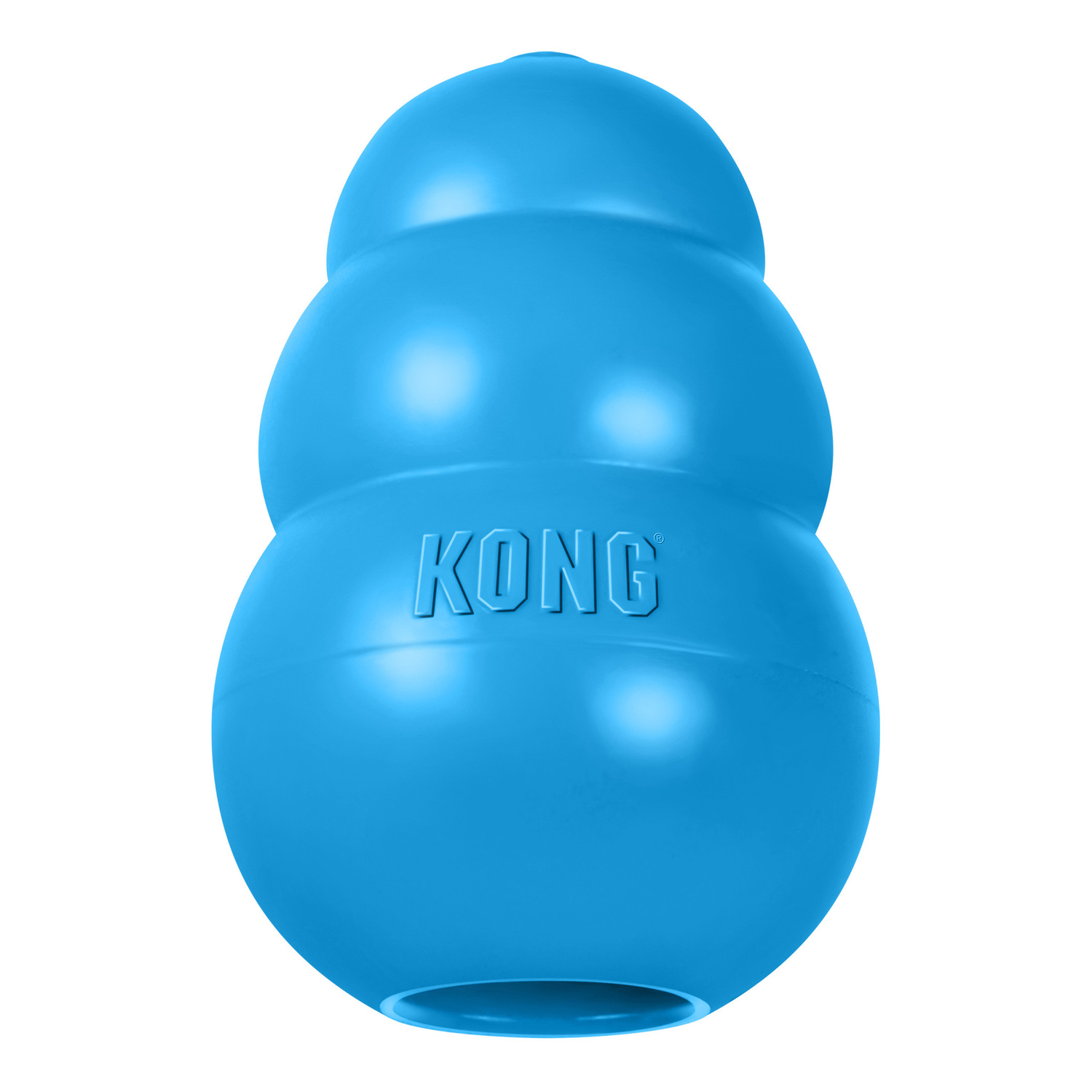
KONG Puppy, Natural Rubber Teething Chew Toy, for Large Puppies, Blue
KONG makes its Puppy rubber softer than its other toys, for teething mouths, and says you can stuff it and freeze it to cool sore gums. That fits the bend-and-freeze rules above.
KONG says to size by your puppy's current weight (Large is 30–65 lb), use it supervised, stop if it's damaged, and move up from it after 9 months.
When teething is not ordinary
The main thing that goes wrong is a persistent (retained) baby tooth. VCA puts it simply: no two teeth should be in the same place at the same time. A baby tooth that stays put can force the adult tooth into the wrong position, crowd the mouth, and trap food. VCA says these teeth typically need to be removed promptly, and that canines are the most common site.
The AVMA's pet dental care page also lists retained baby teeth, broken or loose teeth, refusal to eat, bleeding from the mouth, and swelling as reasons to have the teeth checked sooner. Use this golden retriever puppy teeth chart to understand the typical puppy teething stages by age and spot what’s normal. If chewing seems extreme, your puppy refuses to eat, or you see concerning mouth symptoms, talk to your veterinarian.
Daily care starts now, too. VCA says the ideal time to begin brushing is as soon as you bring your puppy home, gently, because erupting gums are sensitive. The dental care guide covers brushing.
Quick answers
When do golden retrievers start teething?
Most Golden Retriever puppies start teething around 3–4 months as baby teeth loosen and adult teeth begin emerging.
When do golden retrievers stop teething?
Most Golden Retrievers finish teething around 6–7 months when adult teeth are largely in place and gum discomfort decreases.
How long does puppy teething last?
For many puppies, the main teething period lasts about 2–4 months (from roughly 3–4 months through 6–7 months), per VCA.
Do golden retriever puppies lose all baby teeth?
Yes—Golden Retriever puppies eventually lose their baby (deciduous) teeth as adult teeth come in. Sometimes a baby tooth can be retained; if you suspect retained teeth or persistent pain, contact your veterinarian.
How many teeth do Golden Retrievers have?
Puppies have 28 baby teeth and adults have 42, per VCA and the Merck Veterinary Manual.
When do Golden Retriever puppies stop biting?
Biting and mouthing usually ease as the adult teeth settle in, but the urge to chew outlasts teething; VCA says excessive chewing seems to subside around 18 months. Don't let your puppy mouth hands in the meantime. The puppy biting timeline covers the biting side.
More puppy guides: the Golden Retriever Teething Guide, the Golden Retriever Puppy Care Guide, the Golden Retriever Puppy Sleep Chart, and the Golden Retriever Puppy Feeding Schedule Chart.
Sources
Baby teeth at about 3 weeks and complete by 6 weeks, teething from 3.5 to 4 months, adult teeth by 6 to 7 months, 28 and 42 teeth, drooling and appetite, puppy breath, brushing from day one, weekly mouth checks to 7–8 months, and persistent baby teeth: VCA, Persistent Deciduous Teeth. Baby teeth falling out from about 12 weeks and gone by six months, swallowed teeth, a trace of blood, no baby molars, and excessive chewing easing around 18 months: VCA, Teeth, Teething and Chewing in Puppies. Which teeth come in when, 2 to 3 months of teething (with the persistent-teeth timing above, about 2 to 4 months), chewing for several months after, bendable and frozen chews, supervision, redirecting, and not letting puppies mouth hands: VCA, Dos and Don'ts of Puppy Teething Toys.
Baby teeth erupting over the first 6 weeks, order of tooth loss, and puppy canines gone by about 6 months: University of Minnesota, Veterinary Preventive Medicine, Dentistry. Baby teeth from 3 to 5 weeks, permanent teeth from 4 to 5 months, and all present by 7 months: Merck Veterinary Manual, Dental Development of Dogs. Retained baby teeth, loose teeth, refusal to eat, bleeding, and swelling as reasons to get teeth checked: AVMA, Pet dental care.
Signs teeth are falling out: AKC, loose teeth in dogs. Adult incisor count, teeth coming in behind, and up to eight months: AKC, When do puppies lose their teeth? Scissors bite and full dentition: AKC breed standard for the Golden Retriever.
P.S. Get the free Golden Retriever Owner Cheat Sheet — daily feeding, sleep, and care in one printable guide.
Get the Cheat Sheet when you join the newsletter — instant access in your welcome email.