Golden Retriever Jumping Guide (Why It Happens & How to Stop It)
GoldenRetriever.hair
By GoldenRetriever.hair
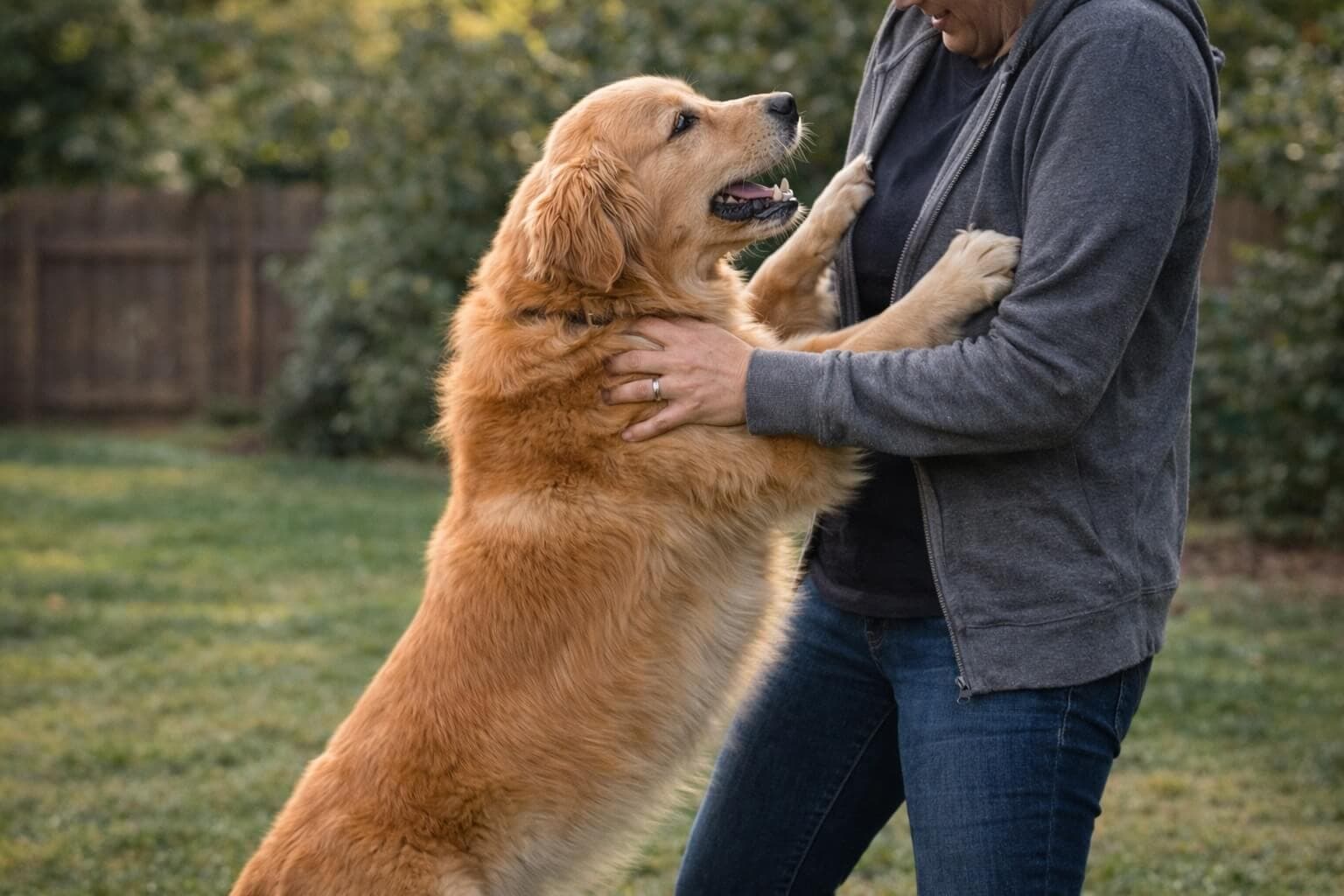
If you live with a Golden Retriever, you’ve probably been on the receiving end of an enthusiastic full-body greeting. Many Goldens jump on family members, guests, and sometimes strangers—often out of pure joy—but that doesn’t make it less of a problem. Golden Retriever jumping can knock over children, startle visitors, and make walks and vet visits more difficult.
Jumping is especially common in friendly, people-loving breeds like Golden Retrievers. The behavior is usually not aggressive; it’s a combination of excitement, habit, and learned reinforcement. The good news: with clear structure and consistent training, you can teach your Golden polite greeting behavior without dampening their wonderful personality.
This guide explains why Golden Retrievers jump on people, how to differentiate normal excitement from concerning behavior, and how to stop Golden Retriever jumping using practical, positive methods.
Why Golden Retrievers Jump on People
Most of the time, Golden Retriever jumping on people is a communication of:
- 🐾“I’m excited to see you!”
- 🐾“Pay attention to me!”
Key Reasons Behind Jumping
Common drivers include:
- 🐾
Enthusiasm when greeting people
- 🐾Goldens are famously happy to see their humans—whether you’ve been gone five minutes or five hours.
- 🐾
Attention-seeking
- 🐾If jumping consistently gets any response (talking, touching, eye contact), it’s reinforced.
- 🐾
Learned behavior from puppyhood
- 🐾Puppies that are cuddled, picked up, or laughed at when they jump learn that vertical greetings work.
- 🐾
Excess energy
- 🐾Under-exercised, overstimulated dogs are more likely to launch themselves at people because they can’t easily regulate their arousal.
Golden Retrievers are naturally social and affectionate (see our Golden Retriever Behavior Problems Guide). Jumping is often just an unpolished version of that friendliness—it needs shaping, not punishment.
Jumping as a Greeting Behavior
Dogs greet differently than humans. We shake hands or say hello; dogs:
- 🐾Approach directly.
- 🐾Sniff faces and body language.
- 🐾Use full-body expression (tail, ears, posture).
Face-to-Face Greetings
Dogs often jump because:
- 🐾They want to get closer to your face—where your eyes, mouth, and voice are.
- 🐾In canine terms, it’s a more direct, engaged greeting.
Common jumping situations:
- 🐾When you come home from work.
- 🐾When guests enter the door.
- 🐾When meeting friendly strangers on walks.
Attention-Seeking Loop
Even negative attention can reinforce jumping:
- 🐾Pushing the dog off.
- 🐾Saying “no” or “down” while touching them.
- 🐾Laughing or engaging in excited chatter.
From the dog’s perspective:
- 🐾Jump → you interact → behavior “worked.”
That’s why many Golden Retriever jumping problems persist for months or years—the dog has been unintentionally rewarded thousands of times.
Why Puppies Jump More Than Adult Dogs
Puppies are bitey, jumpy, wiggly, and full of chaotic energy. Jumping is more common at this stage because:
- 🐾
Impulse control is not developed
- 🐾Self-control is a skill that matures slowly, especially in an energetic breed.
- 🐾
Excitement threshold is low
- 🐾Small events (you standing up, guests walking in) can create huge reactions.
- 🐾
Boundaries are still being learned
- 🐾Puppies don’t magically know human rules about personal space or “no jumping.”
Our Golden Retriever Puppy Biting Guide describes similar patterns for mouthiness—both biting and jumping are normal puppy behaviors that need guidance.
Why Early Habits Matter
Behaviors rehearsed at 10–20 pounds:
- 🐾Quickly become problematic at 60–80 pounds.
If a puppy learns:
- 🐾“Jumping on people makes them pet me,”
…you’ll be undoing that association later. That’s why it’s much easier to teach polite greetings from day one rather than trying to fix them in adolescence.
The Role of Exercise and Stimulation
A significant portion of Golden Retriever jumping is tied to excess energy and under-stimulation.
Physical Exercise
As explained in our Golden Retriever Exercise Needs Guide, Golden Retrievers need substantial daily activity, including:
- 🐾Brisk walks.
- 🐾Off-leash play or fetch in safe areas.
- 🐾Structured games and sports when appropriate.
Without enough exercise, dogs are more likely to:
- 🐾Explode into high-arousal behaviors (jumping, zoomies) when:
- 🐾You return home.
- 🐾Guests visit.
- 🐾You pick up the leash.
Mental Stimulation
Physical workouts alone aren’t enough for a highly intelligent breed. As our Golden Retriever Intelligence Guide explains, mental work is essential:
- 🐾Training sessions (obedience and tricks).
- 🐾Puzzle toys and scent games.
- 🐾Engagement-based play and enrichment.
Mentally satisfied Goldens:
- 🐾Have an easier time staying calm and organized during greetings.
If your dog is constantly jumping, ask:
- 🐾“Have I met their exercise and mental enrichment needs today?”
If the answer is no, that’s a key part of your jumping solution.
Training Techniques to Stop Jumping
Stopping Golden Retriever jumping on people requires:
- 🐾Changing what you do when your dog jumps.
- 🐾Teaching an alternative, incompatible behavior.
- 🐾Staying consistent across family members and visitors.
1. Remove the Reward for Jumping
Since jumping is often reinforced by attention:
- 🐾When your dog jumps:
- 🐾Do not:
- 🐾Push them.
- 🐾Talk excitedly.
- 🐾Make eye contact.
- 🐾Instead:
- 🐾Turn away.
- 🐾Cross your arms.
- 🐾Wait for paws to return to the floor.
- 🐾Do not:
For many dogs, this alone:
- 🐾Dramatically reduces jumping over time—if applied 100% of the time.
2. Reward Calm Grounded Behavior
Don’t just say “no” to jumping; say “yes” to what you want instead.
- 🐾Mark and reward when your dog:
- 🐾Keeps four paws on the floor during greetings.
- 🐾Offers a sit spontaneously.
- 🐾Approaches more calmly.
Use:
- 🐾Treats.
- 🐾Praise.
- 🐾Petting (once paws are down).
This teaches your Golden:
- 🐾“If I stay grounded or sit, I get what I want (attention). Jumping doesn’t work.”
3. Teach “Sit for Greetings”
An incompatible behavior like sit is one of the best tools for Golden Retriever training for jumping. If you want a broader list of essential commands every Golden Retriever should learn, keep that checklist nearby while you practice greetings.
Steps:
- 🐾Practice “sit” without distractions.
- 🐾Add mild greeting triggers (you walking toward your dog).
- 🐾Ask for sit; if they comply:
- 🐾Reward with treats and calm petting.
- 🐾If they jump:
- 🐾Turn away or step back.
- 🐾Withhold attention until they settle or sit again.
Gradually:
- 🐾Use sit when:
- 🐾You come home.
- 🐾Guests enter.
- 🐾You meet people on walks (if you choose).
Consistency is key—if sometimes sitting is required but other times jumping gets them what they want, jumping will persist.
Teaching Polite Greeting Behavior
Let’s put the pieces together into a step-by-step plan for teaching polite greetings.
Step 1: Practice With Household Members
Start in the easiest environment:
- 🐾One family member at a time.
Routine:
- 🐾Person leaves the room.
- 🐾Returns calmly and:
- 🐾Asks for a sit or waits for paws on the floor.
- 🐾Only gives attention when criteria are met.
Rehearse several times per day until your dog:
- 🐾Anticipates that calm behavior, not jumping, makes people interact.
Step 2: Prepare Visitors Ahead of Time
Most training plans fall apart when guests appear because:
- 🐾People naturally want to:
- 🐾Talk to.
- 🐾Pet.
- 🐾Reassure a jumping dog.
Ask visitors to:
- 🐾Ignore your dog if they jump (no talking or touching).
- 🐾Greet and pet only when:
- 🐾All four paws are on the floor, or
- 🐾Your dog is sitting.
You can:
- 🐾Put your dog on leash or behind a baby gate at first for more control.
Step 3: Controlled Greeting Sessions
Set up specific training sessions:
- 🐾Have a friend:
- 🐾Ring the doorbell.
- 🐾Enter and follow your instructions.
You:
- 🐾Guide your dog to a mat or spot near the door.
- 🐾Ask for sit.
- 🐾Reward heavily for:
- 🐾Staying seated while the person comes in.
- 🐾Keeping paws down as they approach.
Gradually increase difficulty:
- 🐾More excitement.
- 🐾Multiple visitors.
- 🐾Longer time before greeting.
Practice makes “polite greeting” your dog’s default behavior, not a special occasion.
Preventing Jumping Through Socialization
Good Golden Retriever socialization (see our Golden Retriever Socialization Guide) helps puppies learn:
- 🐾How to behave in a variety of social settings.
- 🐾That calm behavior wins access to people and places.
Early Socialization and Greetings
From a young age:
- 🐾Expose your puppy to:
- 🐾Different types of people.
- 🐾Controlled, positive greeting situations.
Teach:
- 🐾Sitting or standing calmly as the “ticket” to attention.
Avoid:
- 🐾Encouraging others to pick up or overexcite your puppy when they jump.
By pairing friendly exposure with polite behavior, you prevent many Golden Retriever greeting behavior problems before they fully develop.
Common Mistakes Owners Make
Understanding what not to do is as important as learning the right techniques.
Encouraging Jumping During Puppyhood
Common missteps:
- 🐾Holding or cuddling a jumping puppy.
- 🐾Bending over and talking in an excited voice when they leap up.
Problem:
- 🐾The puppy learns that jumping = access to faces and affection.
Better:
- 🐾Ask for a sit or simply wait for all paws on the floor before giving attention.
Inconsistent Responses
If sometimes:
- 🐾You laugh and pet your dog when they jump, and other times you scold them,
…your dog gets a mixed message.
Result:
- 🐾Jumping persists because:
- 🐾Sometimes it still works.
Fix:
- 🐾Make a clear family rule:
- 🐾No one interacts with the dog while they’re jumping.
- 🐾Everyone rewards calm approaches.
Rewarding Jumping With Attention
Even:
- 🐾Pushing the dog off or saying “no” with eye contact,
…can be rewarding to an attention-seeking Golden.
Instead:
- 🐾Treat yourself like a tree:
- 🐾No movement, no talking, no looking when they jump.
- 🐾Attention resumes only when paws are on the ground or the dog is sitting.
Using Harsh Punishment
Yelling, kneeing the dog in the chest, or using punitive tools primarily to address jumping can:
- 🐾Create fear.
- 🐾Damage trust.
- 🐾Fail to address the underlying excitement and reinforcement patterns.
Golden Retrievers are typically sensitive and people-pleasing—they respond far better to:
- 🐾Rewarding desired behavior.
- 🐾Removing rewards for undesired behavior.
For broader context on correcting unwanted behaviors kindly and effectively, see our Golden Retriever Behavior Problems Guide.
Frequently Asked Questions
Why does my Golden Retriever jump on people?
Most Golden Retrievers jump out of excitement and attention-seeking, not aggression. They want to get closer to your face, greet you quickly, and gain immediate interaction. If jumping has been rewarded—by petting, talking, or even pushing them away—it becomes a habitual greeting style.
Do Golden Retrievers grow out of jumping?
Not usually without training. While many Goldens become a bit calmer with age, jumping is a learned behavior that tends to stick if it continues to “work.” Without clear boundaries and consistent practice of polite greetings, an enthusiastic puppy that jumps will often become an enthusiastic adult that still jumps.
Is jumping a sign of aggression?
In most Golden Retrievers, jumping is not a sign of aggression. It’s typically an expression of joy, arousal, or frustration at being restrained from greeting. That said, if jumping is accompanied by stiff body language, hard staring, growling, or other concerning signals, consult a qualified trainer or behavior professional.
What is the best way to stop a Golden Retriever from jumping?
The most effective approach is to remove the reward for jumping and reward calm, alternative behaviors instead. That means:
- 🐾Ignoring jumping (no eye contact, no talking, no touching).
- 🐾Rewarding four paws on the floor.
- 🐾Teaching and reinforcing “sit for greetings.”
- 🐾Ensuring exercise and mental stimulation needs are met so your dog is calmer overall.
Consistency from all family members and visitors is crucial.
Conclusion
Golden Retriever jumping is a common, understandable behavior in a breed that loves people as much as Goldens do. Jumping is usually the result of excitement, attention-seeking, and early habits, not bad intentions. By meeting your dog’s exercise and mental stimulation needs, using positive reinforcement training, and staying consistent with polite greeting routines, most Golden Retrievers quickly learn to greet with four paws on the floor or a calm sit. Teaching these habits early helps you raise a well-mannered, confident dog who can welcome guests and enjoy social situations without knocking anyone off their feet.
P.S. Get the free Golden Retriever Owner Cheat Sheet — daily feeding, sleep, and care in one printable guide.
Get the Cheat Sheet when you join the newsletter — instant access in your welcome email.