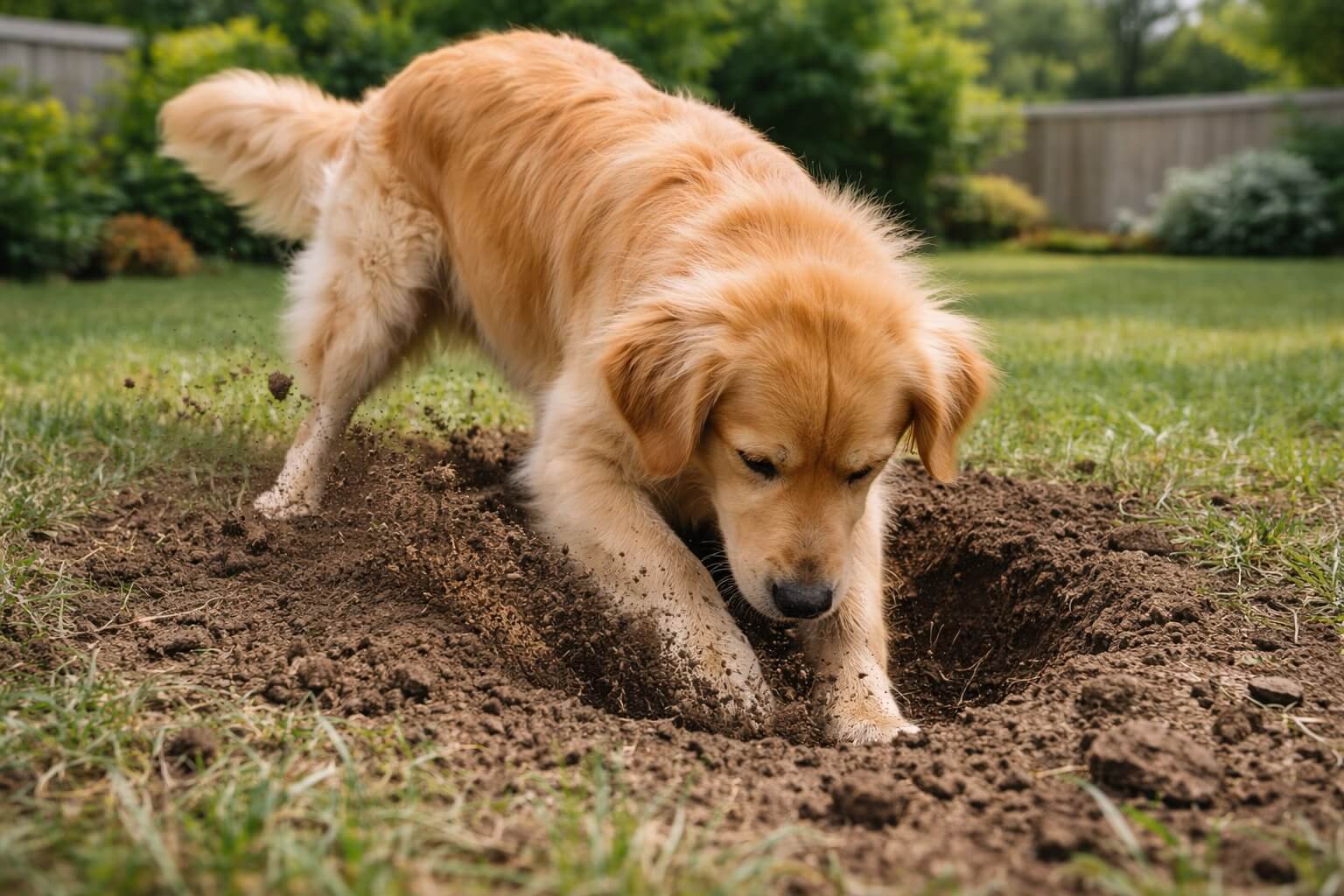
Golden Retriever Digging Guide (Why It Happens & How to Stop It)
GoldenRetriever.hair
By GoldenRetriever.hair
You step into the yard and find a constellation of fresh craters. Your Golden Retriever is covered in dirt, looking proud of the new landscaping. Many owners in this situation ask the same questions: “Why does my Golden Retriever dig holes?” and more importantly, “How do I get them to stop?”
Digging is a natural canine behavior, not unique to Golden Retrievers. But because Goldens are energetic, curious, and often left with backyard access, Golden Retriever digging can become a common—and frustrating—issue. The good news: with the right mix of exercise, mental stimulation, management, and training, you can reduce digging and channel your dog’s energy more productively.
This guide explains why Golden Retrievers dig, when digging is normal, and how to stop Golden Retriever digging in the yard without damaging your relationship with your dog.
Why Golden Retrievers Dig
Digging is part of a dog’s natural behavioral repertoire. For many dogs, including Goldens, it is:
- 🐾Self-reinforcing – It feels good and is interesting.
- 🐾Instinctive – Related to den-building, hunting, or cooling behaviors.
- 🐾A way to burn energy – Both physical and mental.
Common reasons for Golden Retriever digging holes include:
- 🐾Boredom and lack of stimulation
- 🐾Excess energy
- 🐾Curiosity and scent exploration
- 🐾Comfort or temperature regulation
- 🐾Anxiety or stress, including some separation-related behaviors
- 🐾Puppy play and development
Understanding the underlying motivation matters because the most effective solution depends on why your Golden is digging, not just the fact that they are.
Digging Due to Boredom or Lack of Exercise
One of the most frequent causes of Golden Retriever digging in the yard is simple: boredom.
Goldens Are an Energetic Breed
Golden Retrievers are sporting dogs. They were bred to:
- 🐾Work in the field.
- 🐾Retrieve game on land and water.
- 🐾Spend long days active with their handlers.
When a dog with this heritage spends most of the day:
- 🐾Alone in a yard with little interaction, or
- 🐾Indoors with only a brief walk,
…they will naturally look for ways to self-entertain. Digging is:
- 🐾Physically demanding.
- 🐾Mentally engaging (finding roots, rocks, smells).
- 🐾Immediately rewarding.
It’s a perfect boredom buster—from the dog’s point of view.
The Role of Daily Activity
As outlined in our Golden Retriever exercise needs guide, most adult Goldens need:
- 🐾Around 1–2 hours of combined daily activity, tailored for age and health.
If those needs aren’t met, behavior problems (see our behavior problems guide)—including digging—are much more likely.
Signs your dog may be digging out of boredom:
- 🐾They spend long periods outside alone.
- 🐾Digging happens mainly when no one is interacting with them.
- 🐾They display other under-stimulation behaviors:
- 🐾Barking at everything.
- 🐾Chewing on inappropriate objects.
- 🐾Pacing or spinning.
Addressing the exercise and engagement deficit is a crucial part of solving the digging problem.
Digging to Release Energy
Even dogs that get some walks may still dig because they have unspent energy.
Insufficient Physical Outlet
If your Golden:
- 🐾Only gets a short leash walk around the block, and
- 🐾Has high natural drive,
…they may still need:
- 🐾Off-leash play.
- 🐾Fetch or retrieve games.
- 🐾More robust physical outlets.
Digging becomes:
- 🐾A way to run, jump, paw, and throw soil, using both front and rear body muscles.
Lack of Mental Stimulation
Energy is not only physical—it’s mental. Intelligent breeds like Golden Retrievers (see our intelligence guide) also need:
- 🐾Problem-solving.
- 🐾Training challenges.
- 🐾Enrichment activities.
Without mental outlets, a Golden may dig simply because:
- 🐾It’s one of the few activities in the yard that engages their brain.
Signs that digging is energy-release driven:
- 🐾Occurs after a long, unstructured period.
- 🐾Dog appears hyper before and calmer after digging episodes.
- 🐾Other signs of pent-up energy (zoomies, mouthing, jumping).
Again, treating the root cause—insufficient physical and mental exercise—goes a long way toward stopping the behavior.
Digging Due to Separation Anxiety
Sometimes Golden Retriever digging is not about boredom or fun, but about anxiety and distress when alone.
Digging as a Panic Behavior
In separation-related cases, a dog may:
- 🐾Dig or scratch at:
- 🐾The base of fences.
- 🐾Doors or gates.
- 🐾Crate edges.
Motivation:
- 🐾Attempting to escape confinement or reach their people.
- 🐾Coping with intense stress when left by themselves.
Other signs of separation anxiety (see our separation anxiety guide):
- 🐾Whining, barking, or howling when alone.
- 🐾Pacing or panting.
- 🐾House accidents only when left.
- 🐾Destructive chewing focused near exits.
If digging is part of a broader pattern of separation anxiety:
- 🐾Simply filling holes or punishing digging will not solve the root problem.
- 🐾You’ll need a behavior plan to:
- 🐾Gradually build alone-time skills.
- 🐾Adjust exercise and enrichment.
- 🐾Potentially work with a trainer or veterinarian.
Digging for Comfort or Temperature
In some situations, why Golden Retrievers dig has nothing to do with boredom or anxiety—it’s about comfort.
Cooling Down in Hot Weather
Dogs may dig to:
- 🐾Expose cooler earth beneath the surface.
- 🐾Create a shallow “bed” in the soil to lie in.
You might notice:
- 🐾Holes in shady areas.
- 🐾Your Golden lying in the pits they created.
- 🐾Digging increasing on hotter days.
Instinctive Den-Like Behavior
Digging can be a vestige of:
- 🐾Den-building instincts.
Even in a modern yard, some dogs will:
- 🐾Dig shallow “nests” to rest in.
If digging is minimal and mostly in one spot, you may:
- 🐾Choose to allow a designated area for this (see below under “Designated Digging Area”) rather than fight it entirely.
Digging During Puppy Development
Puppies explore the world with:
- 🐾Their mouths and their paws.
Normal Puppy Digging
During puppyhood, digging can be:
- 🐾Play.
- 🐾Curiosity.
- 🐾Practice for motor skills.
This is part of a broader set of normal puppy behaviors that also includes:
- 🐾Mouthing/biting hands and objects (see our puppy biting guide).
- 🐾Chewing as teeth come in.
Puppy digging is:
- 🐾Often shallow.
- 🐾Focused in soft spots like garden beds or loose soil.
Guiding Puppies Early
As with biting, it’s easier to:
- 🐾Shape appropriate digging habits early than to undo deep patterns in adulthood.
For puppies:
- 🐾Use:
- 🐾Supervision.
- 🐾Redirection to toys and games.
- 🐾Management (fencing off delicate areas).
…to communicate what’s allowed and what isn’t.
How to Stop Golden Retriever Digging
Stopping Golden Retriever digging requires a combination of:
- 🐾Meeting needs.
- 🐾Managing the environment.
- 🐾Training alternative behaviors.
1. Increase Exercise and Playtime
Start by ensuring your dog’s exercise needs are met:
- 🐾Daily walks appropriate to age and health.
- 🐾Off-leash time in safe areas.
- 🐾Fetch, tug, or other high-value games.
Well-exercised dogs are:
- 🐾Less likely to seek out digging as their primary energy outlet.
2. Provide Mental Stimulation
Add enrichment:
- 🐾Food puzzle toys.
- 🐾Scent games like hiding treats or toys.
- 🐾Short, frequent training sessions (5–10 minutes).
Mentally satisfied Goldens:
- 🐾Are more likely to rest calmly in the yard rather than create new excavation projects.
3. Supervise Outdoor Time
Instead of:
- 🐾Leaving your dog unattended in the yard for long stretches,
try:
- 🐾Supervising initially, particularly in known digging hot spots.
- 🐾Interrupting and redirecting:
- 🐾If you see the first few paw scrapes, call your dog away.
- 🐾Engage them in another activity (fetch, training, sniffing games).
Over time, you’ll learn:
- 🐾When your dog is most likely to dig.
- 🐾Which areas attract them the most.
Then you can:
- 🐾Increase structure during those times.
- 🐾Provide activities ahead of time to pre-empt digging.
4. Use Management Tools
Management is not cheating; it’s realistic:
- 🐾Fence off garden beds or vulnerable areas.
- 🐾Use temporary barriers or landscaping to make access to favorite digging zones harder.
- 🐾Provide shade and comfortable resting options so your dog doesn’t need to dig for cool spots.
While management alone won’t address the root cause, it:
- 🐾Protects your property.
- 🐾Buys you time to work on exercise, enrichment, and training.
Providing Alternative Activities
Replacing digging with better options is more effective than simply forbidding it.
Enrichment to Reduce Digging
Ideas include:
- 🐾
Food-dispensing toys in the yard:
- 🐾Scatter kibble in the grass for your dog to sniff out.
- 🐾Use treat balls that roll around and dispense food.
- 🐾
Scent games:
- 🐾Hide a few high-value treats in safe, accessible spots and cue “find it.”
- 🐾
Fetch and training games:
- 🐾Incorporate sits, downs, and stays between throws to engage the brain as well as the body.
As outlined in our intelligence guide, Goldens love to work with you. Structured activities:
- 🐾Strengthen your relationship.
- 🐾Make digging a less attractive option.
Creating a Designated Digging Area
For some dogs, especially those with a strong digging drive, it can be more realistic to redirect the behavior rather than eliminate it entirely.
How to Set Up a Digging Zone
- 🐾
Choose a spot
- 🐾Out-of-the-way area of the yard.
- 🐾Sandbox, kiddie pool filled with sand, or a specific patch of soil.
- 🐾
Define boundaries
- 🐾Use edging, stones, or clear visual cues so it’s obvious where digging is allowed.
- 🐾
Make it rewarding
- 🐾Bury toys or treats shallowly at first.
- 🐾Encourage your dog to dig there.
- 🐾Praise and reward for digging in the designated spot.
Training Your Dog to Use the Digging Area
Steps:
- 🐾Bring your dog to the area.
- 🐾Cue something like “dig” if you like (optional).
- 🐾Show them where goodies are hidden.
- 🐾Reward them for engaging in the spot.
When your dog digs elsewhere:
- 🐾Interrupt gently.
- 🐾Lead them to the digging zone.
- 🐾Encourage them to dig there instead.
Over time:
- 🐾Many dogs learn that this is their “legal” place to dig, which can significantly reduce damage elsewhere.
Common Mistakes Owners Make
Avoiding a few common errors will make addressing Golden Retriever behavior digging much easier.
Punishing After the Fact
Mistake:
- 🐾Discovering a hole and:
- 🐾Scolding the dog.
- 🐾Dragging them to the spot.
- 🐾Yelling or using physical punishment.
Problem:
- 🐾Dogs do not connect delayed punishment with past digging.
- 🐾You risk:
- 🐾Creating fear of you in the yard.
- 🐾Increasing anxiety, which can worsen other behaviors.
Better:
- 🐾Manage and supervise to catch digging early, then redirect.
- 🐾Focus on meeting needs and teaching alternatives, not punishment.
Leaving Dogs Unsupervised for Long Periods
Mistake:
- 🐾Assuming a fenced yard equals adequate exercise and stimulation.
Reality:
- 🐾A bored dog alone in a yard often:
- 🐾Digs.
- 🐾Barks.
- 🐾Chews.
Better:
- 🐾Use the yard as:
- 🐾A place for interactive time with you.
- 🐾A safe area for short, managed alone periods with enrichment, once they’ve shown good habits.
Ignoring Exercise and Stimulation Needs
Mistake:
- 🐾Trying to solve digging purely with:
- 🐾Commands like “no dig.”
- 🐾Filling holes.
Problem:
- 🐾If the dog’s exercise and mental work deficits aren’t addressed, no amount of “no” will stick.
Better:
- 🐾Make sure the dog’s daily plan includes:
- 🐾Physical workouts.
- 🐾Mental enrichment.
- 🐾Predictable routines.
These broader lifestyle changes also reduce other behavior problems covered in our behavior problems guide.
Frequently Asked Questions
Why does my Golden Retriever dig holes in the yard?
The most common reasons include:
- 🐾Boredom and lack of exercise – your dog is making their own fun.
- 🐾Instinctive behavior – digging for cool spots or to explore scents.
- 🐾Excess energy – insufficient outlets for a high-energy breed.
- 🐾Anxiety or separation-related stress – especially if digging focuses on exits.
Identifying the main driver for your dog will guide the most effective solution.
Do Golden Retrievers grow out of digging?
Some Goldens:
- 🐾Dig less as they mature, especially if:
- 🐾Exercise and mental stimulation improve.
- 🐾They receive consistent training and redirection.
However:
- 🐾Digging won’t reliably disappear on its own if:
- 🐾It’s heavily rewarded by boredom relief.
- 🐾It’s part of an anxiety pattern.
Proactive management and training are key to reducing the behavior long-term.
Is digging a sign my dog is unhappy?
Digging usually signals unmet physical or mental needs, not necessarily unhappiness in a broad emotional sense. It can mean:
- 🐾“I’m bored.”
- 🐾“I have too much energy.”
- 🐾“I’m hot and want a cooler spot.”
- 🐾“I’m stressed when left alone.”
Addressing:
- 🐾Exercise.
- 🐾Enrichment.
- 🐾Comfort.
- 🐾Anxiety (if present).
…will both reduce digging and improve overall well-being.
How much exercise does a Golden Retriever need to prevent digging?
For a healthy adult Golden:
- 🐾Aim for 1–2 hours of combined daily activity, adjusted for:
- 🐾Age.
- 🐾Health.
- 🐾Line (field vs show, etc.).
This should include:
- 🐾Walks.
- 🐾Off-leash or fenced-in play.
- 🐾Training and mental work.
See our exercise needs guide for detailed recommendations by life stage. Adequate, appropriate exercise is one of the strongest tools for preventing digging and many other behavior issues.
If digging is tied to yard access, fencing gaps, or unsupervised outdoor time, pair this with our Golden Retriever yard-and-fence guide.
Conclusion
Golden Retriever digging is a common challenge, but it’s rarely a mystery when you look closely at your dog’s:
- 🐾Energy level
- 🐾Daily routine
- 🐾Mental stimulation
- 🐾Emotional state
Goldens dig for many reasons—boredom, curiosity, comfort, and sometimes anxiety. Rather than seeing digging as defiance or “bad behavior,” it’s more productive to treat it as information about what your dog is missing.
By:
- 🐾Meeting exercise and mental needs.
- 🐾Supervising and managing outdoor time.
- 🐾Providing alternative activities and, if appropriate, a designated digging zone.
…you can dramatically reduce damage to your yard while still respecting your Golden Retriever’s natural instincts.
For broader support on behavior and lifestyle, explore our guides on behavior problems, exercise needs, intelligence and enrichment, separation anxiety, and puppy biting.
P.S. Get the free Golden Retriever Owner Cheat Sheet — daily feeding, sleep, and care in one printable guide.
Get the Cheat Sheet when you join the newsletter — instant access in your welcome email.