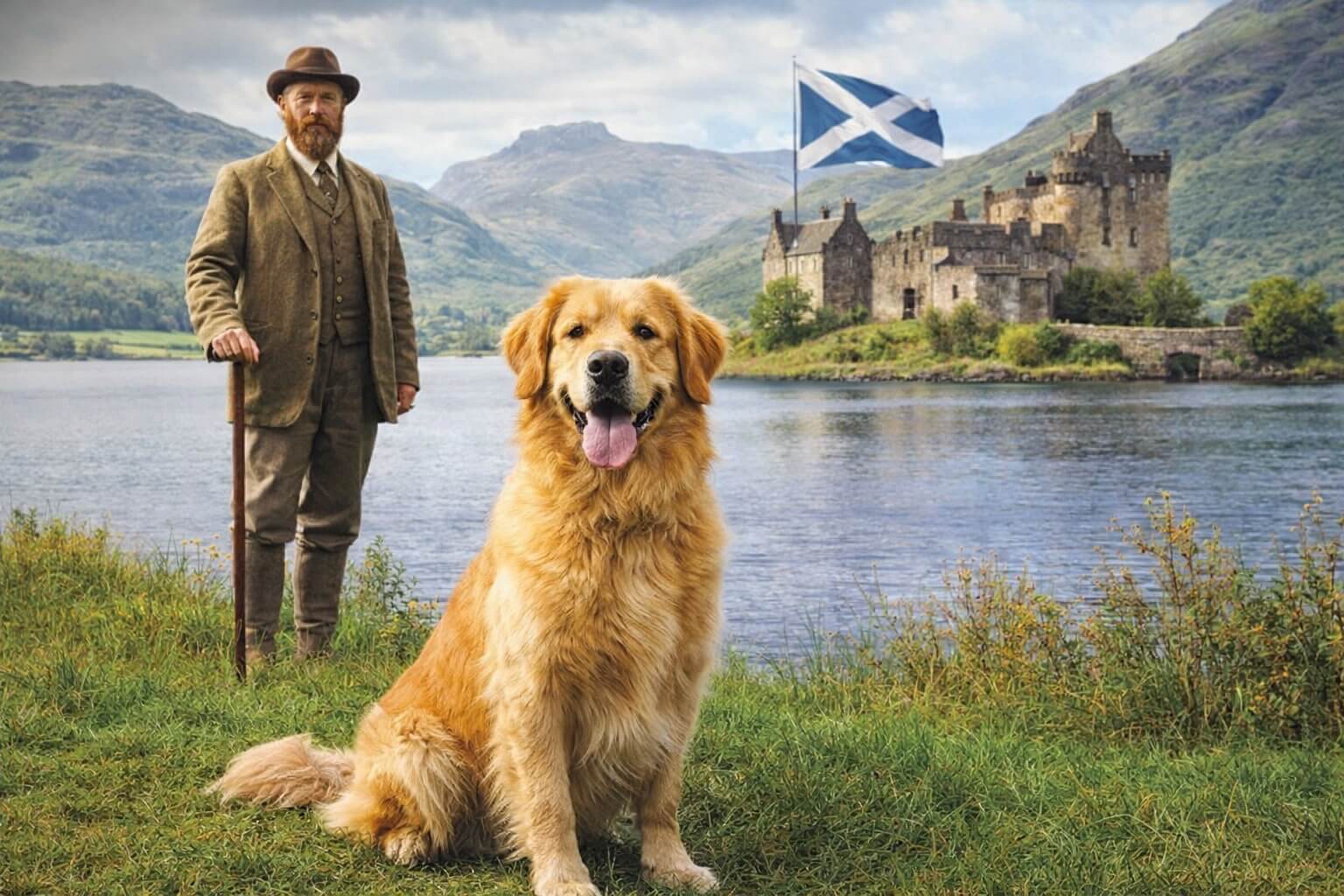
History of the Golden Retriever (Origins, Development & Global Rise)
GoldenRetriever.hair
By GoldenRetriever.hair
The history of the Golden Retriever begins far from suburban backyards and sofa naps. This breed was created in 19th-century Scotland as a purpose-bred hunting and retrieving dog, developed carefully over decades by one family and then refined by many breeders. Understanding where Golden Retrievers came from—and why they were created—helps explain their modern temperament, energy level, and role as one of the world’s most popular dogs.
This guide walks through the origin of the Golden Retriever, Lord Tweedmouth’s breeding program, the breeds that likely contributed to today’s Goldens, and how the breed moved from Scottish estates to homes across North America and beyond.
Table of Contents
- 🐾Quick Answer: Where Did Golden Retrievers Come From?
- 🐾The Origins of the Golden Retriever
- 🐾Lord Tweedmouth and the Creation of the Breed
- 🐾Breeds That Influenced the Golden Retriever
- 🐾Development of the Modern Golden Retriever
- 🐾Recognition by Kennel Clubs
- 🐾How Golden Retrievers Spread Worldwide
- 🐾The Golden Retriever Today
- 🐾Common Myths About Golden Retriever History
- 🐾FAQ
- 🐾Conclusion
Quick Answer: Where Did Golden Retrievers Come From?
The Golden Retriever originated in Scotland in the late 1800s. The breed was developed by Dudley Marjoribanks, later known as Lord Tweedmouth, at his estate called Guisachan in the Scottish Highlands.
Using careful, documented breeding between a yellow-colored retriever and a now-extinct Tweed Water Spaniel, and later crossing in other retrievers and spaniel types, Lord Tweedmouth created a reliable, soft-mouthed retriever suited to the wet, rugged conditions of Scottish hunting estates. Over time, these dogs became known as Golden Retrievers, were recognized by kennel clubs in the UK and North America, and spread worldwide as both working gundogs and family companions.
The Origins of the Golden Retriever
Scotland in the 19th Century
In the mid- to late-1800s, sporting estates in Scotland were thriving:
- 🐾Wealthy landowners hosted shooting parties for grouse, partridge, and waterfowl.
- 🐾The terrain was often wet, marshy, and rugged, with rivers, lochs, and heavy cover.
These conditions created demand for:
- 🐾Dogs that could mark and retrieve game shot at longer distances.
- 🐾Dogs that worked well in water and dense cover.
- 🐾Partners that were biddable, intelligent, and steady around guns.
Existing retrievers and spaniels were useful but not always ideal for these Scottish environments. This set the stage for the origin of the Golden Retriever.
The Need for a Reliable Retrieving Dog
Compared to earlier shooting styles focused on close-range work, evolving firearms allowed birds to be shot farther from the guns, often over challenging ground or water. Landowners and gamekeepers needed dogs that:
- 🐾Could swim strongly and handle cold water.
- 🐾Had a soft mouth, so retrieved game wasn’t damaged.
- 🐾Were trainable and eager to work over full shooting days.
The early Golden-type dogs were bred to fill this practical working niche, not to be show dogs or pets first. Their temperament, intelligence, and energy level today still reflect these working origins—something owners should remember when planning exercise and training (see our Golden Retriever exercise needs guide).
Lord Tweedmouth and the Creation of the Breed
Dudley Marjoribanks (Lord Tweedmouth)
The person most closely associated with Golden Retriever breed history is Dudley Marjoribanks, later ennobled as Lord Tweedmouth. He:
- 🐾Owned the Guisachan estate in Inverness-shire, Scotland.
- 🐾Maintained detailed stud books recording his breeding program.
- 🐾Focused on creating a distinct line of yellow retrievers with strong working ability and a stable, gentle temperament.
These stud books—eventually made public—are a key reason we know so much about the early Golden Retriever breeding program.
Early Breeding Program at Guisachan
At Guisachan, Lord Tweedmouth bred dogs for:
- 🐾Color – favoring yellow/golden retrievers at a time when many gundogs were black.
- 🐾Temperament – biddable, calm in the house, reliable in the field.
- 🐾Working traits – strong nose, soft mouth, and ability in water and rough cover.
He selected and bred dogs that fit this vision, using:
- 🐾A yellow retriever named Nous.
- 🐾A Tweed Water Spaniel named Belle.
- 🐾Later crosses with other retriever and spaniel types.
The First Documented Litter
Lord Tweedmouth’s stud book records that:
- 🐾In 1868, Nous (a wavy-coated yellow retriever) was bred to Belle (a Tweed Water Spaniel).
- 🐾This mating produced a litter of yellow puppies that formed the foundation of what would become the Golden Retriever.
From these early dogs, Lord Tweedmouth and later breeders:
- 🐾Selected for consistent color and coat quality.
- 🐾Preserved the gentle, people-focused temperament.
- 🐾Continued to emphasize working ability in the field.
This documented pairing of Nous and Belle is why Lord Tweedmouth Golden Retriever history is so central to any accurate telling of the breed’s origin.
Breeds That Influenced the Golden Retriever
The Yellow Retriever
The term “Yellow Retriever” in the 19th century did not mean Golden Retrievers as we know them today. It referred more broadly to:
- 🐾Yellow or golden-colored dogs from the wavy-coated or flat-coated retriever family.
- 🐾Retrievers used in the field that happened to have lighter coats.
Nous, Lord Tweedmouth’s foundational retriever, was:
- 🐾A yellow-coated retriever, likely descended from wavy-coated retrievers.
- 🐾Unusual enough in color at the time that he stood out compared to the more common black dogs.
These yellow retrievers contributed:
- 🐾Retrieving instincts.
- 🐾A longer, weather-resistant coat.
- 🐾A cooperative, handler-focused temperament.
The Tweed Water Spaniel
The Tweed Water Spaniel was a now-extinct breed native to the area around the River Tweed, on the border of England and Scotland. It was:
- 🐾A water dog used for retrieving from rivers and estuaries.
- 🐾Known for:
- 🐾Curly or wavy liver-brown coats.
- 🐾Strong swimming ability.
- 🐾Intelligence and trainability.
Belle, the Tweed Water Spaniel bred to Nous, likely contributed:
- 🐾Excellent water work and swimming.
- 🐾Strong retrieving drive.
- 🐾A coat adapted to cold, wet conditions.
These traits blend naturally into what we see in Goldens today—dogs that are confident in water and willing to work in all kinds of weather.
Other Possible Influences
Over time, records and breed historians suggest that other dogs were added to the developing line, including:
- 🐾Additional retrievers (such as flat-coated types).
- 🐾Possibly some Irish Setter or Bloodhound influence, although direct evidence is more limited and sometimes debated.
What is well supported is that:
- 🐾The early foundation involved yellow retrievers and the Tweed Water Spaniel.
- 🐾Subsequent breeding refined these dogs toward:
- 🐾A consistent golden/yellow coat.
- 🐾A particular head shape and expression.
- 🐾The hallmark Golden temperament—gentle, steady, and people-oriented.
Development of the Modern Golden Retriever
Refinement of Coat and Appearance
As the breeding program continued and more breeders became involved:
- 🐾The coat was refined to:
- 🐾A water-repellent outer coat.
- 🐾A dense undercoat, suited to Scottish weather.
- 🐾Shades ranging from light cream to rich golden.
Over decades, this produced the recognizable Golden Retriever coat we know today. For more on modern coat varieties and feathering, see our Golden Retriever coat types guide.
Temperament and Working Ability
Breeders focused heavily on:
- 🐾A soft mouth for retrieving game undamaged.
- 🐾A temperament that was:
- 🐾Friendly and stable with people and other dogs.
- 🐾Eager to work yet biddable and trainable.
These historical priorities are why today’s Goldens:
- 🐾Make such good family dogs, when given enough training and exercise.
- 🐾Excel in obedience, agility, field work, and service roles.
Hunting and Retrieving Roles
Throughout the late 1800s and early 1900s, early Goldens were used primarily as:
- 🐾Gundogs for upland birds and waterfowl.
- 🐾All-purpose retrievers on Scottish and English shooting estates.
They worked:
- 🐾In water (lochs, rivers, marshes).
- 🐾Over rough, heather-covered hills.
- 🐾At the side of handlers who valued reliability and calmness under gunfire.
Though many modern Goldens are pets first, these working roots still show up in their:
- 🐾Need for significant exercise and mental stimulation (see our exercise needs guide).
- 🐾Natural tendency to carry and retrieve objects.
Recognition by Kennel Clubs
Recognition by the Kennel Club (UK)
As the type became more consistent, breeders began showing the dogs and seeking formal recognition:
- 🐾In the early 1900s, dogs of this type were sometimes registered as “Flat-Coats, Golden” by the Kennel Club (UK).
- 🐾Over time, it became clear they represented a distinct breed type.
The breed was officially recognized as “Golden Retriever” by the Kennel Club in the early 20th century (commonly cited as 1911 for recognition as a separate variety, with continued refinement of the standard afterward).
Recognition by the American Kennel Club
Golden Retrievers were introduced to North America in the early 1900s. The American Kennel Club (AKC):
- 🐾Officially recognized the Golden Retriever as a breed in 1925.
- 🐾Adopted a breed standard based on the established UK type, with some regional interpretations over time.
Recognition helped:
- 🐾Formalize breeding goals.
- 🐾Encourage the formation of breed clubs and organized field and show events.
Establishment of Breed Standards
Breed standards in the UK, North America, and other countries describe:
- 🐾Overall structure and movement.
- 🐾Coat type and acceptable colors.
- 🐾Desired temperament—friendly, reliable, and trustworthy.
While show lines and working lines have diverged somewhat, the written standards still emphasize:
- 🐾A balanced, athletic dog.
- 🐾A kind expression.
- 🐾A willing worker with a stable, gentle temperament.
Regional differences between American and British lines are explained in our English vs American Golden Retriever guide.
How Golden Retrievers Spread Worldwide
Arrival in North America
Golden Retrievers came to North America through:
- 🐾Dogs imported by sportsmen and breeders who admired their working ability.
- 🐾Interest from people who saw Goldens in the UK and wanted similar dogs at home.
Once on the continent, they quickly proved:
- 🐾Effective in waterfowl and upland hunting.
- 🐾Adaptable to different climate and terrain conditions.
Rise in Popularity in the United States and Canada
Several factors drove the rise in Golden Retriever popularity:
- 🐾Their combination of:
- 🐾Trainability.
- 🐾Stable temperament.
- 🐾Family-friendly nature.
- 🐾High-profile exposure through:
- 🐾Field trials.
- 🐾Dog shows.
- 🐾Media and advertising in later decades.
By the late 20th century, Goldens were regularly among the most registered breeds with major kennel clubs in the US and Canada. Today they remain:
- 🐾One of the most popular family dogs.
- 🐾A common choice for people wanting a trainable, people-oriented companion.
- 🐾A familiar face in popular culture, from well-known Golden Retrievers on screen to real-life celebrity dogs.
The Golden Retriever Today
Family Companion
Many owners now know Goldens primarily as:
- 🐾Gentle, affectionate family dogs.
- 🐾Patient with children when properly trained and supervised.
- 🐾Eager to participate in everyday life, from hikes to couch time.
Modern families should remember that this easygoing nature sits on top of a high-energy, working-bred dog. Meeting their needs for activity and structure is still essential (see our Golden Retriever training guide and exercise needs guide).
Working Dog Roles
Golden Retrievers are still used in:
- 🐾Hunting and field work as gundogs.
- 🐾Search and rescue, thanks to their noses and trainability.
- 🐾Detection work in some programs.
Their cooperative nature and athleticism make them highly versatile.
Therapy and Service Dogs
The same traits that made early Goldens biddable and steady around guns now make them ideal for:
- 🐾Therapy dog work in hospitals, schools, and nursing homes.
- 🐾Service dog roles, including:
- 🐾Mobility assistance.
- 🐾Medical alert.
- 🐾Psychiatric service tasks.
Their gentle temperament, intelligence, and desire to be close to people reflect their historical purpose: a dog created to work closely and willingly with humans. See our Golden Retriever intelligence guide for how that learning ability shows up today.
For how this background influences typical personality traits, see our Golden Retriever temperament guide.
Common Myths About Golden Retriever History
Myth: Golden Retrievers Came From Russian Circus Dogs
One long-standing myth claims that Golden Retrievers descend from Russian circus dogs purchased and bred by Lord Tweedmouth. This story:
- 🐾Was popularized in early 20th-century writings.
- 🐾Is not supported by Lord Tweedmouth’s stud books or modern historical research.
Those records clearly show:
- 🐾The foundation of the breed was Nous (a yellow retriever) and Belle (a Tweed Water Spaniel).
- 🐾Breeding occurred at Guisachan in Scotland, not from imported circus dogs.
Myth: Golden Retrievers and Labrador Retrievers Are the Same Breed
While Golden Retrievers and Labrador Retrievers share:
- 🐾Some common ancestral retriever types.
- 🐾Similar roles as gundogs and family companions.
They are distinct breeds with:
- 🐾Different coat types and histories.
- 🐾Separate breed standards and development paths.
Both are retrievers, but their breed origins and early development are not identical.
Myth: Golden Retrievers Were Always Primarily Family Pets
In reality:
- 🐾Goldens were developed first as working dogs for the field.
- 🐾Their role as household companions grew as their temperament became widely appreciated.
Their popularity as family dogs is a modern extension of their historical role, not the original purpose.
FAQ
Who created the Golden Retriever breed?
The Golden Retriever breed was largely created by Dudley Marjoribanks, Lord Tweedmouth, at his Guisachan estate in Scotland in the late 19th century. Using a yellow retriever named Nous, a Tweed Water Spaniel named Belle, and subsequent carefully chosen dogs, he developed the foundation of what became the modern Golden Retriever.
Were Golden Retrievers originally hunting dogs?
Yes. The origin of the Golden Retriever is firmly rooted in hunting and retrieving. They were bred to:
- 🐾Work on Scottish shooting estates.
- 🐾Retrieve birds on land and from water.
- 🐾Handle rough terrain and cold conditions while remaining steady, trainable, and soft-mouthed.
Their success as family companions and therapy dogs today comes from the same temperament traits that made them reliable in the field.
Where were Golden Retrievers first bred?
Golden Retrievers were first bred in Scotland, primarily at Guisachan estate in Inverness-shire, under the guidance of Lord Tweedmouth. This is why many sources refer to Scotland as the origin of the Golden Retriever.
When did Golden Retrievers come to the United States?
Golden Retrievers arrived in North America in the early 1900s, brought by sportsmen and breeders who appreciated their working ability and temperament. The American Kennel Club officially recognized the breed in 1925, and their popularity grew steadily throughout the 20th century.
Are Golden Retrievers related to Labrador Retrievers?
Goldens and Labradors both descend from earlier retriever and water dog types, and share a general retriever heritage. However, they were developed as separate breeds with distinct breeding programs and standards. They are related at a broad historical level, but Golden Retriever breed origins are specifically tied to Scotland, Lord Tweedmouth, and the Guisachan dogs, while Labrador Retrievers have their own Newfoundland and UK history.
Why did Golden Retrievers become so popular worldwide?
Golden Retrievers became popular worldwide because they combine:
- 🐾Trainability and intelligence, rooted in their working origins.
- 🐾A steady, people-oriented temperament.
- 🐾Versatility as:
- 🐾Family companions.
- 🐾Hunting dogs.
- 🐾Therapy and service dogs.
Their history as a carefully developed working breed created a dog that fits many modern roles, as long as owners respect their exercise needs, mental stimulation requirements, and lifespan considerations (see our guides on exercise, training, and lifespan).
Conclusion
The history of the Golden Retriever is a story of intentional breeding, clear purpose, and long-term refinement. From Scotland’s Guisachan estate and Lord Tweedmouth’s stud books to modern homes and working partnerships around the world, Goldens have always been defined by their relationship with people—as hunting partners, teammates, and beloved companions.
Understanding the Golden Retriever breed origins helps explain why today’s Goldens:
- 🐾Need significant exercise and training.
- 🐾Have such a strong desire to be with their families.
- 🐾Excel in roles that ask for gentleness, reliability, and intelligence.
For a deeper look at how this history shows up in daily life, see our guides on Golden Retriever temperament, coat types, exercise needs, training, and lifespan.
P.S. Get the free Golden Retriever Owner Cheat Sheet — daily feeding, sleep, and care in one printable guide.
Get the Cheat Sheet when you join the newsletter — instant access in your welcome email.